
Hit Enter to Search or X to close
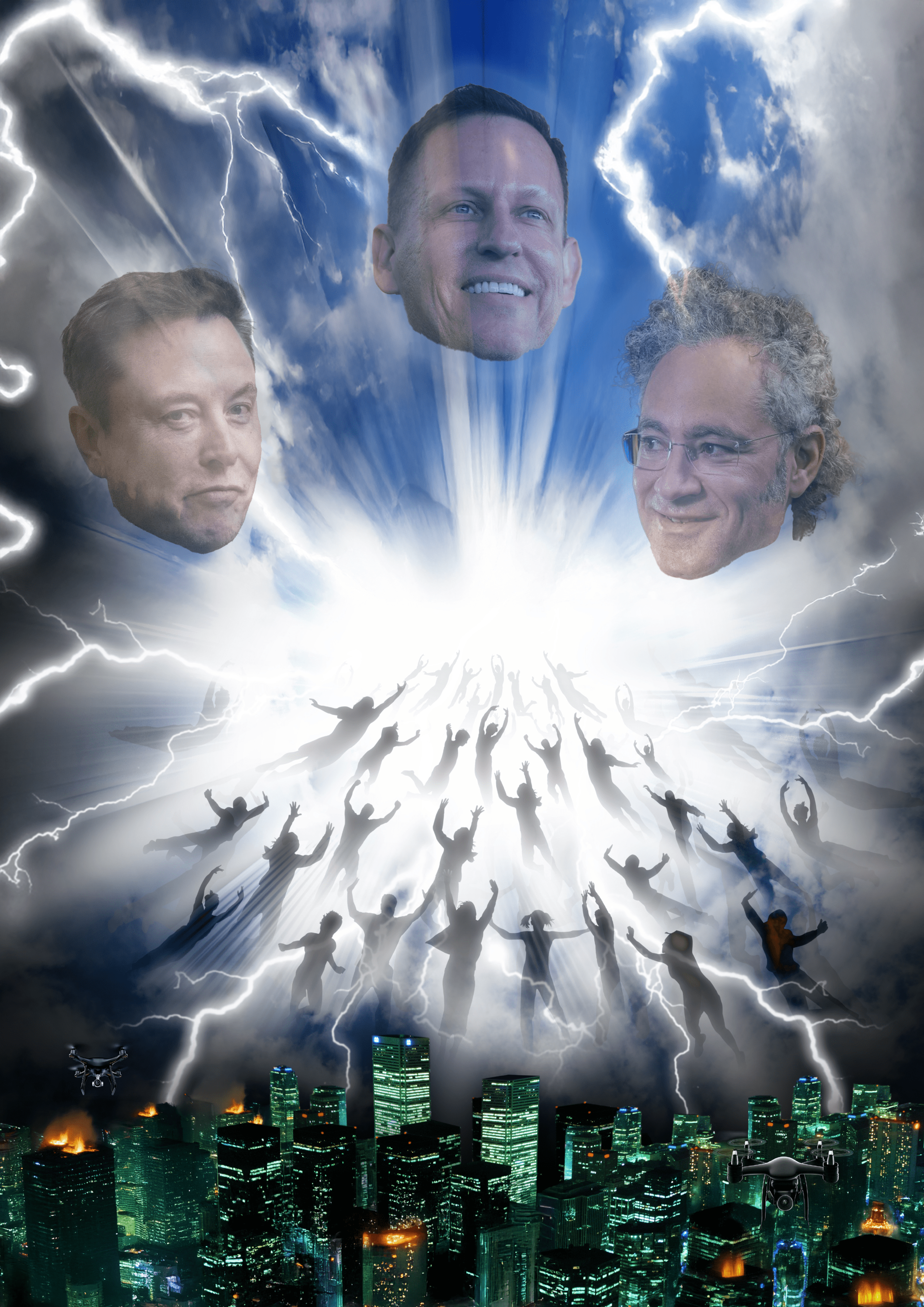
On January 16, the airspace above Boca Chica, Texas lit up with glittering comets, painting the sky in phantasmagoric ribbons of color and light, like something out of the bible. Rather than angels on high, the spectacle was a shower of debris from Elon Musk’s failed Starship launch, which ended in a massive explosion that destroyed something between 16 and 160 million dollars worth of research. Coming just four days before the 2025 presidential inauguration, the event felt like a cosmic omen for the looming presidency. As Musk himself described the Starship failure on X, “Success is uncertain, but entertainment is guaranteed!”
Through the presidential campaign season of 2024 and subsequent re-election of Donald Trump, tech has progressively embedded itself into the political sphere. With massive contributions to campaign funds from Silicon Valley elites, an official ‘crypto ball’ in DC to celebrate Trump's reelection, and Elon Musk occupying one of the most significant political positions in recent memory, it is increasingly important to understand tech ideologies and their implications.
One of the most complicated and strange iterations of Silicon Valley ideology is “effective accelerationism” (e/acc), which emerged from an amalgam of other tech philosophies, making it an effective lens to examine the present techno-political situation. E/acc and its contemporaries have blossomed from their days in web forum threads and tech conferences/raves DJ’ed by Grimes into the guiding hand behind a coalition of powerful actors that have real sway over the present and future of the United States, along with the rest of the world.
I. Genesis
One of the most salient influences on effective accelerationism is “effective altruism” (EA), which initially sprang up in the early 2010s amongst Oxford scholars. Inspired by utilitarianism, the general idea is that the best way to help people is by “earning to give,” making as much money as one can and allocating it to issues that are both pressing and most demonstrably impacted by funding. In line with this reasoning, EA thought leader Peter Singer notably argued that the proximity of suffering shouldn’t matter in altruistic considerations. A classic example of EA involves providing mosquito netting to communities in the global south as a means of preventing malaria, one of the most common and relatively avoidable deadly diseases on earth.
There are two major camps of effective altruists: “neartermists” and “longtermists”. Neartermists are more closely aligned with the typical philanthropic mindset of doing what one can to help people, animals, and the environment as they exist today. On the surface, longtermism “Is the idea that positively influencing the long-term future is a key moral priority of our time,” per EA founding father and longtermist William MacAskill’s introduction to his book What We Owe the Future. At its core, longtermism extends Singer’s proximity argument beyond the physical, arguing that temporal proximity should have no bearing on altruistic decisions when considering net positive outcomes.
Despite worries over the wellbeing of future peoples, forward-looking longtermism has some potentially grievous consequences for those of us living in the present. In his book, MacAskill argues the only empathetic approach to thinking about humanity is “at the full scale of human history, the future—where almost everyone lives and where almost all potential for joy and misery lies,” a scale that he argues could be “only as long as the typical mammalian species (one million years)”, but potentially as long as four trillion years. This directly relates to the longtermist definition of value – the hazy concept of wellbeing regarding the future of humanity. As MacAskill’s associate, Nick Bostrom, founder of the humbly named Future of Humanity Institute, wrote in 2003 “[longtermist] considerations suggest that the loss in expected value resulting from an existential catastrophe is so enormous that the objective of reducing existential risks should be a dominant consideration whenever we act out of an impersonal concern for humankind as a whole”. Helpfully, he then elaborates on the kind of impersonality he’s calling for: “Unrestricted altruism is not so common that we can afford to fritter it away on a plethora of feel-good projects of suboptimal efficacy.” Longtermists are inherently growthist, driving for population increase in pursuit of maximum good (with more existent people equating to more experienced good) and extending our species’ survival despite their apathy towards living human beings today.
^ This video perfectly captures Alex Karp' core ideology and why we should all be afraid he has access to all of our data
II. The Gospel According to Beff Jezos
Effective accelerationism (e/acc) is perhaps the most perplexing branch of philosophical thought conceived by Silicon Valley elites, in part because it pulls from some of the most extreme and bizarre facets of the aforementioned ideologies and related ideas like cosmism and singularitarianism. The term “effective accelerationism” is a play on “effective altruism.” The primary difference between the two is that while effective altruists (particularly longtermists) would consider themselves techno-cautious, particularly regarding generative AI like ChatGPT, effective accelerationists are firmly techno-optimists. Both believe that AI has the potential to be an important factor in space colonization (which is good) and creating large numbers of future people (also good), many of whom would probably be digital people living in computer simulations (good), all of which is value-aligned with the most ethical version of the future (very good).
The contrast between EA and e/acc is that EA subscribers are concerned that if artificial intelligence takes a wrong turn, it will destroy the entire glorious future of humanity, while e/acc believers harbor no such reservations. Put succinctly in mega-accelerationist and tech billionaire Marc Andreesen’s definitely-reassuring “Techno-Optimist Manifesto,” stripped of any distracting explanations as to how or why: “AI will not destroy the world, and in fact may save it.”
E/acc owes much of its philosophy to one of the (christened by Andreesen) “Patron Saints of Techno-Optimism,” @BasedBeffJezos, AKA “Beff Jezos,” AKA Guillaume Verdon, “a Canadian mathematical physicist, quantum computing researcher, serial entrepreneur, and writer who is a key contributor of Google's quantum machine learning software, Tensorflow Quantum” according to his wikipedia page. @BasedBeffJezos, as he is referred to within e/acc circles more often than by his legal name, claims e/acc is rooted in the science of thermodynamics. He backs up this claim with his interpretation of a speculative (read: unproven) theory proposed by MIT physicist Jeremy England. In essence, he argues that since the universe is moving toward maximal entropy (the second law of thermodynamics), life arose because it aids this process by taking usable energy from the environment and converting it into unusable energy. More intelligent life arose because it does so even more efficiently. Following this line of reasoning, our increased (and artificial) intelligence spreading across the cosmos is actually “the will of the universe” because it will use up even more energy, creating more entropy. Therefore, he argues, we have an obligation to accelerate AI capabilities research. This theory gets at the heart of the major disagreement between longtermists and accelerationists — EA strives to maximize moral value, which they often categorize as “pleasurable experiences,” while e/acc is concerned with maximizing energy consumption and bringing about the “technocapital singularity,” or the moment when technological progress accelerates such that humans merge with technology, colonize space, and spread consciousness throughout the universe, which will then ‘wake up.’
Along the same lines, e/acc is also concerned with the ideology of “transhumanism,” the belief that we ought to use technology to reengineer humanity into a new “posthuman” species (including the aforementioned digital people) to set ourselves up for more population growth, and therefore the creation of more net good. @BasedBeffJezos pulled some key ideas from “cosmism” when formulating his thoughts on e/acc. Cosmism goes beyond merging humans with machines, championing humanity’s spread throughout space and the reconfiguration of galaxies with “scientific ‘future magic.’” To fuel their mission, e/acc’s borrow the “proactionary principle” from another tech ideology, Extropianism. This principle argues that we must consider the harm that might come from not developing a specific technology. As Andreesen writes in his manifesto, “we believe any deceleration of AI will cost lives. Deaths that were preventable by the AI that was prevented from existing is a form of murder.” For e/acc’s like Andreesen, technological acceleration is not only good, it is a moral imperative.
Overall, effective accelerationism is less of a distinct philosophy than the animorph-style evolutionary product of other tech ideologies, taking on the most imaginative, absurd, and callous attributes of its forebears. Because of this, it is an excellent lens for analyzing a breadth of activity in both Silicon Valley and Washington, DC, and considering potential consequences.
III. Move Fast and Break Things
Now that Marc Andreesen and Elon Musk work directly with the president of the United States, Silicon Valley ideology has rapidly become influential on policy decisions that have far-reaching impacts. As Andreesen explained to Bari Weiss, today he “is helping form [Trump’s] policy on tech, business, economics, and the “success of the country” more generally.” He is also helping staff Elon Musk’s DOGE and “weighing in” on other government hires. Both men are responsible for the “AI-first” strategy being pushed through government agencies, slashing budgets and employees along with regulations.
As of April 7’s “Executive Order" to remove barriers to American leadership in Artificial Intelligence,” the Trump administration “is focused on encouraging and promoting American AI innovation and global leadership, which starts with utilizing these emerging technologies within the Federal Government,” according to Lynne Parker, Principal Deputy Director of the Office of Science and Technology Policy. Already, politicians have been caught using AI to write their policy proposals in the case of NYC mayoral candidate/former NY governor Andrew Cuomo, and formulate their action plans à la the Trump administrations tariff rollout. A recent survey of federal, state and local government employees shows that 51% use AI daily or several times a week.
With each level of government stripped of its humanity, what will become of the people at its mercy? The MIT Technology Review reports that “Increasingly, algorithms have begun to arbitrate fairness for us. They decide who sees housing ads, who gets hired or fired, and even who gets sent to jail.” The use of AI within the prison system influences who gets paroled, with reports predicting recidivism prepared for judges by COMPAS, one of several “risk assessment” tools used by the US legal system that often sways life changing decisions. Similar algorithms have cut a sweeping number of Americans’ healthcare, and Thomas Shedd, head of the General Services Administration’s Technology Transformation Services (TTS), intends to integrate AI into systems like social security “to further identify individuals and detect and prevent fraud.” In a move that no doubt spiked the blood pressure of many a techno-cautious observer, Shedd cut 18F, which was responsible for improving federal agencies' technology, deeming them “non-critical,” in an email that came just weeks after he referred to them as the “gold standard” of government-affiliated tech developers. His prediction for the future of TTS operations aimed at integrating AI? “Things are going to get intense.”
IV. Fire and Brimstone
Beyond administrative effects and their consequences, the proliferation of AI into American life poses an ecological threat. Much like evangelical millenarians, effective accelerationists view what many would consider the end of the world as a utopian miracle — for the chosen people, that is. With generative AI’s major environmental impacts draining water and increasing global temperatures, it's important for longtermists and e/acc’s to hasten their exodus into outer space. But rather than sinners, when our cyberbodies arrive it’s likely the decels (an e/acc slur for decelerationists) who will be left to fend for themselves in the hellscape they leave behind here on Earth. By decels, I don’t just mean techno-cautious, pro-regulation longtermists, but everyone who is not actively contributing to the growth of technology from a place of power through money, status, or politics.
The computers that power generative AI like ChatGPT are detrimental to the environment. These computers use up valuable water and energy while creating hazardous e-waste, not to mention the impacts of mining for cobalt and the other materials used to build their hardware, almost exclusively performed by exploited people and children in some of the poorest places in the world. For every 20-50 questions a chatbot like ChatGPT answers, or 100-word emails it writes, it “drinks” the equivalent of a 16oz bottle of water, which is used to cool down the overheating computers and generate the energy necessary to power them. This energy leaves behind a notable carbon footprint, which varies depending how it is generated. While it’s difficult to suss out definite statistics for how many queries ChatGPT (not to mention other generative AI technologies) processes each day, OpenAi self reported in December of 2024 that over 300 million people use it each week.
Even without the dizzying rise in everyday use of AI, the rate at which we are draining resources and emitting CO2 into the atmosphere is catastrophic. We’ve already seen the disastrous impacts of climate change with wildfires, rising sea levels, record-breaking hurricanes, devastating floods, and rapidly depleting resources affecting every part of the world, all of which are projected to worsen in the coming years.
Without any planned intervention, these disasters will only get worse. The US government’s abandonment of towns like Asheville and cold response toward the recent wildfires in Los Angeles are only the most recent demonstrations of a difficult lesson for many Americans: no one — not even the middle, upper-middle, or upper class — can evade the fallout of climate change, and with the gutting of federal relief agencies like FEMA by Elon Musk, help isn’t coming.
V. Exodus
Rather than put their energy (and funding) toward de-escalating climate change, the wealthiest and most powerful people on earth are devoting their resources, including American tax dollars, to finding ways to escape the fallout completely. This, unsurprisingly, lines up with e/acc thinking, which views our planet as little more than a stepping stone toward intergalactic colonization. Musk’s newfound control over NASA and plans to reallocate agency funds toward colonization should only expedite (dare I say accelerate?) the process. He posted his concerns on X: “Will we make Mars self-sustaining before civilization loses the ability to do so? That is the critical question.” While leaders like Musk hail new technology as our only viable savior, they skirt the fact that tech is what got us here in the first place, from industrialization to the rise of ChatGPT. Moreover, they silently admit they don’t believe tech can undo the harm it has caused, or perhaps that they are simply uninterested in a salvage mission. After all, efforts would be extreme and costly in order to mitigate or even substantially slow the course of climate destruction we are already on. Moreover, there is still money to be made from extracting resources and burning what they can before they leave for good.
But who among us might be saved? If Jeff Bezos’s recent flirtation with launching pop stars into space is any indication, it won’t be anyone who can’t afford to shell out the $150,000 deposit required to begin the process. An exodus to Mars seems an unlikely option for regular folk, and plans as to who should populate the galaxy are likely to befit those who orchestrate it, like Musk, whose inherited wealth comes from Apartheid emerald mines — with a well-evidenced reputation as a techno-eugenicist.
E/acc and longtermist thinking’s exceedingly growthist and pronatalist ideals are exemplified in Musk, notorious for his belief that he must have as many children as possible and “reach legion-level before the apocalypse.” With a rapidly failing economy that shows no sign of magically fixing itself, all of those newly born people seem unlikely to achieve the sort of wealth and success en masse that might buy them tickets off-planet. Given mercurial government standards regarding who even qualifies as a permanent resident of the United States, it’s equally unlikely the vast majority of Americans would make the ideological cut, even if the government did choose to save a special few.
VI. The Coming Millennium
The ascension of tech elites from Silicon Valley to the White House marks a concerning turning point in the future of politics and technology. Ideas that once populated niche internet forums have now found their way into the ears of some of the most influential people in the world and technology plays an increasingly important role in government operations. As AI advances and expands into new sectors, the computers that run it drain water supplies and hasten climate change, expediting unpredictable weather patterns and devastating natural disasters. While the planet rapidly deteriorates, tech elites funnel money into programs for space colonization, procreate with zeal, and stake their prayers on a benevolent realization of generative AI. However the next four years play out with Marc Andreesen and Elon Musk behind the wheel of the Tesla that is the American government, we may very well find out whether techno-optimists or decels were right in their predictions. As we hurtle into the new testament of American technology, those in power would be wise to make sure they are prepared for the consequences of accelerationist rashness, or at least ensure that their rockets won’t explode within minutes of launching.


.jpg)
.jpg)