
Hit Enter to Search or X to close
Author's note: A previous version of this article was published with words from committee member Alice Siregar, who has since retracted her statements and clarified her position on Zionism.
"Lesbian Dykes Gay Women: We Want Revenge and We Want It Now,” read the first club cards handed out at the March on Washington for LGBTQ Rights and Liberation in 1993, according to Sarah Schulman. Later that evening, she would see 20,000 women show up to march through D.C. at night without a permit. She was one of the five activists involved in creating what’s now known as the Dyke March nationwide.
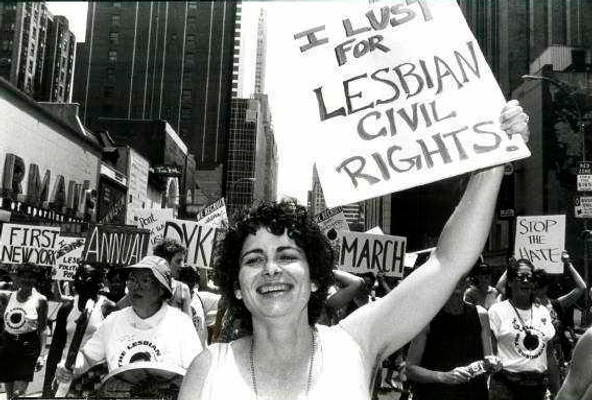
Schulman, Maxine Wolfe, and Anne-Christine D'Adesky were involved in ACT UP, and quickly realized they weren’t getting the true feminist movement leadership they needed. They teamed up with Ana Maria Simo, who ran a POC-focused lesbian theater called Medusa's Revenge for 10 years, and Marie Honan, who fought for the Irish Gay movement's long efforts to be allowed into the Saint Patrick's Day parade. Together, they were a dynamic force, known as the Lesbian Avengers.
In D.C.’s early 1990s queer scene, the goal of the Avengers was lesbian visibility and survival. “The value was direct action,” Schulman told Shadowbanned in an interview. “The March on Washington was co-opted by the Democrats, and this was a return to the grassroots nature of lesbian culture and politics,” she said.
The 2024 Controversy
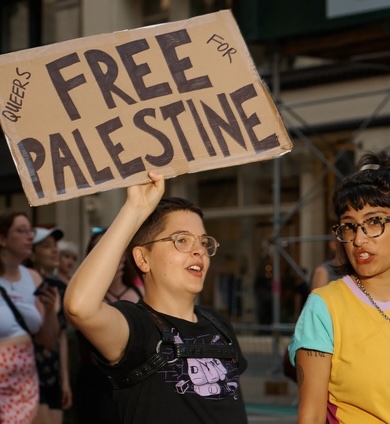
Thirty years later, an instagram post featuring the text “Queers For Free Palestine” began gaining traction online, after the New York City march organizers announced the theme for the 2024 Dyke March: Dykes Against Genocide. “The NYC Dyke March has always stood for liberation, and that includes the liberation of Palestine. [watermelon]”
A subsequent post was made reiterating the committee’s firm anti-Zionist stance, was intended to follow in the footsteps of revolutionary dykes before, such as Schulman who had paved the path for change and had been part of the Palestinian liberation movement for 15 years. The March is intended as a space for all sapphic women – an umbrella term for women who are attracted to other women – to not only stand firm in their existence, but fight for the existence of sapphic women worldwide.
The committee found that their audience overwhelmingly wanted them to stay political. So they were taken off guard when the participation went from over 100 members down to just 10, as of January 2025. As Alice Siregar pointed out, the standards have to change.
“It's nice to have dyke joy, it's nice to have sapphic joy, trans joy. But oftentimes, just existing doesn't do enough to help those who are more marginalized within this group,” said Siregar, a member of the NYC Dyke March committee. “Maybe simply existing in a space was enough of a revolutionary statement. But in 2025, it's not.”
A Fractured Movement
In response to the Dyke March’s political stance, a group of lesbians organized a Pride party specifically for Jewish lesbians who felt unsafe participating in the march. Shalom, Dykes is the informal community that emerged from this effort, creating space for Jewish lesbians who disagree with the anti-Zionist position taken by other queer organizers.
The wave of anger, tension, and backlash that followed the announcement of the year’s theme was unprecedented. By the end of 2024, a group of Jewish sapphic community members had withdrawn from the Dyke March, feeling abandoned by the broader lesbian community. Many of them told the Jewish Telegraphic Agency they no longer felt safe and believed that open dialogue had become impossible.
The theme of the 2024 Dyke March was decided not unanimously, but democratically, as it always has been. All NYC Dyke March committee decisions are made by majority vote. While there are caucuses within the committee dedicated to individual communities, the emergence of an oppositional faction was unexpected. The themes have always been intentionally contentious—and, for lack of a better word, raunchy.

This bold, provocative tradition is nothing new. The march’s theme in 2004 read, “Women of Mass Defiance Lick Bush,” as a dig at the sitting president’s emphasis on weapons of mass destruction justifying the invasion of millions of Iraqis. In 2008, they celebrated 16 years of marching with the theme “sweet-snarky-sultry-sexy-slammin'-sinful-sapphic-shocking-strong-smartass-swanky-slutty 16".
The Dyke March has always been clear: it exists to protest, not to parade. From its inception, the march has been a space to express rage, demand a better world, and assert that dykes will not stand by in the face of injustice. The Lesbian Avengers’ iconic fire-eating ritual embodied this spirit of defiance.
Organizers were surprised that naming the genocide in Gaza sparked controversy, given the march’s long-standing commitment to collective liberation. Why, they asked, were the people of Gaza excluded from that vision—especially amid what they saw as the most extreme expressions of discrimination, genocide, and erasure?
Just as the 2021 theme, “Black Dyke Power,” rightfully honored Black lesbians without diminishing other communities of color, “Dykes Against Genocide” was never meant to alienate anyone.
In response, a number of Jewish lesbians created their own faction, an openly Zionist one that minimized the occupation in Gaza. “By asserting anti-Zionism as a core value over responding to the urgent threats to our communities—attacks on trans existence, healthcare access, immigration rights, and physical safety against rising hate crimes—the NYC Dyke March committee abandoned its role as a leader in the queer justice movement,” reads an open letter on the Shalom, Dykes homepage. The group further argued that the current climate has restricted Jewish visibility within the larger queer movement.
Shalom, Dykes did not respond to request to comment.
Broader Implications
This is not a new issue. Chicago’s chapter of the Dyke March confronted similar conflicts in 2017, followed by D.C. in 2019, when communities banned nationalist symbols deemed harmful—such as the American and Israeli flags. Citing ongoing genocides and pogroms linked to these countries, dykes nationwide have remained steadfast in rejecting Zionism within the queer liberation movement. In both cases, they faced comparable backlash.
When did Zionism leak this deeply into the lesbian community? Why is Zionism so integral to many sapphic women's queer expressions? Is the divisive factioning of a mostly-Jewish group of NYC lesbians, like Shalom, Dykes, productive to a liberated future for us all?
Schulman recalls that many in the 1950’s were raised with unquestioning attitudes toward Israel. “When Women of Color Feminism blossomed in the 1980's some Jewish women also wanted to inhabit their cultural identities- and for some that involved Israel,” adds Schulman. “But there were parallel tracks because Jewish Voice for Peace, the anti-Zionist Jewish organization that now has 35,000 members- was founded thirty years ago by a group that included queer women.”
Zionism vs. Judaism vs. Queer Identity
While the New York City Dyke March committee has stood staunchly against genocide, its messaging around anti-Zionism has been inconsistent—prompting criticism and concern from Palestinian advocates and allies. The group was recently called out for public statements that downplayed the harm of Zionism, framing it as a benign dream of a Jewish homeland later hijacked by extremists. This narrative overlooks the fact that the forceful displacement of Palestinians was not a deviation, but a foundational element of the creation of the Israeli state.
This incident illustrates two overlapping realities: first, how deeply Zionist propaganda has shaped the consciousness of many Jewish Americans, including those who now identify as anti-Zionist. Even with growing opposition to Israeli apartheid and genocide, the whitewashing of Israel’s history runs so deep that it continues to surface in progressive spaces, often unintentionally reproducing harmful narratives.
Second, the episode has revealed deeper organizational dysfunction within the Dyke March itself. As a volunteer-led coalition made up of individuals with a range of political backgrounds, the group is united in its opposition to the genocide of Palestinians but lacks a clearly articulated collective analysis of Zionism. While education may not be the primary function of the Dyke March, this moment underscores the need for internal political development and education among volunteers—especially if the group seeks to remain in principled solidarity with Palestinians. Establishing points of unity and deepening internal alignment could help the Dyke March more accurately reflect its values—and potentially repair the harm caused to those who have felt confused, alienated, or erased.
As one organizer, Siregar, candidly admitted on Threads: “I didn’t know the entire history of Israeli Zionism up until yesterday … my understanding of Zionism was based on a revisionist one due to what I was taught and I failed to question even that.”
The Dyke March’s commitment to intersectional struggle remains essential—but so too does the responsibility to speak with clarity and political rigor, especially when addressing issues of settler-colonialism and genocide.
This issue is less about Jewish identity than it may seem. Accepting that selective violence is justified in the name of peace is a difficult struggle in itself. “Zionism is a failure, and Jews have to come to terms with this,” Schulman explains. “At this point in history, the largest Zionist organizations are Christian Evangelical groups. For example, Christians United for Israel has 10 million members—more than the entire Jewish population in America.”No matter the controversy surrounding the Dyke March, the community remains unwavering in its commitment to combat antisemitism.“I want to make sure that people understand that we don't want people to conflate anti-Zionism and anti-semitism, because they're not the same,” Siregar clarified. As a trans-lesbian herself, Siregar posits that the struggle for intersectionality should be at the center of queer revolution. “It's similar to the cis gay men that are out there, where they are cis men first, or cis women first,” she said. “[They] are those ones who've found that comfort, found that privilege, and comfort in that privilege that they were willing to abandon others, and I think that's where it got lost.”
The Shalom, Dykes homepage states “We will not abandon our history.” The history of queer revolution challenges Zionism in its definition, in its practice, and in its core belief. Rather than asking Jewish lesbians to abandon themselves, Palestinian advocates are asking them to recognize intersectional privilege and embrace community.
“We don't want people who support ethnic cleansing or genocide, it’s unacceptable to have those views because you're dehumanizing a group of people in a similar way that lesbians have been dehumanized around the world,” said Siregar.
Looking Ahead
Zionism and queerness cannot exist under the same umbrella of liberation. One stands for imperialism while the latter stands for salvation. One thing is for sure – every queer person is on their own path of unlearning hundreds of years of colonial propaganda. As a community, we need to be more open to authentic growth and receive that in good faith.
The statement from the march committee continues, “We recognize that as a planning committee we still have work to do to strengthen our own political education and solidarity. To that end, we're striving to learn from organizers, especially from Arab and Jewish-led anti-Zionist organizations, that have been working for decades in support of Palestinian liberation.”
“If you're going to try and paint the committee as anti-semitic or against Jewish people, then you are lying, and you are actually being bigoted in this respect,” said Siregar. “You are being anti-semitic because you're conflating Zionism with Jewish people, which is hurtful for a lot of Jewish people who are at the forefront of these pro-Palestinian protests.”
Regarding the fractured dynamics of the group, and the different factions that have resulted, the committee acknowledges that their role is limited — they can only focus on keeping protesters safe and upholding the legacy of the original Lesbian Avengers. “I don’t necessarily see a loss of community,” Siregar said. “What I see is a very vocal minority trying to shape the narrative in a certain way.”
For the LGBTQ+ community, intersectionality must be at the core. The queer revolution, movements against fascism, police violence, and state-sanctioned genocide are deeply interconnected. It’s time to foster genuine collective freedom rather than divide along selective or personal interests.

.jpg)
.jpg)