Hit Enter to Search or X to close
On Wednesday morning, I woke up in a state of disbelief. Did the Democrats really just pull off a historic sweep across the country? The last time Democrats experienced a political realignment of this magnitude was in the aftermath of Watergate, when public disillusionment with Richard Nixon helped deliver sweeping Democratic victories in the 1974 midterms.
Across the internet, people described experiencing a similar disbelief. Many chalked it up to remembering what hope feels like after a decade of Trumpism. For some, this election seemed to mark the beginning of the end of an era that has dominated American political life for the better part of ten years. My reaction, however, was rooted in something closer to cynicism.
My cynicism came from a familiar pattern in American politics: Republicans leaving Democrats to clean up an economic disaster, only for Democrats to squander the opportunity for meaningful change. With another potential financial crisis looming, I couldn’t help wondering whether we were about to watch history repeat itself.
After all, I had spent the past three months sufficiently panicking about the possibility of Trump and his cronies subverting the election. The news had been filled with warnings about deploying federal agents near polling locations, invoking emergency powers, and using the machinery of government to undermine the electoral process. I had mentally prepared myself for an election that might turn into a political and legal battle lasting months, if not years.
Instead, on the evening of November 3, America witnessed a blue wave of historic proportions. Republicans lost races in places that had seemed politically untouchable, and the results delivered an unmistakable rejection of the Trump administration. What surprised me almost as much as the results themselves was how quickly the election appeared to be accepted. After months of anticipating some extraordinary attempt to interfere with the outcome, the whole thing felt almost anticlimactic.
Perhaps the results were simply too overwhelming to contest. Perhaps Republicans recognized that continuing to undermine the election would only deepen their losses. Or perhaps they were content to leave Democrats holding the bag when the next economic crisis hits.
Inheriting the AI Bubble
For the past several years, the American economy has become dependent on the promise of artificial intelligence. Wall Street has poured extraordinary amounts of money into companies developing AI models, manufacturing semiconductors, constructing data centers, and supplying the enormous amounts of electricity required to keep the industry running. AI has become more than another speculative technology boom. AI has woven itself into the financial infrastructure of the American economy, with the fortunes of some of the world’s largest corporations, investment funds, and financial institutions tied to its continued expansion.
The problem is that the amount of money being invested in AI is growing far faster than the industry’s ability to demonstrate sustainable returns. Much of the excitement surrounding the technology is based on what investors believe it will eventually become, rather than what it is currently capable of producing in profits. Companies are spending hundreds of billions of dollars building infrastructure in anticipation of future demand, while investors assign trillion dollar valuations to businesses whose long-term profitability remains uncertain — and these companies are borrowing money to do it.
That should concern anyone who remembers 2008. Because this debt is being distributed throughout the financial system via corporate bonds, private credit, commercial mortgage-backed securities, and other complicated financial instruments. Institutional investors, insurance companies, mutual funds, and pension funds are among the institutions exposed to these investments. The same financial institutions managing the retirement savings of ordinary Americans are wrapped up in the AI boom, whether directly or indirectly. That doesn’t mean every American’s 401(k) is holding risky AI loans, but it does mean that the financial consequences extends well beyond the companies making the bets.
AI infrastructure spending now touches construction, commercial real estate, energy utilities, semiconductor manufacturing, and local economies that have become dependent on data-center development. If investors suddenly decide the projected returns aren’t materializing, the consequences could extend far beyond a few overvalued technology stocks. Highly leveraged firms could default on their loans, triggering a chain reaction of financial losses, bank failures, and potentially a broader crisis across the financial system.
None of this guarantees a repeat of 2008. But, the similarities are difficult to ignore: speculative valuations, increasingly complicated debt structures, and enormous concentrations of financial risk. The Kansas City Fed has already warned that some of the financing arrangements underpinning the AI boom have never been tested by a serious economic downturn. Unfortunately, our economy is dependent on the continued expansion of an industry whose financial foundations remain uncertain. When the AI bubble pops, ordinary Americans could once again find themselves paying for risks they never agreed to take.
Privatize the Profits, Socialize the Losses
There is something almost comically predictable about the timing. Just as Democrats prepare to return to power in Congress, another potentially catastrophic financial reckoning is looming. It’s a familiar pattern in American politics, since the neoliberal turn of the 1980s. Republicans promise to liberate capital from government regulation, often leaving the public exposed to its volatility. Democrats, meanwhile, are elected to restore stability, only to treat protecting the financial system as a prerequisite for helping the people harmed by it. And that is where Democrats become complicit in the cycle.
Consider the Reagan administration. Reagan entered office promising that tax cuts, deregulation, and an aggressive assault on organized labor would unleash American prosperity. His administration weakened labor’s bargaining power, accelerated the ideological shift toward market fundamentalism, and helped normalize the idea that enriching corporations and wealthy investors would eventually benefit everyone else. The federal debt nearly tripled during his presidency, while his administration also presided over the savings and loan crisis, a financial disaster fueled in part by deregulation, risky lending, and inadequate oversight. Its eventual cleanup cost taxpayers billions. Then came George W. Bush, who inherited a federal budget surplus and proceeded to enact sweeping tax cuts, oversee two expensive wars, and preside over an era of financial deregulation and regulatory failure that culminated in the worst economic collapse since the Great Depression. By the time he left office, millions of Americans were losing their jobs, homes, and retirement savings. Barack Obama inherited that catastrophe.
The Democratic Party embraced neoliberalism as well. By the 1990s, Bill Clinton had helped transform the party into a political home for market-friendly liberalism, corporate donors, and the idea that economic growth depended on accommodating Wall Street. In 1996, Clinton signed legislation fundamentally restructuring welfare, replacing the federal entitlement to cash assistance with a more restrictive system of block grants and work requirements. In 1999, he signed the Gramm-Leach-Bliley Act, which dismantled major barriers between commercial banking, investment banking, and insurance established under the Depression-era Glass-Steagall framework. Most notoriously, he signed NAFTA, an act that was originally conceived under President Ronald Reagan and negotiated under President George H.W. Bush which destroyed domestic manufacturing in America.
These policies helped create an environment in which financial institutions could become larger, more interconnected, and capable of taking risks that threatened the entire economy. This was the bipartisan neoliberal consensus in action. Republicans and Democrats might disagree about abortion or immigration, but when it came to Wall Street, they alway seem to agree about whose interests deserved protection.
By 2008, the consequences were impossible to ignore. Americans had spent decades being told that deregulated markets would deliver prosperity. Instead, they watched financial institutions gamble with the economy, accumulate enormous profits, and then turn to the federal government when their bets collapsed. Millions lost their homes. Millions more lost their jobs.From that catastrophe stepped a young, handsome, relatively unknown presidential candidate by the name of Barack Obama.
His election shocked the world. Here was America’s first Black president, propelled into office by a movement promising hope and change at a moment when the country’s economic and political institutions had suffered a historic collapse of public trust. Obama’s victory represented something far more significant than a change in party leadership. It reflected a public desperate for an alternative to the corruption, corporate excess, and political establishment that had brought the country to the brink. Americans were tired of watching the wealthiest people in the country get richer while their own quality of life deteriorated. They were tired of being told that the economy was thriving when they could barely afford to participate in it. They wanted someone who would finally hold the people responsible accountable.
Instead, the financial system was rescued, and the people who had been devastated by its collapse were left to pick up the pieces. The $700 billion Troubled Asset Relief Program was signed into law by George W. Bush in October 2008, before Obama took office. However, when Obama took office, he continued the Bush-era Wall Street rescue, using federal guarantees, bank stress tests, and the promise of additional taxpayer-backed capital to stabilize financial institutions. Meanwhile, his administration’s mortgage relief program, HAMP, relied on voluntary participation by mortgage servicers rather than requiring banks to reduce homeowners’ debts. By the end of 2009, fewer than 70,000 homeowners had received assistance through HAMP while 2.5 million received foreclosure notices. The housing collapse devastated Black Americans, whose median household wealth fell by 53% between 2005 and 2009, compared with just 16% among white households. Wall Street was stabilized while millions of families continued losing their homes and the wealth they had spent generations building.Letting the very people who were responsible for the crisis get bonuses and these same executives escaped any type of criminal accountability. Wall Street recovered far more quickly than the communities whose homes, savings, and livelihoods had been destroyed.
The federal government demonstrated that it possessed extraordinary resources and political will when the stability of the financial system was at stake. I would argue that the failure to deliver meaningful economic accountability after 2008 was one of the most consequential political mistakes of the twenty-first century. It helped create the conditions in which Donald Trump could emerge as an anti-establishment political figure, despite being a billionaire whose economic policies would overwhelmingly benefit the wealthy.
Trumpism did not emerge from the financial crisis alone. Racism, xenophobia, right-wing media, and decades of conservative organizing were central to its rise. But the disillusionment that followed 2008 gave anti-establishment politics fertile ground. A generation of Americans watched the political establishment promise change, rescue the people at the top, and then ask everyone else to be patient. By the time Trump arrived promising to drain the swamp, millions of Americans were willing to believe that the entire political system needed to be torn apart.
A Crisis Is a Terrible Thing to Waste
Now, eighteen years later, we may be approaching another defining economic crisis. Despite some important progressive victories in the midterms, the Democratic Party remains heavily influenced by corporate donors, financial interests, and an institutional leadership that has repeatedly demonstrated its preference for moderation over structural change. When the new Congress convenes in January, Democrats could find themselves confronting the early stages of a financial disaster driven by the AI investment boom. If that bubble bursts, they will face a familiar decision: will they once again prioritize rescuing financial institutions and protecting investors in the name of economic stability, or will they use the crisis to fundamentally reconsider who the American economy is supposed to serve?
If AI companies and their investors have made reckless bets, why should taxpayers guarantee their returns? If financial institutions require public assistance to prevent a systemic collapse, why shouldn’t that assistance come with public ownership stakes, restrictions on executive compensation, and enforceable conditions protecting workers? Why shouldn’t relief be directed toward mortgage assistance, affordable housing, public employment, healthcare, and household debt rather than preserving the fortunes of the people who created the crisis? We already have a historical precedent for using economic catastrophe as an opportunity to fundamentally restructure the relationship between the government, capital, and working people. It’s called the New Deal.
When the American economy collapsed in 1929, the consequences were catastrophic. By 1933, approximately one in four American workers was unemployed. Banks had failed by the thousands, families were losing their homes and livelihoods, and the existing economic order had suffered a crisis of legitimacy. What followed was one of the most significant periods of political and economic transformation in American history. Under Franklin D. Roosevelt, the federal government expanded its responsibility for the economic security of ordinary Americans on a scale that would have been nearly unimaginable just a generation earlier.
The Works Progress Administration employed millions of Americans building roads, schools, parks, and other public facilities. The Civilian Conservation Corps provided employment for millions of young men working on conservation and infrastructure projects. The National Labor Relations Act strengthened workers’ rights to organize and bargain collectively, while Social Security established a lasting federal commitment to retirement security. These programs, together with the labor movement, wartime mobilization, and postwar policies, helped lay the foundations for the expansion of the American middle class. While Medicare and Medicaid would not arrive until 1965, their creation built upon the political understanding that the federal government had a responsibility to provide a basic level of economic security.
Of course, the New Deal was far from a socialist revolution. It preserved capitalism, protected private property, and excluded many of the people most vulnerable to economic exploitation. Agricultural and domestic workers, disproportionately Black Americans, were excluded from key early labor and social insurance protections. Racial discrimination in housing, employment, and the administration of federal programs reinforced existing inequalities. Women, immigrants, and other marginalized communities also faced barriers to accessing many of its benefits. The New Deal was, in many respects, an effort to save capitalism from itself. But it was also a radical departure from the prevailing political orthodoxy. For the first time on such a scale, the federal government acknowledged that Americans should be entitled to a certain quality of life.
Of course, these reforms did not emerge from the benevolence of political elites. They were won through enormous pressure from labor unions, unemployed workers’ movements, socialists, communists, and other radical organizations that had spent decades challenging the existing economic order. Socialist and communist movements existed long before the Great Depression, but the crisis expanded their influence and helped make ideas once dismissed as politically impossible part of the national conversation.
Economic crises create political openings, but what fills those openings depends on who is organized enough to seize them.
A Crisis Is a Terrible Thing to Waste
Unfortunately, the likelihood of Democrats taking this electoral mandate and delivering anything approaching the structural transformation this country desperately needs seems pretty low. Especially when the party’s congressional leadership remains in the hands of Hakeem Jeffries and Chuck Schumer.
Just months before the midterms, Hakeem Jeffries, a.k.a., AIPAC Shakur, was reported to have held a private meeting with Jared Kushner, Trump’s son-in-law and longtime adviser. According to reporting from the Associated Press, the two discussed potential areas of cooperation on housing, immigration, and the cost of living.
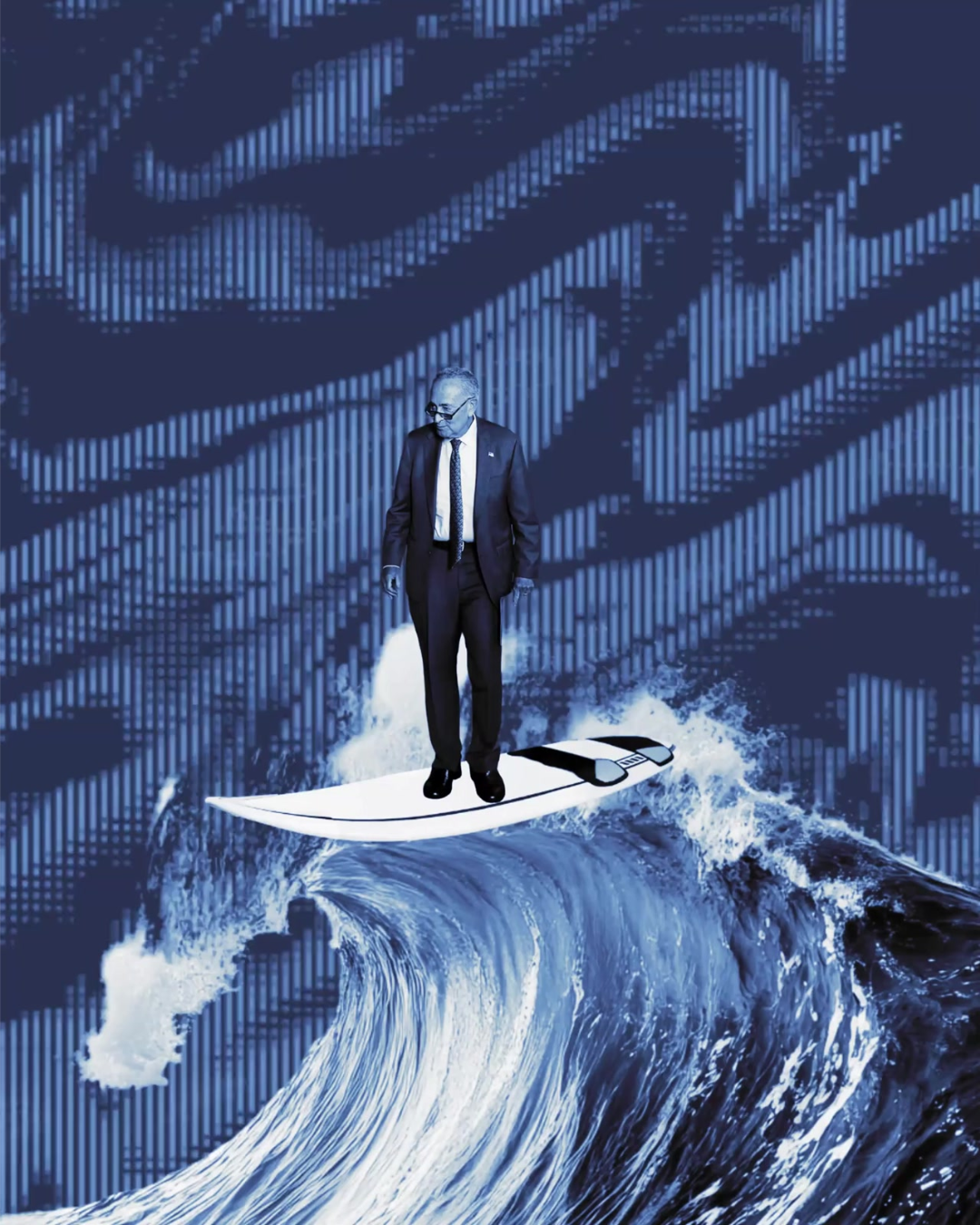
And then there’s Chuck Schumer, a politician whose relationship with Wall Street has long made him emblematic of the Democratic Party’s dependence on corporate money. Schumer has spent decades representing New York, home to the country’s most powerful financial institutions. His political career has been shaped by a close relationship with the financial industry, and his instinct for compromise has repeatedly frustrated just about every democrat in the party.
We saw that instinct on full display in March 2025, when Schumer helped advance a Republican spending bill despite widespread opposition from his own party. Schumer argued that allowing a government shutdown would give Trump and Elon Musk even greater power to dismantle federal agencies, but many Democrats believed the party had surrendered one of its few opportunities to meaningfully challenge the administration.
Now, with another potential financial crisis looming, those same leaders could be asked to decide how much public money should be committed to protecting an industry that has already made some of the wealthiest people on earth even richer. I suspect that if the AI bubble bursts, we will hear a great deal about the importance of restoring market confidence, protecting investors, and preventing economic instability. We will be told that the situation is too urgent for political disagreements, that there is no alternative, and that saving the financial system is the same thing as saving the American economy. And once again, the people who created the conditions for the crisis will have an enormous influence over how the government responds.
The Democrats Won, Now What?
Which brings me back to the election. For all the excitement surrounding this historic victory, I think it’s important to remember that the Democratic Party did not create the political energy that made it possible. It benefited from it.
For years, Americans have been organizing against the political and economic conditions that made Trumpism possible. The Pro- Palestinian movement has mobilized a generation of young people, exposing the enormous human cost of American imperialism and forcing difficult conversations about the relationship between corporate power, foreign policy, and the political establishment. Labor organizers have challenged some of the largest corporations in the world, reminding Americans that collective action can accomplish wins for working class Americans, where politicians fail. Mutual aid networks have demonstrated what systems of care and solidarity can look like when people organize to meet one another’s needs. Immigrant rights organizers have mobilized against detention, deportation, and the expanding power of ICE. Artists, independent journalists, community organizers, and ordinary people have spent years building political education networks and creating spaces where people can imagine alternatives to the existing system.
This work has expanded the political imagination of an entire generation, and much of it has happened independently of, or in direct opposition to, the Democratic Party establishment. Democrats may have been the electoral beneficiaries of this growing dissatisfaction, but we can’t let them claim ownership of the movements and people who made this victory possible, only to co-opt and undermine them. Nor can we fall into the familiar trap of surrendering our demands in the name of political pragmatism.
There is a very real danger that the excitement of this election will encourage people to mistake a change in congressional leadership for a transformation of the political system. It isn’t. The structures that allowed corporations to accumulate extraordinary economic and political power still exist. The financial system that devastated millions of Americans in 2008 remains deeply interconnected with the lives and livelihoods of ordinary people. The military-industrial complex is still operating. ICE still exists. The Democratic Party is still beholden to many of the same wealthy interests that have shaped American politics for decades.
I don’t want to diminish what happened on November 3. Millions of Americans rejected an administration that has spent years undermining democratic institutions, attacking vulnerable communities, and governing in the interests of the wealthy. For people who have spent the past decade watching the country move further toward authoritarianism, this election offered something that has felt new or unfamiliar: hope.
But hope without political organization is a dangerous thing. We cannot allow ourselves to fall into the same trap we did in 2008, when the election of Barack Obama was treated as proof that the political transformation people had been demanding was here.
If the AI bubble collapses, we need to be organized before the bailout negotiations begin. We need to demand that any public rescue prioritize workers, homeowners, and communities rather than shareholders and executives. We need to continue fighting for the demands that existed long before this election, including abolishing ICE, ending American complicity in imperial violence, and removing corporate money from our political system.
The lesson of the New Deal is that political transformation doesn’t happen because the right people win elections. It happens when organized people make maintaining the status quo politically impossible. The lesson of 2008 is what happens when that pressure dissipates.
Now, eighteen years after Obama’s historic victory, we may be approaching another moment when the contradictions of American capitalism become impossible to ignore. We can allow the political establishment to manage the crisis in the interests of capital, or we can organize to demand something fundamentally different. Because if Democrats squander this mandate the way they squandered the opportunity of 2008, the consequences will extend far beyond another disappointing election cycle.
The economic resentment, institutional distrust, and political alienation that helped produce Trumpism have not disappeared. If anything, another financial collapse followed by another corporate rescue could deepen them. The next political figure to exploit that resentment might be far more capable and dangerous than Donald Trump…