
Hit Enter to Search or X to close
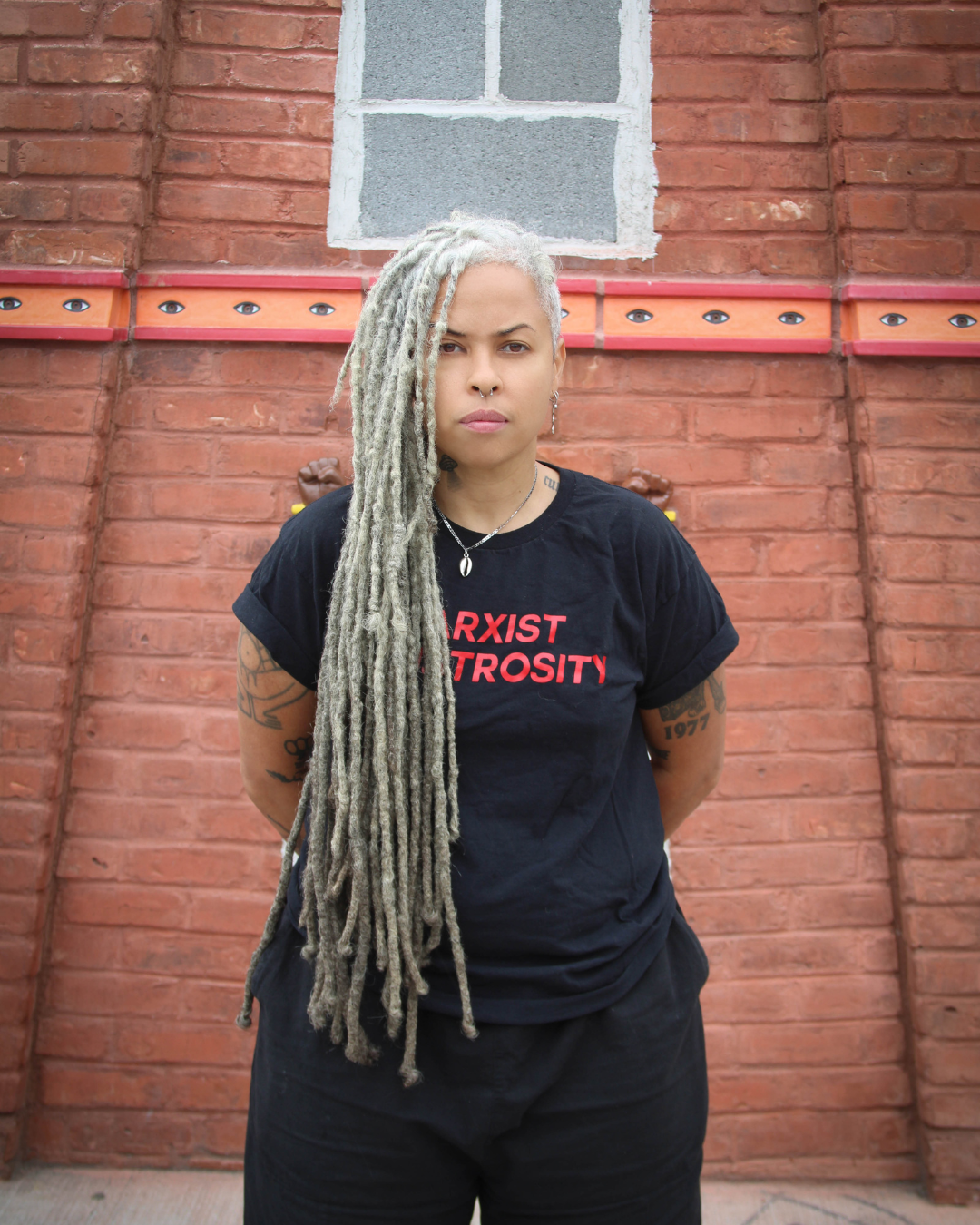
Artist and organizer Shellyne Rodriguez has been fired, doxxed, splashed across two New York Post cover cycles, and turned into a right-wing punchline. She’s still here and still building.
Shellyne Rodriguez wore a T-shirt to our interview that read like a band name. “Marxist Monstrosity,” it said — the phrase the* New York Post *coined for the public monument she spent seven years making for her own borough. “Amazing,” I told her. “Is that what they called you?” “That’s what they called us,” she said, and laughed.*
Rodriguez is a Bronx-born visual artist and community organizer — a self-described Black, anti-state Marxist whose practice runs from drawing and sculpture to grassroots work for housing and against policing. She earned a BFA from the School of Visual Arts and an MFA from CUNY’s Hunter College, and for the better part of a decade she taught: as an adjunct at Hunter, at SVA, and at the Cooper Union School of Art. Her work has been shown at El Museo del Barrio, the Queens Museum, and the New Museum.
Then, in May 2023, she swept the pamphlets and rubber fetus models off a table run by Students for Life of America, an anti-abortion group tabling at Hunter, and told them, in so many words, to get out. The group circulated the footage. Within days her phone number and email were leaked, and a wave of racist and misogynist threats followed. When two men from the *New York Post* showed up unannounced at her Bronx apartment, she met them at the door with a machete. She was arrested, charged with two misdemeanors, and fired — first by Hunter, then by SVA, later by Cooper Union. A plea deal eventually withdrew the menacing charge after six months of mandated therapy. Fox News ran a segment speculating on the appropriate punishment for her.
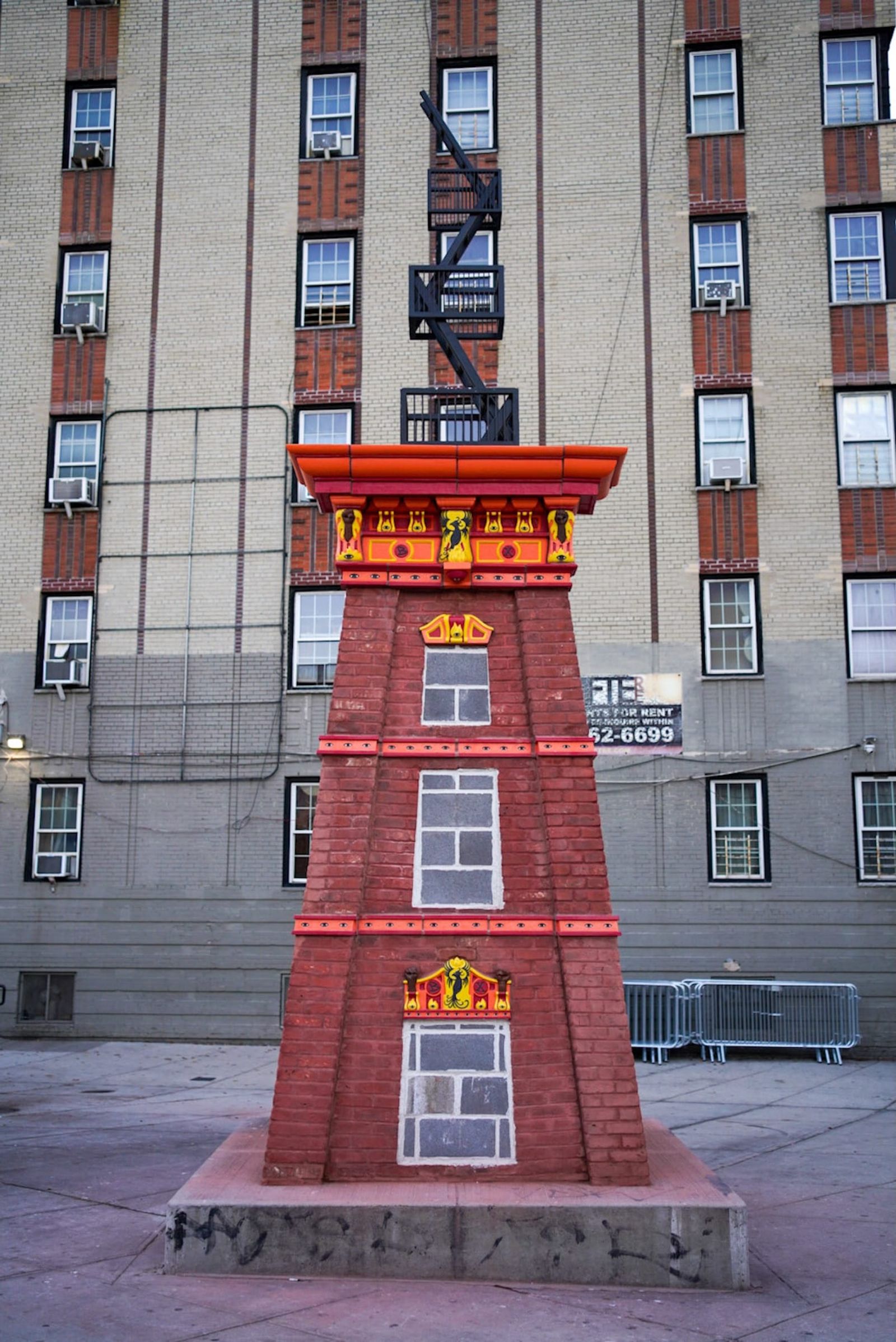
She has not been able to teach since. In November 2025, her permanent public sculpture — *Phoenix Ladder: Monument to the People of the Bronx*, a 23-foot tower of brick, steel, and terracotta commissioned through the city’s Percent for Art program — was unveiled on the Grand Concourse. Within months the *Post* came back for a second pass, this time over the public money behind a “Marxist” monument. Someone left a broken racist statue at the site. She left town for a few days.
We met in the Bronx and talked for a long time — about caricature, the price of self-defense, what social media did to organizing, and what she’s learned about fear from a lifetime of fighting. This is that conversation, condensed and lightly edited for clarity.
How is your life still impacted by the fallout from your activism?
I have to go back. My thing begins five months before the Palestine moment — May of 2023, which was actually a confrontation with Christian nationalists, an organization called Students for Life of America. It was on the heels of the overturning of Roe. At the time you couldn’t really see it, but they were having an organized presence on campuses everywhere.
For me it was very run-of-the-mill to be like, *get the fuck out of here.* But my “get the fuck out of here” at that moment got politicized and orchestrated into a thing. And nobody else was saying anything. I was the only weirdo, apparently, who was like, yo, we gotta. Which is crazy, because the week before, I was snatching CIA recruitment ads off the bulletin boards in the student area. I’m like, these motherfuckers are on campus, why isn’t anybody — my idea of CUNY has always been that professors are really involved. I think adjuncting killed that a little. People go in and out so fast. But if you invest a little in campus life, in what your students are imbibing, you take a stake. So it really came from that place.
That’s when the harassment started. That’s when the New York Post came through — which I didn’t know was the *Post* at first. I just saw two white men show up to my house. I caught charges after that, two misdemeanors, menacing with a weapon. But if you watched Fox News, they gave the impression they were going to put me in jail. They even had a reporter come on and speculate about the best punishment for me. It was anti-Black and fucked up. The outcome was a year of anger management.
So by the time Palestine came around, you were already on thin ice...
By then I was already sullied — with academia, with institutional life. I had one adjuncting gig teaching sculpture at Cooper Union, and the Christian nationalists were following me everywhere. I was supposed to be a visiting artist at a school out in Massachusetts; they were calling there, harassing them, threatening to protest. I lost gigs because of that. When they found out I was at Cooper, they organized a protest, and that put me on Cooper’s radar. The faculty in the department knew me, knew my work, moved me through the channels — nothing on paper said *don’t hire this person.* Then they caught on to who I was, and it was, oh shit, hot potato. HR, HR, HR.
So the school started acting like my parole officer. I was finishing the legal aspect of the Hunter situation — the mandated anger management — and Cooper demanded that, in order to keep that adjunct job and be considered for the next semester, I turn in a monthly report proving I was showing up to therapy.
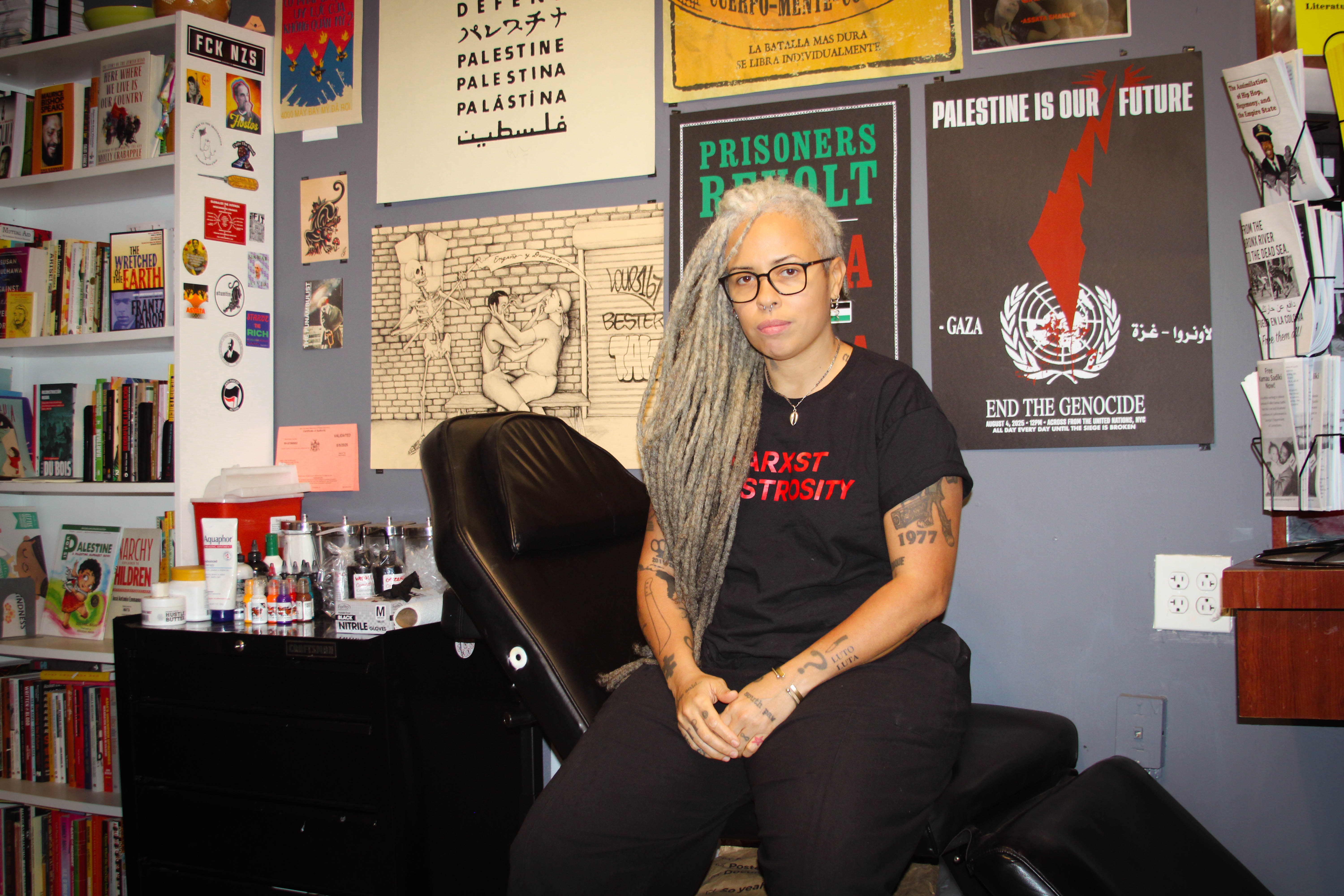
The semester ended without a problem. In between semesters, I did a teaching on Palestine at another school, and they used that as the reason to really let me go. So, long-winded as that is — I have not really been able to teach again. That sealed it. I’ve only been teaching for the past decade; that’s what my work history is. So I’ve been out of work for two years. I hustle. There’s good solidarity with solid professors who have me visit their classes — honorarium here, honorarium there. And I’m tattooing. I run a shop. It’s clandestine, because it has to be, because of these assholes. So I
can’t say where it is.
These institutions (CUNY especially) trade on a radical, progressive legacy. How does that square with how they treated you?
Legacy is only as good as you keep it up. The year all this happened to me was the same year they named the street behind Hunter after Audre Lorde. In that moment, they were doing a street naming for Audre Lorde. And me, I’m —you know. The union, the PSC, didn’t support me. Now you see the campaign to rehire the professors
who got pushed out, and shout out to those professors, all solidarity, I hope they get their jobs back. But fuck that union. They gave a statement to Fox News.
Why do you think they showed up for others and not for you?
Because they’re liberals. Because of optics. Because I had a picture of me in the New York Post with a machete, and they didn’t investigate the thing. It’s a mindset of liability. They assumed I attacked students. I never attacked students — I attacked an organization. And “attack” is a strong word. I shoveled papers and rubber fetuses off a table. Were there students acutely present? Yes. Were the people at the table orchestrating it CUNY students? No. They were right-wing agitators — we know them as faces for that in other spaces. The students who brought them there for religious purposes, I hope they find their way in life.
In the very beginning, when I was first dealing with HR, the union represented me, and everything was fine. I wasn’t fired. I got written up. But then there were two weeks of consistent death threats. So the school flipped— from wagging a finger at me about how you can’t confront students that way, to *oh my God, you need to go to the police and file a report, we think an active shooter is going to come on campus.* That kind of 180. There’s a record of them telling me I was in danger, because I forwarded the worst of the emails to the provost. The day the *Post* showed up at my house, I was facing all sorts of threats already, and then some white man shows up at my door unannounced. I had no clue if he was with the New York Post. There was a security lockdown on my floor — guards in front of my classroom. They feared for my life. So imagine: the school takes that position, and the minute self-defense is invoked for *myself*, the narrative becomes, “oh, you’re violent”. They fell right into the tropes. So it was all this bullshit about *we don’t condone violence.* And self-defense isn’t even apart of the conversation.
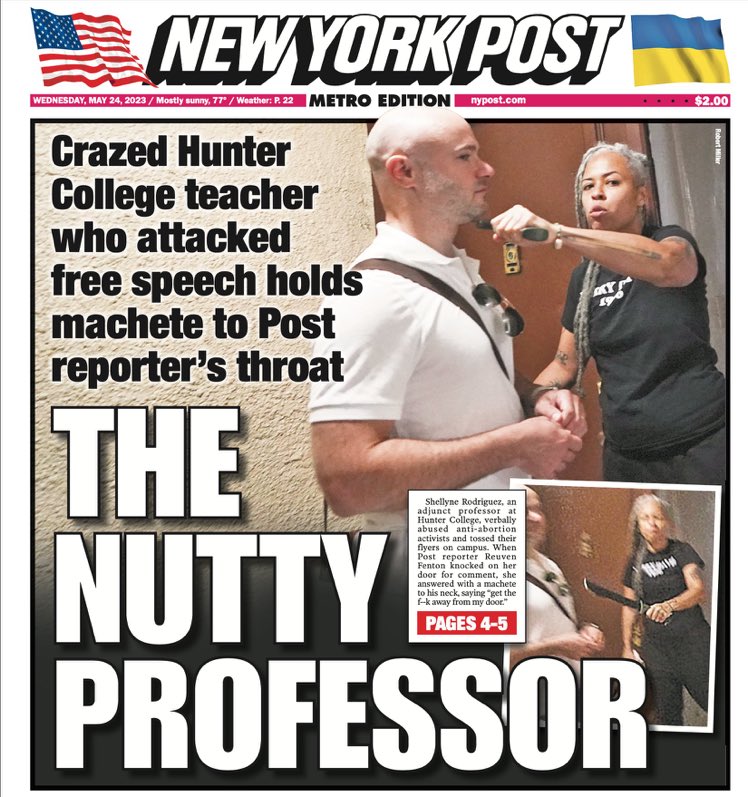
How do you hold on to your humanity when the media reduces you to a caricature
It’s not just the media. This is what it is to be a Black queer woman in the United States — a Black queer woman who doesn’t code-switch, who moves unapologetically the way I do. The knee-jerk is to reduce me. I’ve become used to it. I don’t really give a fuck what they say. Is it tiring? It is, because it has repercussions. But I know who I am.
If anything, it’s a lament — about the constant feeling of being dehumanized. That weighs on you. And the thing is, inside that caricature is the flip side: *Shellyne is so brave, so strong.* There’s a lot of weight in that picture too. A dehumanization where I can’t be afraid, can’t feel weary. So it’s removed from me in that way. It becomes a fetish. And I’m just a middle-aged woman, period. Standing on what I believe. Who
has always had to fight.
You’ve said that framing — “she can handle it” or “she’s an animal” — leaves you exposed. How does that show up in how you move now?
Either way, it leaves you vulnerable to violence. I’ve lived on the same block for years, so people know me; I can almost feel when someone’s not from the block. But I’m always looking over my shoulder. Hypervigilance. And I’ve got to get on the train. So when they put me on the cover of the *Post*, I get paranoid on the subway, because I’ve been recognized there. Now I’ve got to get my defenses up — *do I have to fight right now?* And if I fight, they’ll say I was the violent one, because they’ve already locked me in that.
When a person unapologetically shows up and confronts the things that need to be confronted, in this body, you get painted as violent, un-nuanced, all of it. It’s not the first time. I’ve had my bumps with institutions in the art world, and it was always easy to just say *violent, extreme.* Who gets more right-wing than a liberal who feels attacked, who can’t handle their cognitive dissonance? It’s a playbook — stringing together a narrative that lends itself to my isolation and removal. But I won’t be isolated or removed. Y’all can’t get me. It’s just easier to make the person highlighting the problem go away. I won’t go away. I’m not done yet.
The monument finally went up in late 2025. Then the *Post* came back. Walk me through the second cycle.
Phoenix Ladder had been cooking since around 2017, and it went up in October — November of 2025. It was pretty chill at first. But the city submits public records for everything it builds, my name showed up, and they put two and two together. The *Post* thought they could generate controversy and spectacle, and sell papers by stirring an uproar about the city spending money on a “violent marxist”, monument. The first time around, in 2023, they didn’t even mention I was an artist. It was just *professor, professor.*
It started with an email asking for a quote. I’m like, okay, these motherfuckers are starting again. The next day they were outside my apartment — but this time I knew to expect them, so I gave them nothing. *I’m sorry, baby, I don’t got no cash.* They couldn’t get it to move beyond pissing off some of their readers. Somebody came and left a racist monkey statue in front of the monument. By the time people sent me the photo, someone had already broken it. So I left town for a couple of days. Because it’s not so much that I have to deal with the *New York Post* — it’s who the *Post* incites. That’s the mechanism. They’re a dog whistle. They’ll claim no responsibility if some psycho white supremacist decides to come do whatever the fuck.
And the shop — you’ve worried about keeping it running through all this. How do you run a business when you can’t even be public?
It’s already hard — it’s in the Bronx, out of the way, trying to get off the ground. Removing the open advertising makes it harder. But comrades sustain me. It’s been a lot of word of mouth, tattooing people in my neighborhood, and it gets around like that. These are the circumstances we’re living in. I try to keep it in perspective: how did Paul Robeson deal with it in his time? How did people who lived through McCarthy deal with it? I don’t know what the end of this movie is. But I feel a sense of urgency right now — as an artist, to make what I can make, write what I can write. To leave behind the record. I don’t know if I can stay in the United States. I don’t know if I can go, either. Nobody knows. So I just focus on the work.
What did this experience teach you about your community — who showed up, and who didn’t?
Nobody broke my heart more than the faculty at Hunter. I was taken aback by how quickly they distanced themselves, inventing bureaucracy around taking a position they knew they should take. The stalling. The students, though, came out hard for me — that was beautiful. The art world was finicky. The people who really came out were academics and thinkers. That’s who I gravitate toward, and that’s who sustained me. People who think for a living. And the chairs of the programs where I taught went to bat for me — they understood what I brought to the table. It was the faculty who were thinking about their mortgages. Crabs in a barrel.
My actual community is Caribbean — the Bronx is Caribbean. Everybody understood. I didn’t have to explain anything. It was either *I wish a motherfucker would* or *that could be my daughter.* Everybody got a machete behind the door. It’s a no-brainer; you don’t even think about it. I heard that when they were investigating the “incident,” one of the detectives — a Black detective — told a business in the area, *I’d probably do the same thing.* Strange men show up at your door. It’s common sense.
But there’s also the authority of the news.If the news says you did something bad, maybe you did something bad. So there were moments I had to hold the contradiction in front of my neighbors: *you’ve known me for ten years, and the news is saying this. So who has more authority here — the news, or you? Trust yourself.* That’s how deep under the spell our people are. That’s where you feel the dehumanization the most.
What did it confirm for you about organizing?
What plays in my favor is that I’m an organizer, and organizers organize. People held me down. People made sure I had places to stay. People disappeared me. People managed my inbox so I didn’t have to experience that. People showed up for me in court — I was never alone in court. Those are the things that matter. Organizing
gets the goods.
Have you considered disappearing from public life? What’s kept you from it?
I think I *have* disappeared from public life. You happen to be one of the lucky ones allowed to follow my private Instagram — there are thousands of requests I sit on until I meet people. I’ve never had a Twitter. That one private account is my only social media. I don’t leave much. You’re not going to see me at openings. I live a very normal life. The work I’ve done — organizing, art — has a life of its own that isn’t me. It’s *aspects* of me. People make their own things out of things. I only pop in when I’ve got something meaningful to say. There’s too much in the world. Everything’s equalized now — it’s all the toothpaste on the shelf at the CVS, locked behind the plexi. This opinion, this opinion, everybody with the fucking furry little mic. I respectfully decline. I’m trying to be Sade out this motherfucker — only show up when I have something to say.
How has that changed you as an organizer?
People got confused about the role of social media in organizing — including me. For a long time I really thought it was an important tool. And it was, to a degree. Palestine was the experiment. The collective we built around it had a robust social media presence, and the people in the Bronx were probably an insignificant percentage of who followed it. Everybody else was the echo chamber. When that echo chamber started to implode on itself, we shut it down. We pulled out, because it gets to a point where it becomes self-destructive.
The organizing we’ve been doing in the Bronx for going on two years now — from the beginning, we collectively agreed: no social media footprint. Online don’t know we do it. It’s going. I won’t speak on it, but it’s going. You don’t need it. It’s useful for what it’s useful for. But there’s an ego, a narcissism, that starts to invade the activism. What is this really about? Is it about you, or about the work? What does it matter if people in Brooklyn know we’re doing mutual aid in the Bronx? The people who eat every week are eating. Why does it need to be announced?
A lot of people experience this kind of repression privately and silently. What has it taught you about fear — its power and its limits?
People deal with fear in different ways, and how I deal with it was shaped by my upbringing, like everybody. When they say fight, flight, or freeze — I’m very much a fight. I’ve always had to fight; I grew up in the crack era. My knee-jerk, when I get anxious, is to do more work, throw myself into it. That’s played out quite publicly. Fight is how I’ve survived this long.
But there are limitations. You can’t do it alone. If I can critique myself about 2023, it’s that I didn’t ask for help. I thought I had it — *fuck it, I got it.* And I still have that attitude; it’s the kind of person I am. But when strangers showed up at my door and I thought they were there to harm me, I didn’t have the capacity to stop and think. I just reacted. They tried to get me again the second time, recently — but I was up. Fool me once.
A lot of lessons came out of that, beyond the actual incident. I had to temper my Ogun energy with some Obatala and Oshun — lean into wisdom. Rage is not the tool for everything. You’ve been fighting so long that it’s a very sharp tool, but you can’t keep reaching for it. You’ve got to have a diverse toolbox. That’s character development. I’ve got to walk this earth until I’m not walking it anymore, so — what can I learn?
Last question. For younger artists, organizers, and educators watching people be publicly punished for speaking out — what would you want them to understand about survival, risk, and solidarity?
I’m not the first and I won’t be the last. Honor and dignity over everything. When you’re lying in bed staring at the ceiling, what’s the conversation like with that person — which is you? Do you want to be comfortable with that person? There was a point in time when our ancestors never thought they’d see the end of their enslavement. It was inconceivable that they wouldn’t be cutting sugarcane or picking cotton. And history moves. So why wouldn’t it move for us? If they could overcome the fear of their situation, why can’t we?
Memory and history are the biggest things to hold on to. Because when we start to forget — shit gets dangerous.
As we wrapped, Rodriguez stood up to show me the shop.
.jpg)

.jpg)