Hit Enter to Search or X to close

Isabelle Brourman has spent years drawing people at the center of American spectacle: Donald Trump in court, Luigi Mangione at hearings, families confronting ICE, protesters facing federal agents. What began as courtroom sketching has become something larger. A real-tim evolving record of a country in upheaval.
Isabelle Brourman does not think of herself as a traditional courtroom artist. She respects the tradition deeply, but her ambitions are different. She is not trying to solely reproduce what happened. She is trying to document what it felt like to be there.
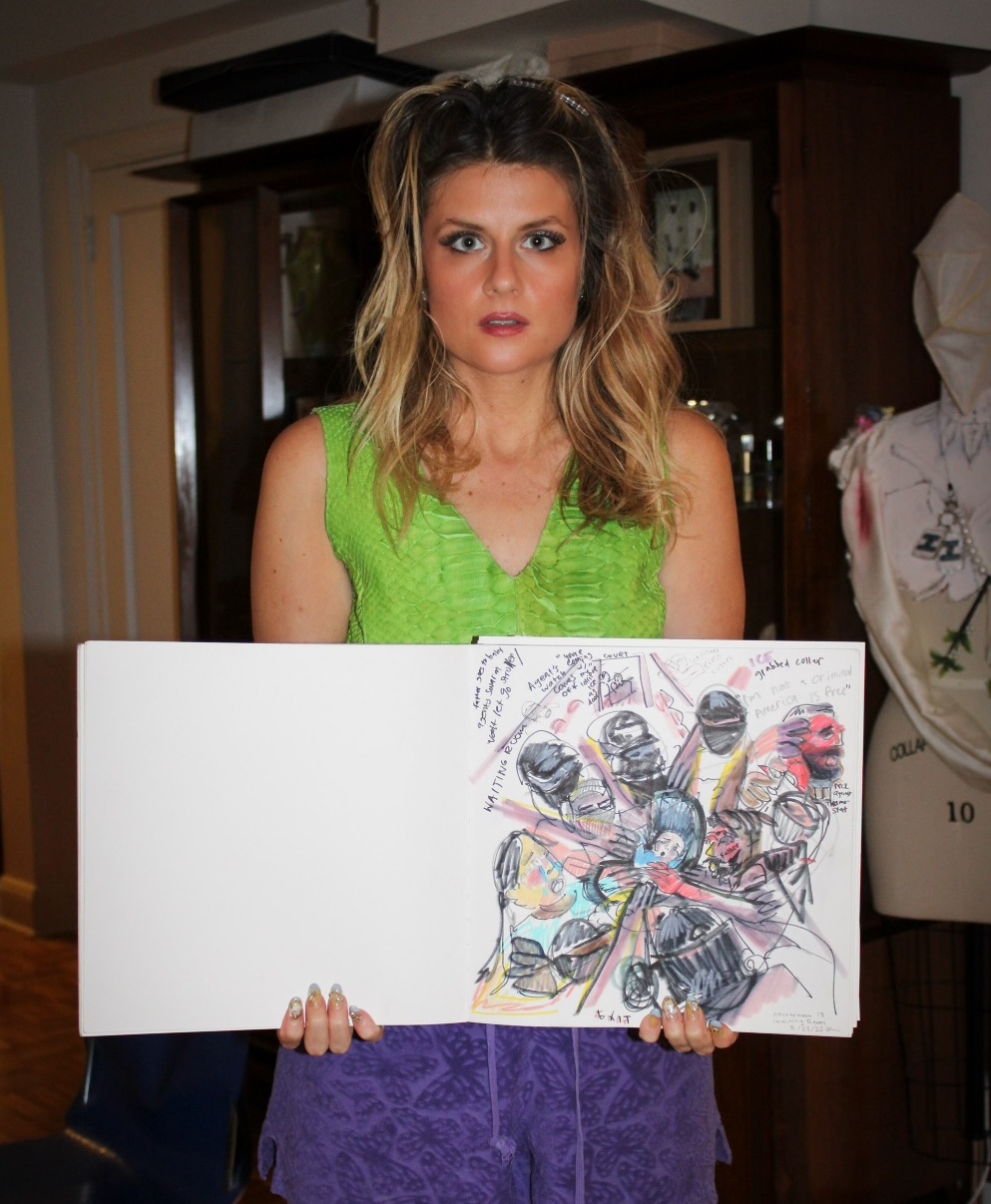
Her drawings are made quickly, often under pressure, and then transformed with writing, color, gesture and distortion. Sometimes they are finished in the courtroom; sometimes she returns to them hours later Over time, the conditions themselves become part of the work: paper damaged by rubber bullets, markers failing in freezing temperatures, words bleeding across a page as quickly as events unfold.
“I’m not taking a picture,” she has said. “There’s a level of personal memory and shock that’s infused into the work.
Brourman’s work began with trials involving figures such as Johnny Depp and Amber Heard and eventually brought her into Donald Trump’s criminal and civil proceedings. From there, the courtroom became a vantage point for observing power itself. Her work around Trump was never about making an unusual likeness. She was interested in what happened when an artist sat close enough to study someone whose image had already been consumed millions of times through television and photographs.
Trump, she says, was a “dark muse.”
Watching him in person altered her understanding of him. What struck her the most was not his appearance, but his awareness of the room: his eyes moving, his attention shifting, his apparent calculation of the people around him. Her role as a courtroom artist gave her the opportunity to learn how to watch — really watch.
That became central to her practice. Live sketching, is her process to attempt to capture both what is visible and what remains invisible in tense situations — the gestures, reactions, power dynamics, and subtle shifts that a camera or conventional record might miss.
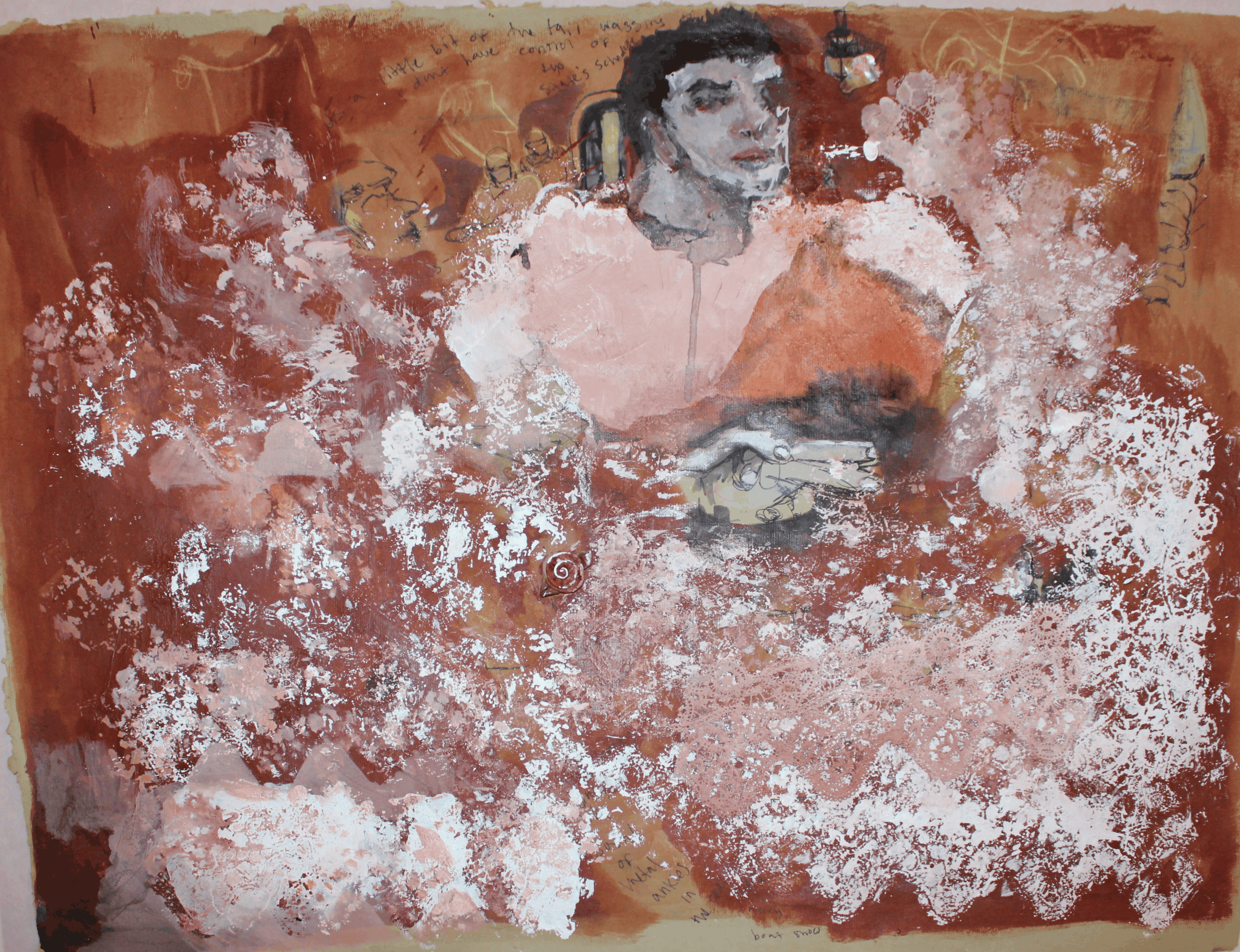
The People v. Luigi Mangione, The Suppression Hearings (view from the jury box). New York State criminal court, December 2025
Her drawings consequently resist the flattering conventions of portraiture. She wants something more essential—the person, but also the atmosphere around the person. “I’m not trying to make them look flattering,” she says. She wants to get the core of the person or situation.
Trump offered an especially complicated subject because of the distance between the familiar television figure and the person in the room. Brourman remembers being shocked by how different the experience of seeing him directly could feel. He was charismatic, highly alert and difficult to reduce to the caricature that exists in the public imagination.
The work eventually became less about any single defendant and more about the structures surrounding them.
That shift was obvious when Brourman began documenting immigration court.
In New York, since she is a courtroom artist she was able to enter courtrooms where cameras were not permitted and became one of the few visual chroniclers of what was happening inside and around the proceedings. During the immigration crackdown, she spent months returning to the courthouse, watching families arrive for routine hearings and confronting the possibility that they could be detained when they walked back into the hallway.
Her work changed with the circumstances.
The drawings became denser. There was more writing. The clean separation between courtroom and hallway began to collapse. Brourman started incorporating the waiting rooms, the agents, the families and the spaces between legal proceedings into the same visual field. She calls this “structural collapse”: bringing separate spaces and moments together in one image because, in reality, they had become inseparable. “I was hearing the most insane sentences every day—having sort of an outer-body experience,” she says. “I couldn’t.” She began writing more directly onto the drawings. The images became denser, less polished, more immediate. The work began to move beyond documenting what happened in the courtroom and toward capturing what it felt like to watch someone’s life change between walking into court and walking back out. In one episode she described, a family’s hearing ended with the father being detained. Agents surrounded the stroller containing his baby. Brourman knew that stepping in could jeopardize her position, but she stopped drawing anyway.
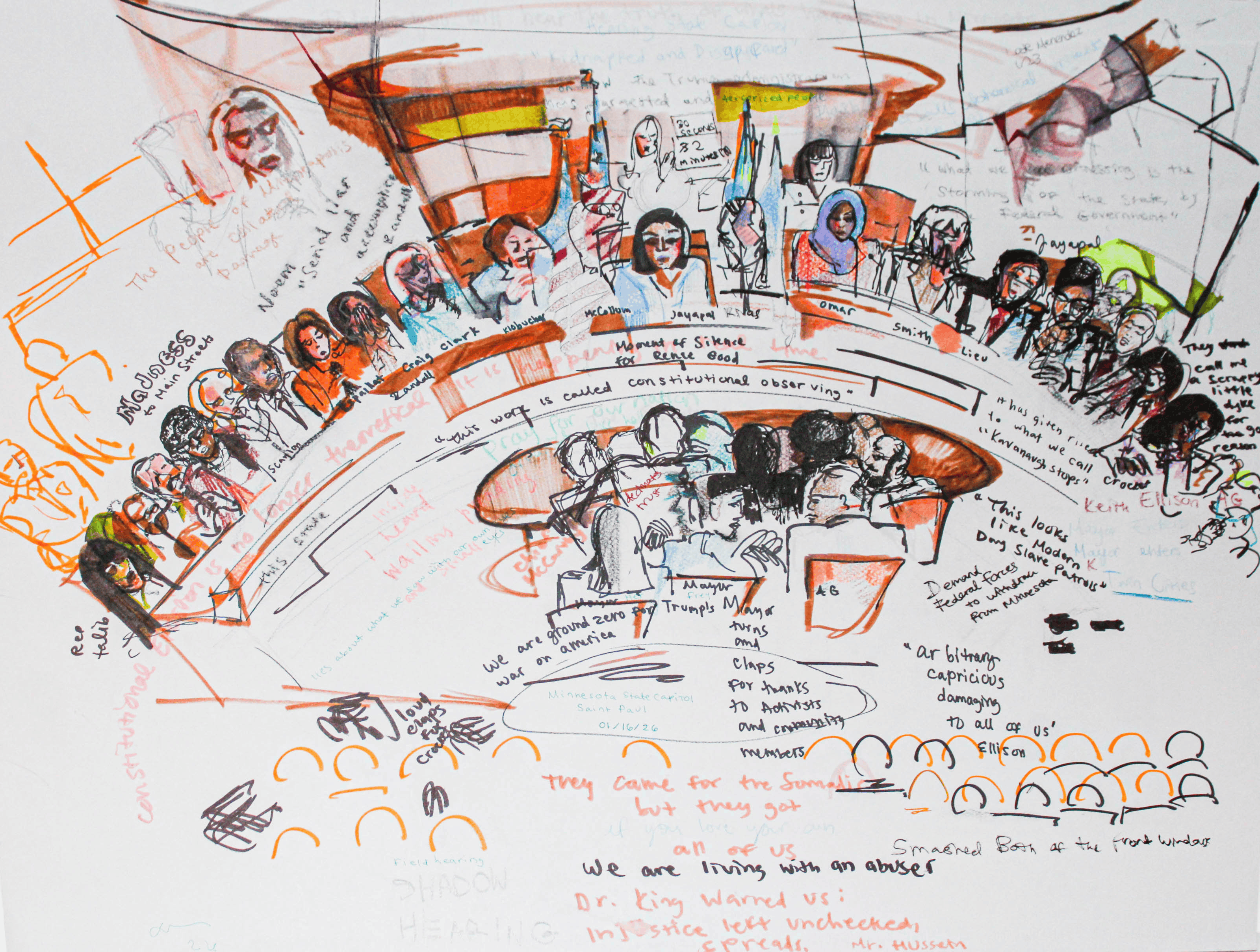
She pleaded with the agents to let the mother and child through. In that moment, the line between watching and participating began to disappear. “I think it’s important to assert that right,” she says of her role as press and artist. But there are moments when the role falls away. When someone is injured, when a baby is involved, when the situation becomes physically dangerous. That tension followed her beyond the courthouse when Brourman began documenting clashes between ICE agents and protesters as they unfolded in real time. In Minneapolis, Brourman encountered a different kind of legal and political theater: demonstrations, federal agents, barricades, detentions and violent confrontations unfolding in the street. The drawings became physically marked by the conditions under which they were made. One series of works bears the damage of the environment itself. A board was struck between legal proceedings into the same visual field. She calls this “structural collapse”: bringing separate spaces and moments together in one image because, in reality, they had become inseparable. “I was hearing the most insane sentences every day—having sort of an outer-body experience,” she says. “I couldn’t.” She began writing more directly onto the drawings. The images became denser, less polished, more immediate. The work began to move beyond documenting what happened in the courtroom and toward capturing what it felt like to watch someone’s life change between walking into court and walking back out. In one episode she described, a family’s hearing ended with the father being detained. Agents surrounded the stroller containing his baby. Brourman knew that stepping in could jeopardize her position, but she stopped drawing anyway.
She pleaded with the agents to let the mother and child through. In that moment, the line between watching and participating began to disappear. “I think it’s important to assert that right,” she says of her role as press and artist. But there are moments when the role falls away. When someone is injured, when a baby is involved, when the situation becomes physically dangerous. That tension followed her beyond the courthouse when Brourman began documenting clashes between ICE agents and protesters as they unfolded in real time. In Minneapolis, Brourman encountered a different kind of legal and political theater: demonstrations, federal agents, barricades, detentions and violent confrontations unfolding in the street. The drawings became physically marked by the conditions under which they were made. One series of works bears the damage of the environment itself. A board was struck by a rubber bullet, leaving a hole through the paper. Several sheets stacked on the board were damaged in the same place, creating a progression of increasingly faint impressions.She also began noticing something beyond the violence she was witnessing, the beautiful acts of community and solidarity. Particularly, during her time in Minneapolis. She recalls the show of community was completely different from some of the other places where she has worked. Minneapolis struck her as a place where people seemed unusually organized around one another. Protesters, photographers, medics and other community members seemed to understand that they were responsible for one another.After returning from Minneapolis, Brourman says she felt lost. “I think it’s probably how people feel when they come back from war,” she says. The event ends, but the body doesn’t immediately understand that it is over.
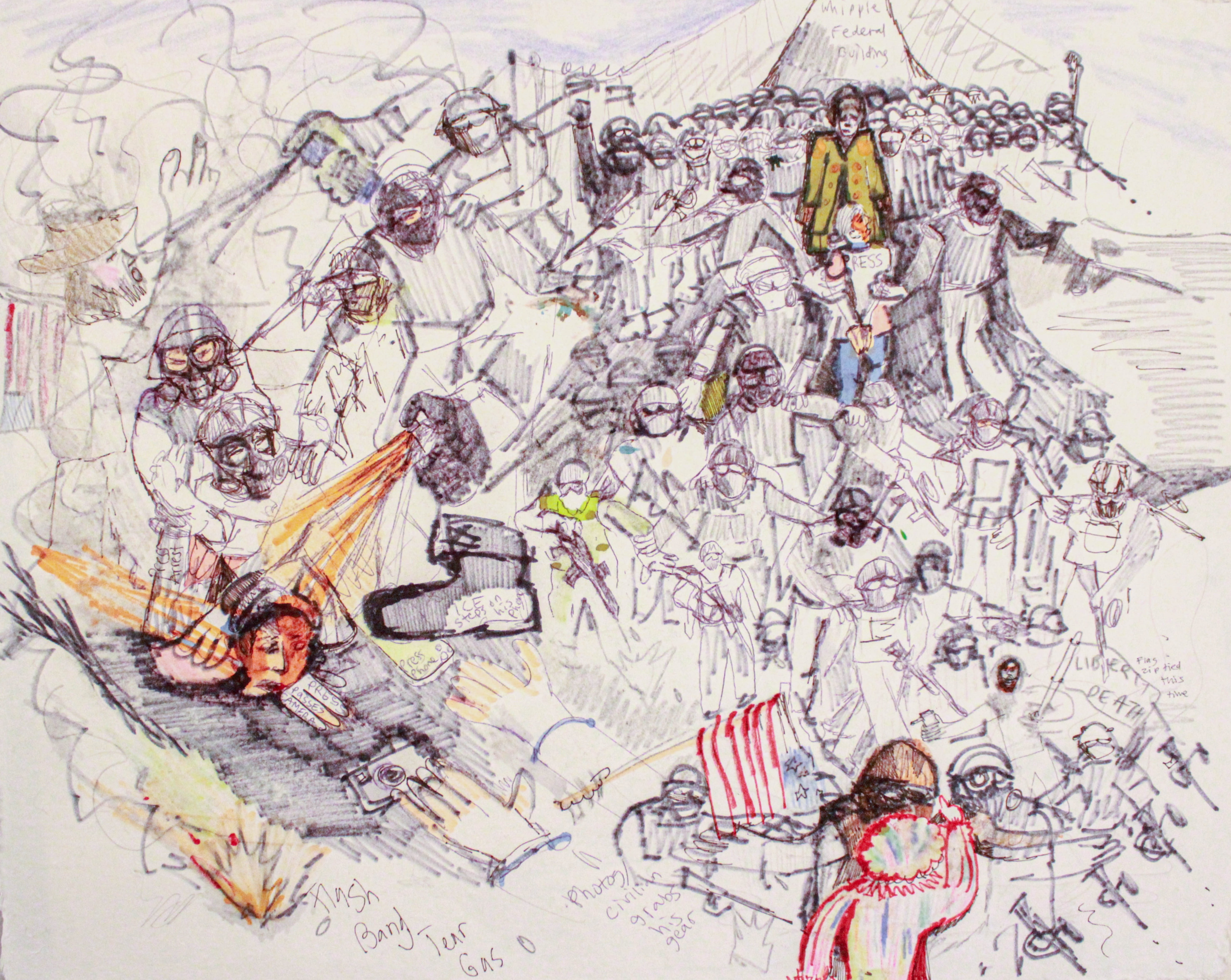
She had spent months watching people get detained and confrontations unfold, as agents and protesters became increasingly hostile toward one another. When she returned to the art world, she found it difficult to leave that reality behind.She would research obsessively and fall down rabbit holes, trying to understand what she had seen. Then she would realize that she hadn’t made anything.Eventually, she says, she learned that she had to return to the work. Lately, she has been documenting the clashes between protesters and I.C.E. agents at the Delaney Hall concentration camp in New Jersey, continuing to follow the story as it moves between courtrooms, detention centers and the streets.
She doesn’t know exactly when the project will end. It may not end when this particular political moment does. For Brourman, the work has become a way of staying present inside a history that is still being written — and of preserving what might otherwise disappear.
“I’ve started something and it’s impossible to forget in a way,” she says. “And I want to stay sharp and engaged.”
So she keeps going back.