
Hit Enter to Search or X to close

They are young, conventionally attractive, and often photographed pouting at the camera in military fatigues. Sometimes they’re dancing. Sometimes they’re cradling rifles in the same hands that will later post selfies with manicured nails. They are not recruiters, at least not officially. But scroll through TikTok or Instagram long enough, and you will find them. Female soldiers who have become among the most effective propaganda tools their governments have ever deployed.
This is not an accident.
The use of sexualized imagery of female soldiers as a tool of state propaganda has a name, a history, and an increasingly sophisticated operational logic. Researchers Eva Berger and Dorit Naaman coined the term “combat cuties” to describe the blend of innocence and titillation surrounding women soldiers — a formula that, in the age of social media, has become both algorithmically irresistible and politically useful. A 2026 academic paper published in Political Communication examining TikTok and the Israeli Defense Forces describes it as “participatory militainment” — a form of entertainment-as-propaganda that turns viewers into unwitting amplifiers of state violence, one like and one share at a time.
““participatory militainment” — a form of entertainment-as-propaganda that turns viewers into unwitting amplifiers of state violence, one like and one share at a time.
“There is a long history within Israel of military iconography favoring the beauty in uniform as a nationalist symbol,” explains Rebecca Stein, professor of cultural anthropology at Duke University and author of Screen Shots: State Violence on Camera in Israel and Palestine. “The military is using it in new ways to meet the needs of the digital moment.”The digital moment, it turns out, has been waiting for exactly this.
A Brief History of Beautiful Soldiers
The exploitation of women in wartime imagery predates the internet by at least a century. World War I was, as historian John L. Shover described it in 1975, “the poster war”, and those posters did not feature women as generals. They featured them as victims to be avenged, nurses to be admired, and homemakers to be returned to. World War II gave us Rosie the Riveter: a symbol of female strength, yes, but also a carefully managed image designed to mobilize women’s labor in service of the state. In wartime, this becomes especially visible, women’s bodies are represented,deployed, and made useful to the war effort. As scholar Cynthia Enloe wrote in 2000, military policy makers have historically needed women “to boost morale, to provide comfort during and after wars, to reproduce the next generation of soldiers, to serve as symbols of a homeland worth risking one’s life for.”
What has changed is the platform, the scale, and the precision. The poster reached whoever walked past it, while TikTok’s algorithm reaches exactly who the state wants it to reach.
Israel Wrote the Playbook
No country has pursued the combat cutie strategy as aggressively, publicly, or as systematically as the state of Israel.
By the early 2000s, Israel had a measurable PR problem in the United States. Surveys showed that men aged 18 to 35 — a crucial demographic for political support — viewed Israel primarily as a conflict zone. They weren’t interested. Something had to change.
The solution, remarkably, was bikinis.
In 2007, Israel’s Ministry of Foreign Affairs and the American-Israel Friendship League orchestrated a photo spread in Maxim magazine, then one of the most widely read men’s lifestyle publications in the United States, featuring five Israeli models who had served in the IDF. The architect of the initiative at the Israeli Consulate in New York described the models as “a Trojan horse to present Israel as a modern country with nice beaches and pretty women.” The result was a series of Maxim features with headlines like “Meet the Sexy Israeli Army Soldier Who’s Got the Internet All Fired Up” and “Behold, 12 More Smoldering Soldiers From the ‘Hot Israeli Army Girls’ Instagram Account.” The strategy even had a name: bikini diplomacy.
This was not a rogue PR stunt. It was the formal launch of Brand Israel, a public relations campaign instituted in 2005 by the Israeli Foreign Ministry in response to growing international boycotts of Israeli institutions in the Occupied Palestinian Territories. The campaign’s goal was to rebrand the country as a modern, liberal, Western-aligned democracy — a sun-soaked place of beaches, nightlife, and empowered women. In this framing, Palestinians did not appear as a colonized people seeking self-determination. They were instead Israel’s backwards and inconvenient neighbors impeding on the “only democracy in the Middle East” that was bountiful in scantily clad women. The bikini became a geopolitical argument.
“The campaign’s goal was to rebrand the country as a modern, liberal, Western-aligned democracy — a sun-soaked place of beaches, nightlife, and empowered women.

October 7 and the Shift to Uniforms
When social media arrived, bikini diplomacy had to adapt. Anyone could now have a platform, which meant the state could no longer fully control the image war. The solution was to flood the zone and bombard TikTok and Instagram with content so engaging, so algorithmically optimized, so genuinely appealing to young men’s attention, that it would crowd out other narratives.
After the attacks on October 7, 2023, that strategy accelerated dramatically. Research identifying 200 individual TikTok accounts belonging to IDF soldiers found videos with up to 46 million views each — a reach more than seven times greater than the official IDF TikTok account or Prime Minister Netanyahu’s own page. The content followed a consistent formula: female soldiers dancing in uniform to trending audio, performing suggestive gestures calibrated to the platform’s native aesthetic of imitation and mimicry, blending the personal with the political until the two became indistinguishable.
The state-level endorsement of this content is documented and deliberate. The IDF has awarded at least one soldier a certificate for promoting the military on TikTok through dancing videos. Its official TikTok page has posted female soldiers lip-syncing to Dua Lipa. What might look like soldiers just having fun is, in fact, a coordinated expansion of what the academic literature now calls digital militarism.
The most prominent individual figure in this ecosystem is Natalia Fadeev, a military police reservist who goes by the handle Gun Waifu. Posting highly sexualized content alongside passionate defenses of Israel, Fadeev at one point had 2.7 million TikTok followers before her account was suspended. Her content mixes openly hostile rhetoric toward Muslims with not-so-subtle denial of Israeli military conduct. One post asked her young male audience: “Look me in the eyes, do you really think I could commit war crimes?” The implication is that someone this attractive, this fun, this relatable, couldn’t possibly be complicit in atrocity.
“The solution was to flood the zone and bombard TikTok and Instagram with content so engaging, so algorithmically optimized, so genuinely appealing to young men’s attention, that it would crowd out other narratives.
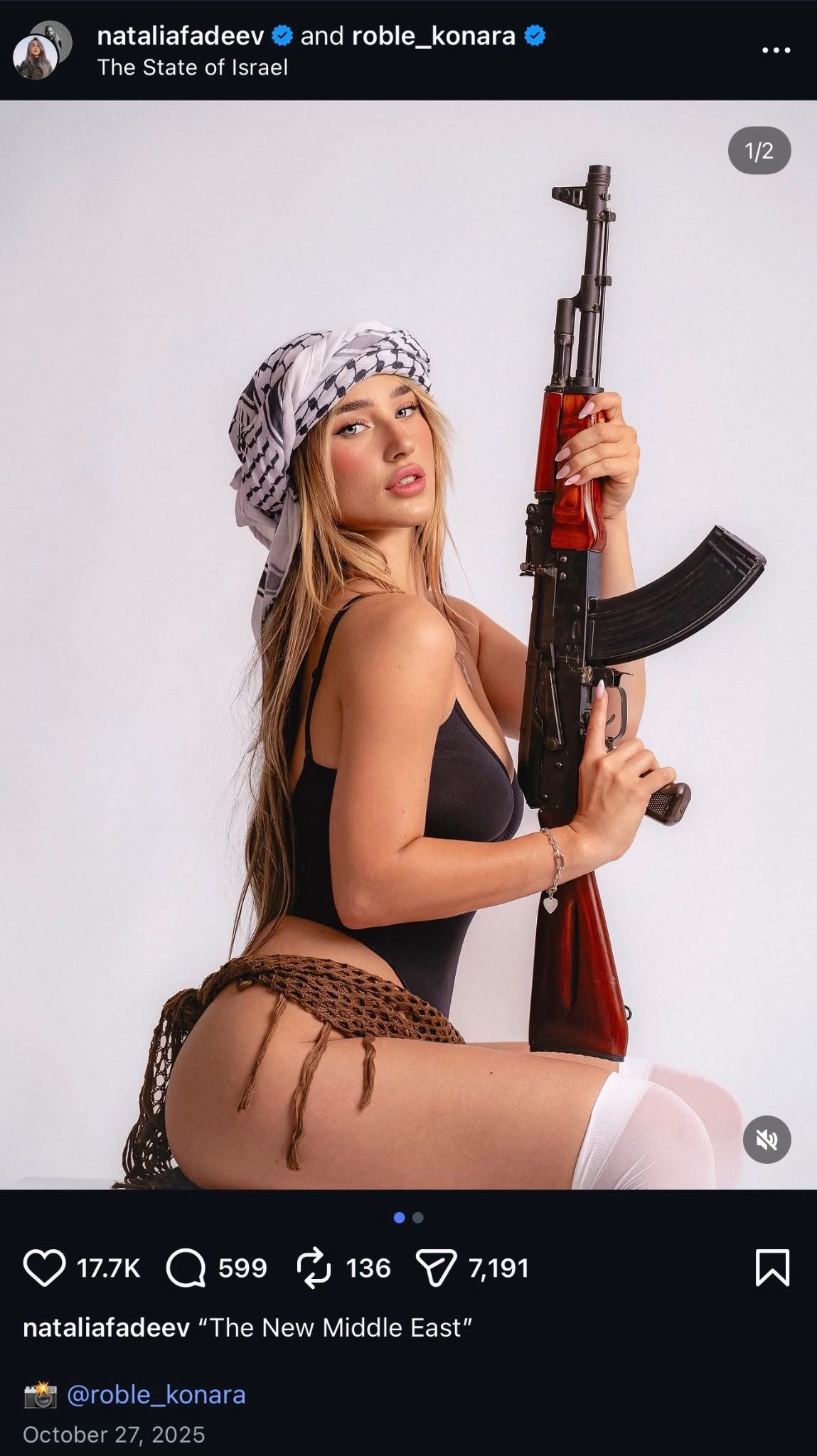
This extends to the treatment of Israeli women killed in the October 7 attacks.
Israel’s official Instagram page posted multiple suggestive images of Shani Louk, even as it announced her death. The Times of Israel illustrated an obituary for Romi Eliyahu Bernat with a suggestive back shot. Another obituary for 20-year-old Liraz Nisan, who died fleeing the Supernova Music Festival, used a photo of her wearing only a bra. When a memorial post for Karin Vernikov — a 22-year-old killed that day — went viral for using an overtly sexualized photograph, it drew immediate condemnation. “What is with this soft-core porn obituary?” read one widely shared reply. The women were mourned and shamelessly objectified in the same breath.
The Propaganda Architecture Behind the Feed
Israel's 2026 national budget allocates roughly $730 million to hasbara — the Hebrew term for public diplomacy — more than quadrupling the prior year's figure, which was itself already twenty times what the country had spent on such efforts before the war in Gaza began. Part of that budget is directed specifically at young male demographics through social media campaigns. The goal is not only to generate positive associations with Israel, but to actively compete for the attention that might otherwise go toward coverage of humanitarian conditions in Gaza, the West Bank, or Lebanon.
There are plenty of coordinated digital campaigns that are intended to humanize militarization. For example, researchers identified a coordinated computational campaign titled “I Work as a Nurse,” consisting of hundreds of manipulated videos featuring IDF military nurses disseminated as serial thirst trap content in October 2023. The campaign used personalized overlays on authentic IDF footage to generate engagement from a global audience, particularly middle-aged men, by mimicking the aesthetic of personal, intimate communication. Participants were drawn to produce selfie responses to what appeared to be direct invitations from these nurses. The nurse archetype, as the researchers note, invokes care and harmlessness, even when paired with a military uniform and deployed in the middle of a war.
By encouraging male viewers to see themselves in, or feel connected to, the subjects depicted, these campaigns make the political project more intimate and familiar. That sense of familiarity can, in turn, soften the skepticism of viewers who might otherwise oppose war or remain detached from the political project being promoted.
The United States Takes Notes...
If Israel wrote the playbook, the United States is now running its own version, and doing so in the context of its own recruitment crisis.
The U.S. military missed its recruitment goals by nearly 25% in both 2022 and 2023. The Army only reached its 2024 target of 55,000 new soldiers after reducing the goal by more than 10,000. Facing a generation skeptical of institutional authority, wary of never-ending overseas wars, and overwhelmingly online, the military has turned to the same tools Israel pioneered: attractive young women in uniform, posting content engineered to recruit men to serve in the military.
The most popular figure in this ecosystem is Hailey Lujan, commonly known as the “U.S. Army E-girl.” An Army Psychological Operations Specialist with nearly one million TikTok followers, Lujan posts thirst traps alongside explicit calls to enlist. “Don’t go to college, become a farmer or a soldier instead,” she tells her audience.
Lujan is not alone. Military police officer Juliana Keding has over 900,000 TikTok followers and regularly combines thirst traps with content about Army life. Air Force medic Rylee, posting as @RyeRoast to 468,000 followers, has leaned into the self-aware irony of being a psyop — which is itself a psyop, because acknowledging the structure of manipulation while continuing to execute it is among the most effective propaganda techniques for someone who grew up extremely online.

Another notable figure is Jessica Foster. Foster is a social media personality who amassed more than a million followers by presenting herself as a patriotic, conventionally attractive U.S. Army soldier. Her content blended military imagery, glamour photography, and political symbolism, frequently depicting her alongside Donald Trump, world leaders, military hardware, and other highly recognizable symbols of American power. The account constructed an elaborate fictional life, posting images of Foster in barracks, on military bases, and at major political events, creating the impression that she was a real service member with extraordinary access to the centers of power.

Foster was portrayed as approachable, attractive, patriotic, and supportive of a particular vision of American nationalism. Foster was portrayed as approachable, attractive, patriotic, and supportive of a particular vision of American nationalism. The content combined elements of influencer culture, military recruitment aesthetics, and soft-core thirst-trap imagery, making it simultaneously political and aspirational. Reports later revealed that the account was entirely AI-generated and was linked to efforts to monetize followers through adult-content platforms.
The ownership of the account remains largely anonymous. While numerous commentators have speculated that Foster could have been part of a coordinated political influence operation, no public evidence has emerged linking the account to any government agency, military organization, or state-backed project.
Jessica Foster is no longer an isolated phenomenon. Across social media platforms, AI-generated military influencers are beginning to proliferate, often combining patriotism, attractive avatars, military symbolism, and highly shareable content, signaling a new frontier in information warfare.
What differentiates the American version from the Israeli content is the purpose. Israeli content serves as an active attempt to counteract growing international awareness of Palestinian casualties. However, the American version is primarily, though not exclusively, about recruitment numbers. The two purposes are not unrelated. Both rely on the same mechanism: get young men to associate sexual desire with military service, and the ideological and physical risks of that service become easier to overlook.
The Gendered Costs
It is worth pausing to name what this strategy costs the women deployed to execute it. Research consistently shows that sexualization fuels discrimination and sexual violence in institutional environments. The U.S. military already has a crisis-level record of sexual violence against female service members — a record that has persisted for decades, through multiple congressional hearings and reform efforts, the system has remained the same. In 2024 alone, the Department of Defense received more than 8,000 reports of sexual assault involving service members, while independent researchers argue the true number of incidents may be significantly higher. Recruiting young men into the military by associating it with attractive women in uniform can help create the conditions for those risks to persist.
Comparable dynamics appear in Israel’s military system. According to data presented to the Knesset’s Foreign Affairs and Defense Committee, the Israeli army received 2,420 sexual assault and harassment complaints in 2025, an increase of roughly 350 from the previous year. Of these, only 42 cases resulted in indictments, while 21 led to internal disciplinary action. In more than 700 cases, allegations were handled through “command-level discussions,” meaning perpetrators were warned or reprimanded rather than formally investigated or prosecuted. Overall, only around 10 percent of cases were referred to criminal authorities.
Propaganda Hiding in Plain Sight
What makes the current era of military thirst traps different from all previous propaganda is that it works precisely because it doesn’t look like propaganda. It looks like content. It looks like a girl you might follow anyway. It leverages the same aesthetics, sounds, and ironic self-awareness that defines internet culture in 2026.
“By making people doubt what is real — are these girls actually in the army? Are the stunts real? Are their faces real? Is the war real? — they just add to an overall confusion and disassociation and can lead to desensitisation, ultimately,” explains Dr. Christiana Spens, author of The Fear and Shooting Hipsters. “This confusion allows the government further scope to exercise control over its subjects.”
We have entered an era where the most effective propaganda tools are individual women's TikTok accounts - accounts that generate genuine engagement, genuine desire and parasocial attachment, and then quietly attach all of that emotional energy to the project of militarism. The posts do not ask you to support a war. They ask you to follow a girl. That girl just so happens to be a soldier, enlisted in a war for your attention.

Screenshot from A.I. generated video of women soliders dancing in the desert . Source: Unknown
Freedom of the press is under attack! Support our work and let us continue to uplift marginalized and working class voices. Become a member or subscribe to our print publication today. Tiers range from $3-15/month.

.jpg)
.jpg)