
Hit Enter to Search or X to close
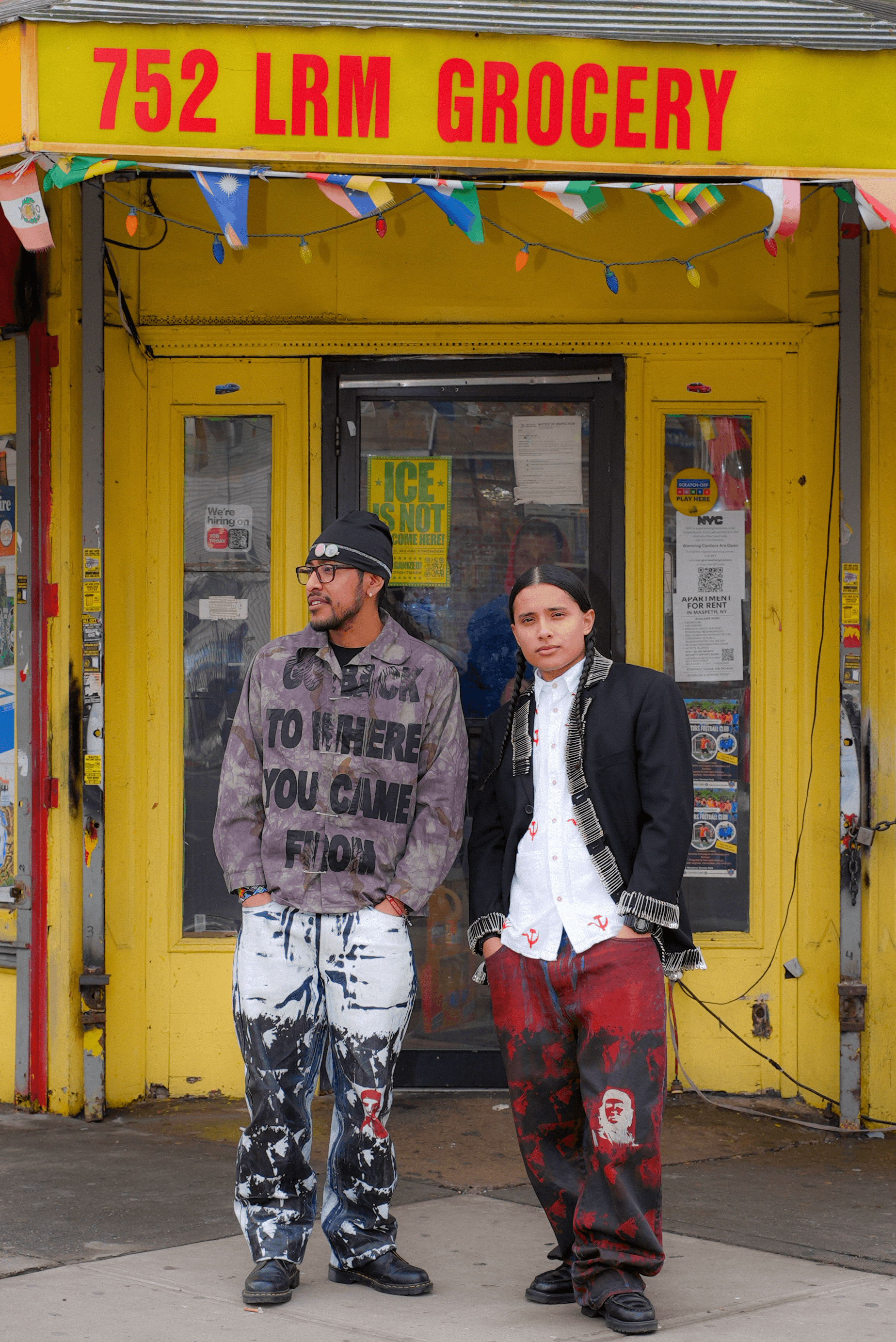
On a gray afternoon in Ridgewood, Queens, Victor stands beneath the elevated tracks near Myrtle–Wyckoff. The neighborhood hums with buses, dollar stores, and corner bakeries. It’s the kind of place where languages overlap and histories collide—Caribbean, Central American, South American, Indigenous, immigrant.This is where Victor wanted the photoshoot.
He moves easily between conversation and direction—adjusting lighting, explaining the symbolism behind a shirt, greeting people passing through the plaza. Fashion is the medium he works in, but what he’s building is closer to a cultural project.
His brand, Primer Rebelde de América, blends streetwear with history, politics, and Indigenous identity. The shirts are bold, confrontational, and often unsettling. Phrases like “Indigenous, Not Latino” or “American Holocaust” appear in stark type.For Victor, the clothing isn’t the product. The message is. As he puts it: the brand is just the vehicle.
Note: This interview was edited for clarity and length
Shadowbanned: What is Primer Rebelde de América?
Victor: The brand is the vehicle for the ideology. Originally I wanted to pursue writing and theater. I was classically trained as a theater actor and thought storytelling would be the path. But when I entered the acting world, it became clear those spaces weren’t ready to hold the kinds of stories I wanted to tell. The roles available were stereotypes. The deeper historical narratives weren’t there.So I asked myself: how else can I reach people?
I had already been working in fashion since I was about fifteen — first behind the camera and then professionally by 16 or 17. Fashion has something theater doesn’t: immediate access.
If you want someone my age to sit through a play or read a dense academic text, that’s difficult. Those spaces are expensive and often inaccessible. Fashion reaches people instantly. “The brand is the vehicle. The message is the destination."
“The brand is the vehicle. The message is the destination.”
S: You’ve described the clothing as a form of propaganda. What do you mean by that?
V: People hear “propaganda” and they get uncomfortable, but propaganda just means planting seeds. A shirt might say “Indigenous, Not Latino” or “American Holocaust.” Someone sees that walking down the street and thinks, “What the hell does that mean?”Maybe they go home and Google it. Maybe they will start reading. That’s the whole point. I’m not trying to lecture people. I’m not standing on a milk crate screaming ideology. I’m putting the idea in front of them so curiosity can take over. Once that curiosity starts, people begin discovering things on their own.
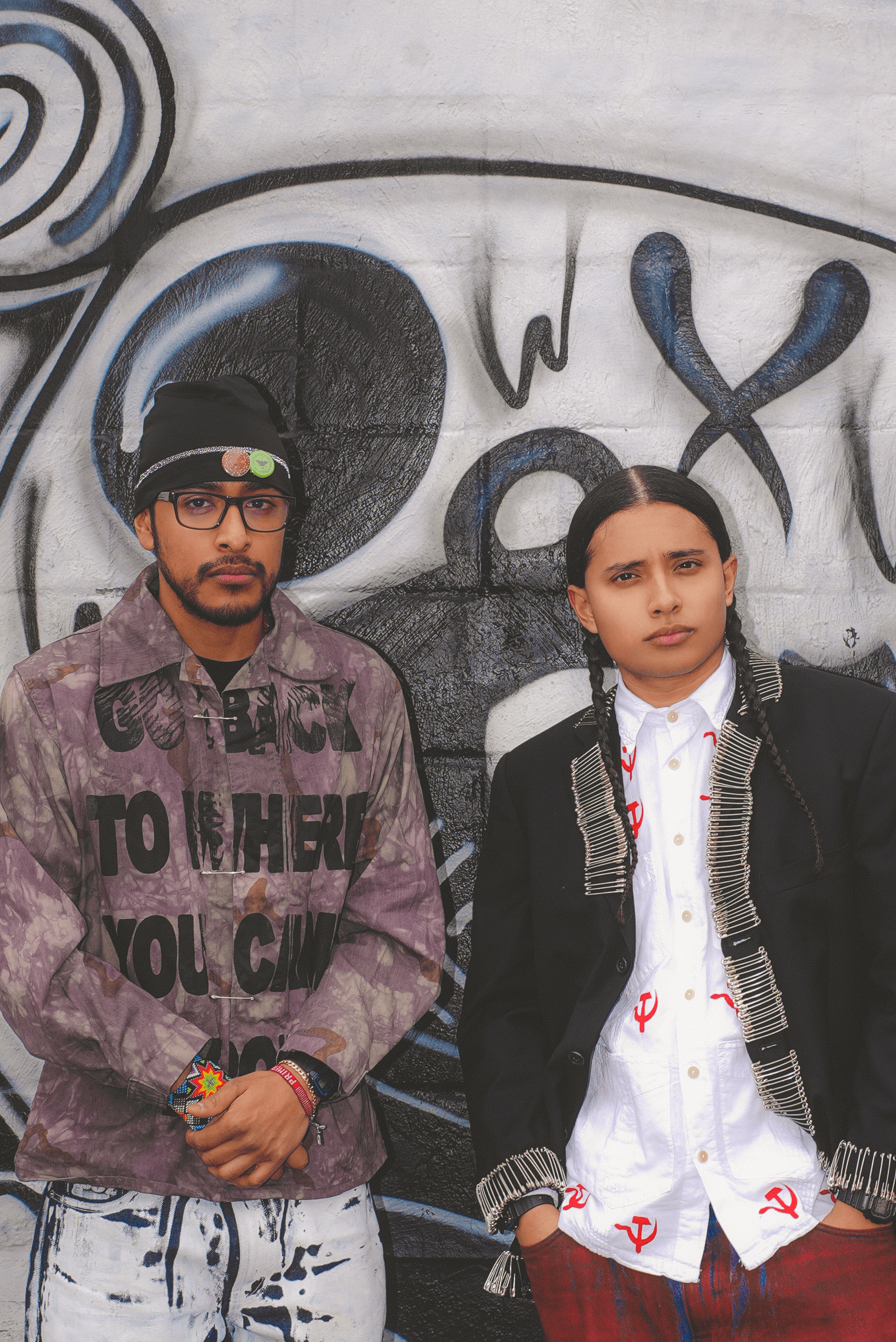
S: The name Primer Rebelde de América references a historical rebellion. Why that name?
V: It’s an homage to the first documented rebellion against Christopher Columbus, led by a Taíno cacique in the Caribbean.People often talk about Indigenous resistance in the Americas but overlook the Caribbean entirely. The Caribbean was actually one of the first places where colonization violently collided
S: A major theme in your work is rejecting the label “Latino.” Why?
V: Because the label itself was designed to flatten people.Historically the term Latino was introduced into the U.S. census in the 1970s. It lumps together dozens of completely different cultures and histories under one category. On paper it looks like unity. But in reality it erases identity. How does it make sense that Indigenous people in the Americas should primarily identify with the descendants of the people who colonized them?
“Latino was never meant to describe us. It was meant to simplify us.”
And at the same time, it’s also unfair to collapse Indigenous histories with the experiences of Africans who were kidnapped and enslaved and brought to the Americas. Those are distinct histories.These categories blur everything. “Latino was never meant to describe us. It was meant to simplify us.”
S: You’ve talked about reconnection with Indigenous identity as a form of healing, can you expand on that?
V: Across the Americas our people were taught to hate themselves.That shame didn’t happen naturally. It was built through centuries of colonization. Indigenous languages were suppressed, cultures were criminalized, and people were told their identities were inferior.If someone grows up believing that about themselves, how are they supposed to love themselves?And if people can’t love themselves, they can’t build solidarity with others. Reconnection is about undoing that damage. It’s about understanding who we are and where we come from.
S: You also argue that the borders of the Americas divide people who share history.
V: In reality the Americas are one land and our people share deeply connected histories.
The borders between countries — Mexico, Colombia, Venezuela, the United States — were created through colonial systems that divided people who had long-standing cultural connections.Recognizing that doesn’t erase local cultures or identities.It just acknowledges that many of us are part of a larger story.
S: Why does this conversation feel urgent right now?
V: Because our people are still under attack.ICE raids, deportations, family separations — none of this is new. It’s part of a long pattern that goes back to the conquest period. When people say my rhetoric is extreme, I ask them: what language should we use when families are torn apart or when migrants are treated like enemies?If anything, the situation means we need to multiply our efforts. Whatever we were doing five years ago isn’t enough anymore.
S: What pushed you personally to start the brand?
V: In 2019 there was a mass shooting at a Walmart in El Paso. A white nationalist murdered more than twenty people and left behind a manifesto talking about a supposed “Latin invasion.” At that point I had already been reconnecting with my Indigenous ancestry for several years. When that happened I remember thinking: What am I supposed to do?
Our generation has seen the systems behind everything. But sometimes seeing the system can make people freeze. Starting the brand was my response to that moment. It was my way of refusing to just watch.
S: Your work goes beyond clothing. Why is it important for you to organize events and community projects?
V: Community is the foundation. Last year we organized more than 10 events. One of the biggest was a performance at Myrtle–Wyckoff Plaza with Indigenous Enterprise, a group of world champion powwow dancers from Native communities in the U.S. and Canada. These are performers who dance on stages like the Sydney Opera House. But we brought them to Myrtle–Wyckoff so people from the southern diaspora in Queens could experience that culture directly. We’ve also done murals, portrait series, and fundraisers. One photography project recreated historical Native portrait styles but placed migrant communities from New York in those visual traditions.
The goal is always connection.
Video from their special performance at Myrtle Wycoff Plaza for Native American Heritage Month.
S: You’ve worked inside major fashion companies before. What did that experience teach you about how they view culture and community?
V: I sat in rooms with big budgets and global brands. I pitched ideas about mutual aid, community programming, free food events — things that would actually help people. Every time I was told no. Eventually I realized the issue wasn’t money. The money existed. The issue was intention. So I decided I needed to build something independently — even if that meant working blue-collar jobs to keep it alive.
S: What do you hope Primer Rebelde becomes in the future?
V: Ideally the brand becomes bigger than me. If I walked away tomorrow, the idea should continue. Because the point isn’t to build a personality or a celebrity brand. The point is to awaken people to their history. I always say the Latin peoples of the Americas are a sleeping giant. If even a fraction of us woke up to that history, it would change everything.
You can shop Primer Rebelde de América here.



.png)