
Hit Enter to Search or X to close
.png)
More than a year after it was internally released, the Democratic National Committee (DNC) unveiled its 2024 election autopsy report. Everyone — including the DNC — hated it, though for different reasons.
Among many issues with the clearly unfinished document, it didn't once cover the Biden Adminstration's genocidal actions against Gaza. This is despite polling like that from the Institute for Middle East Understanding (IMEU) Policy Project in January 2025 showing that the number one reason 2020 Joe Biden voters decided to choose someone other than Kamala Harris in 2024 was because of Gaza. I was one of them.
It also lamented that candidate Harris didn't distance herself more from her previous progressive positions on "transgendered" people, even though during an October 2024 interview with NBC she couldn't bring herself to say transgender people should have access to gender-affirming care, but that "we should follow the law."
And yet Blue MAGA and the online center-left are more upset with the actual left for Kamala's loss. Last April, liberal YouTube video essayist Contrapoints sarcastically tweeted, "Well I was told we didn’t need to vote because there would be a revolution if things got bad. So, I assume that’s happening? Any minute now." That was followed up with "Seriously where are the revolutionaries? Are they at brunch?"
Of course compared to Trump, a Harris presidency would've been relatively better. But what centrists and liberals fail to see as they mock a yet-to-be-realized revolution to overthrow Trump 2.0 is that no matter who is at the helm of American Empire, a revolution is still absolutely necessary.
Under Harris, pro-growth capitalists would've ensured global warming continued. As she said, we would've still had the "most lethal fighting force in the world" to brutalize the global south and ideological enemies.
After all, our imperial motherland across the pond got their Kamala during their last national election with Keir Starmer. Yet his government rushed in the "best pal" of Jeffery Epstein, Peter Mandelson, to become ambassador to the U.S., criminalized pro-Palestine speech harder than its Tory predecessors, and continues to strip rights from trans people.
Though I'm not going to yuck the yum of the Democractic Socialists of America (DSA) and I support a lot of the work their candidates do, there's plenty of reason to doubt that we can collectively realize a peaceful ballot-driven end to capitalism. So how should we think about elections, and where would a revolution arise from?
How Actual Revolutionaries Used and Viewed Elections
Electoralism, meaning the ritual of political campaign cycles that includes debating who you'd have a beer with, casting a ballot, then not thinking about it again for four more years, kills true political consciousness. However, elections can be one tool for ushering genuine revolution.
For example, the Bolsheviks intentionally leveraged parliamentarian elections from September to November 1917, even as they were taking power during the October Revolution. This wasn't an inside/outside strategy, i.e. getting electoral wins and building mass movements simultaneously to create reform. In the communists' view, parliament overall was a sham because it was always going to side with rich, not the people. But working people still saw it as a legitimate, so elections were a way to speak to the masses on why the institution should be smashed and a new, proletarian-controlled one should take its place. As such, revolutionaries like Lenin viewed electoral participation as non-negotiable in the lead up to what would become the October Revolution.
Around the same time in Germany, Rosa Luxemburg shared this view. Notably, she didn't think revolutionaries needed to win a majority, a key difference to what the DSA here advocates for. The point in Luxemburg's opinion wasn't to make gradual change until socialism was achieved. Instead, communist elected officials within a bourgeois government were there to help reveal the institution as inherently and irreconcilably against the working class' interests — so the masses could take on the historic task of dismantling it themselves and establish a new workers' state.
In other words, the key is using the current system's elections as one tool towards building political consciousness that illuminates why a new system is necessary and how voting alone will not get us there.
But this challenges many people's conception of democracy. As Thomas Sankara of Burkina Faso said to Claudio Hackin of Radio Havana Cuba in 1987, "Democracy is the people, with all their strength and potential. Ballot boxes and electoral apparatus in and of themselves don't signify the existence of democracy. Those who organize elections every so often and are concerned about the people only when an election is coming up don't have a genuinely democratic system. [...] Democracy can't be conceived of without total power resting in the hands of the people — economic, military, political, social, and cultural power."
Progress Towards Political Consciousness Isn't Linear
Revolution sounds far off, but the prospect was making ground in our not-so-distant past.
In February 1919, upwards of 100,000 workers joined a general strike in Seattle. According to The Nation at the time, this in part helped block weapons otherwise destined to overthrow the new socialist government in Moscow.
Seattle's mayor said later that year, "The so-called sympathetic Seattle strike was an attempted revolution. That there was no violence does not alter the fact. [...] The intent, openly and covertly announced, was for the overthrow of the industrial system; here first, then everywhere. [...] True, there were no flashing guns, no bombs, no killings. Revolution, I repeat, doesn't need violence. The general strike, as practiced in Seattle, is of itself the weapon of revolution, all the more dangerous because quiet. To succeed, it must suspend everything; stop the entire life stream of a community. [...] That is to say, it puts the government out of operation. And that is all there is to revolt-no matter how achieved."
If a politician said this today about any strike (we'll get to modern examples and the hope they carry), it would perhaps be seen as hyperbole. But because of leftist organizing, including electoral work that got Socialist Party of Washington candidates into city office who were expressly Bolshevik-style revolutionary, Seattle's mayor wasn't too far off from reality at that point.
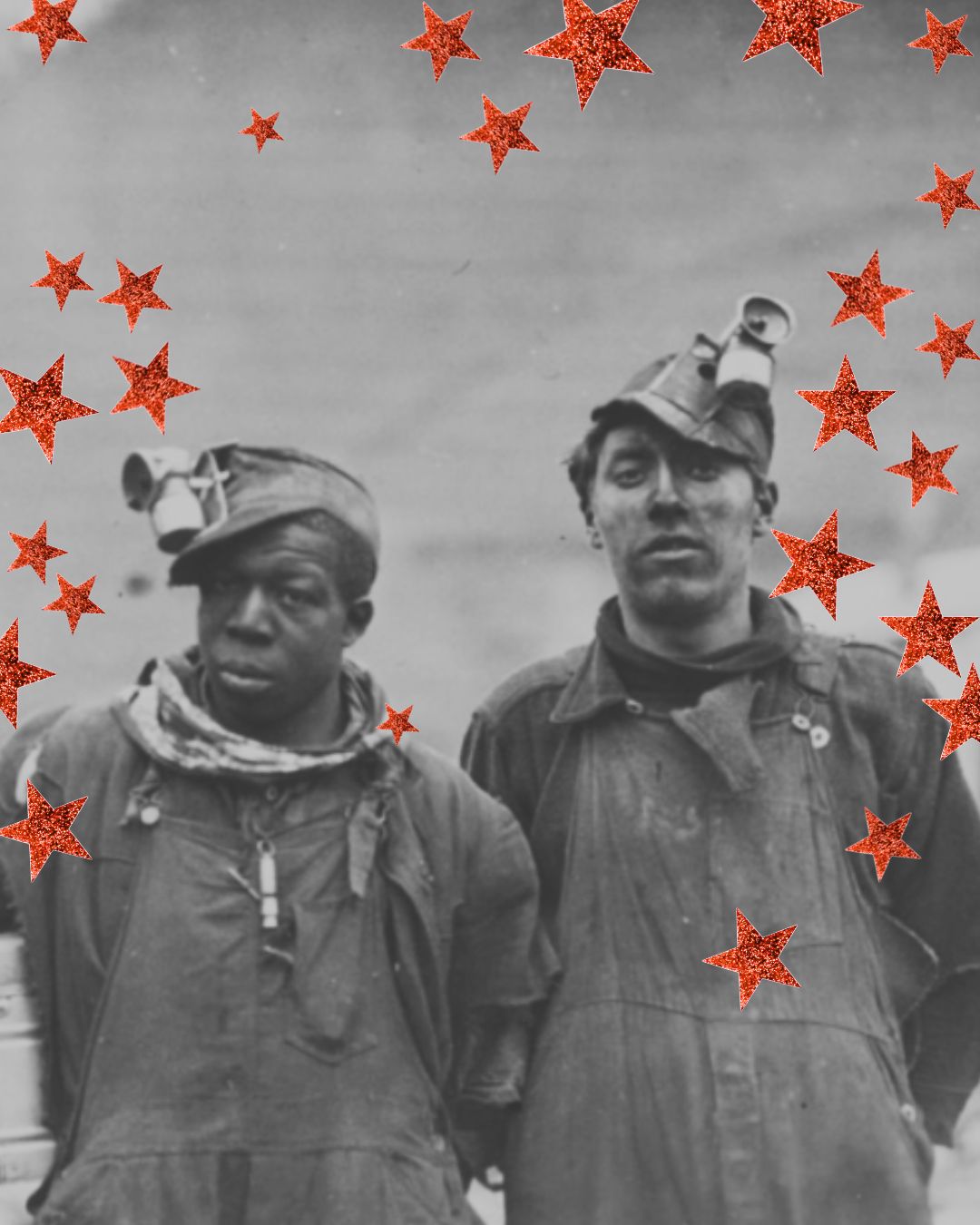
This post-WWI militancy picked up across the country, and it would reignite during the Great Depression. More strikes (including ones unauthorized by unions) and other direct actions, like when 500 Arkansas farmers who were devastated by the dust bowl marched into their local downtown demanding free food, which they would take from stores if not provided otherwise, compelled the government to tamp down revolutionary fervor with increased social services. In other words, people in power saw these movements as a threat to the system; the New Deal welfare state served to ultimately protect capitalists from workers taking back what was rightfully theirs.
Through decades of neoliberal austerity policies and privatization, what little crumbs the (mostly white) working class got during the New Deal have been stolen again. The lesson here is that the working class cannot be placated again; we must push until the capitalist system is completely destroyed and replaced with one that serves the masses.
Be Realistic, Demand the Impossible
The good news is that, whether Blue Maga sees it or not, the revolution is on its way. And it will continue if the we keep fighting, no matter who is at the helm of American Empire. Two major strike movements show a potential path.
First is the January 2026 general strike in Minneapolis, where at least 50,000 marched despite -9 degree weather to protest ICE and other federal immigration officers killing two U.S. citizens and kidnapping thousands of compas. Hundreds of other cities hosted their own solidarity actions.
Then there's the hunger and work strike at Delaney Hall that began on May 22, a concentration camp in New Jersey ran by private prison company GEO Group that has reportedly fed captives maggot-riddled and spoiled food, pepper sprayed strike organizers, and retaliated against family members waiting for loved ones to be freed, including by denying visitation.
Beyond strikes, there are also lefty and queer gun clubs that are getting like-minded folx skilled up. With so many alt-right 2A groups itching for a civil war for reliving their peepaw's failed confederate crusade, it doesn't hurt to learn a thing about pew pews, just in case.
And more workers are joining unions than over the previous decade and a half, even in the face of Trump Admin attacks against labor. Together, and with enough political education, these developments could get us closer towards the revolution.
Still, so-called pragmatists, like the CEO of AI data research company Outward Intelligence that is ran by Palantir and Harris Poll alumni, will try to convince us that moving to the center (read: right) is how we turn this country around. Pundits like Jon Chaitt at The Atlantic said Harris was simply too woke to win in 2024. And when the center convened for the WelcomeFest in June 2026, they asked election candidates to make a Promise to America that included real zingers like "We're capitalist, not socialist," and "We are mainstream, not extreme."
Electoral sore losers are clinging to normal. But in the era of polarization, we might as well get an actual left wing that will use elections to agitate towards revolution. Since the fascists aren't shy about using any means necessary, what good does being coy do for us?

.jpg)
.jpg)