
Hit Enter to Search or X to close
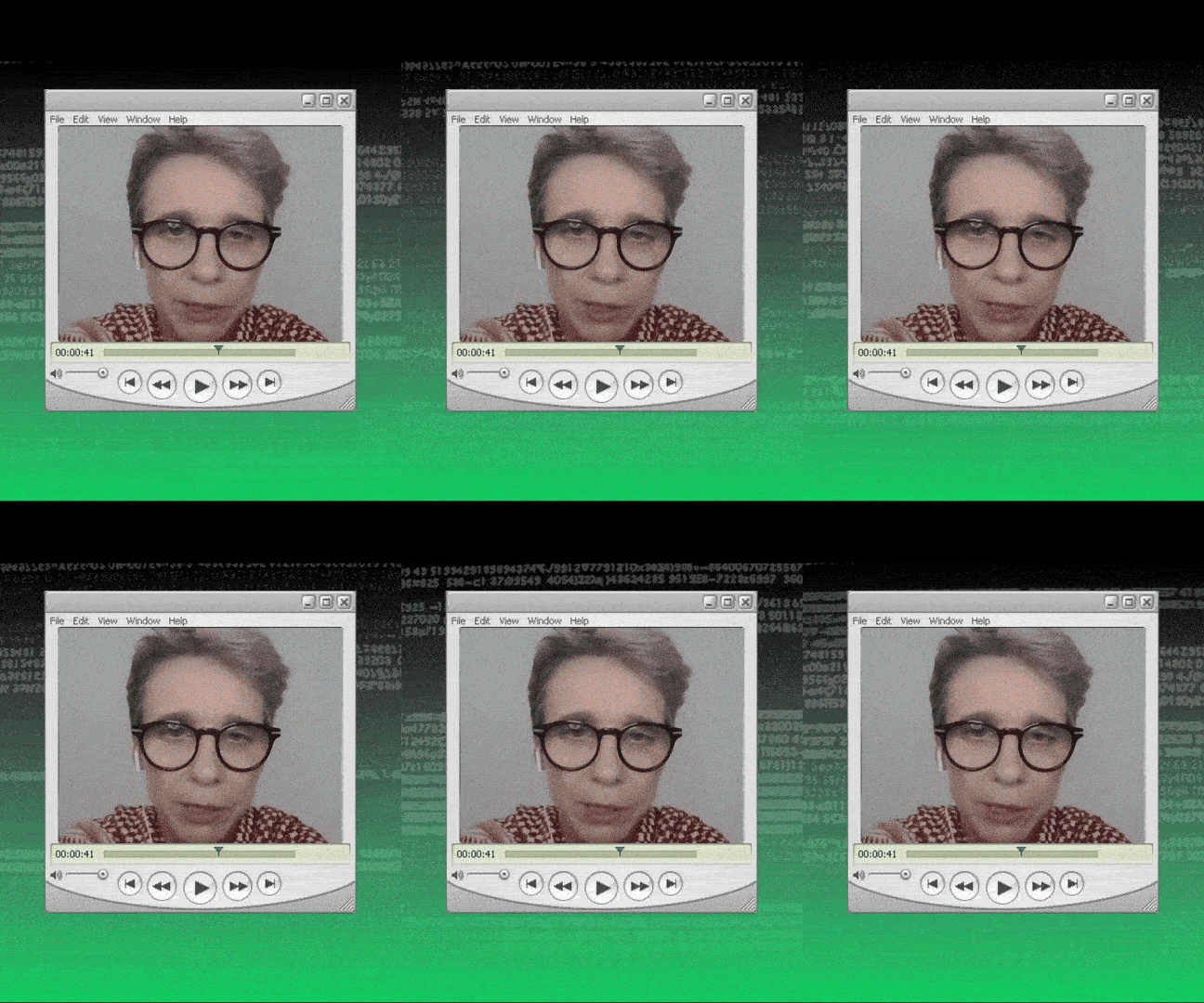
In this interview, Shadowbanned Magazine speaks with Cira Pascual Marquina, a Caracas-based political scientist, popular educator, and organizer, to explore the Venezuela that rarely reaches Western headlines, a society shaped by resistance, self-government, and collective struggle under conditions of blockade and war.
SHADOWBANNED: What aspects of Venezuela’s current political landscape do you think are most misunderstood or overlooked by U.S. audiences?
CIRA: This is a project based on a collective sovereign objective. Since the beginning of the Bolivarian Revolution, which formally began in 1999, participatory and protagonistic democracy has been at the core. But this is also a revolution with historical roots in Bolivarianism and in the struggle for emancipation. It’s essential to understand that Venezuela’s independence revolution was not solely about achieving formal independence from colonial power. After the encounter with the Haitian Revolution, the independence movement in what we now know as Venezuela aimed for social emancipation, not just an end to colonial domination.
Almost 200 years later, when Chávez called our process Bolivarian, it was precisely because he understood that social justice is not only about formal independence. It’s about independence with substance, with collective objectives of social transformation, with true popular sovereignty.
What we see in mainstream media regarding the Bolivarian Revolution is a cartoonish representation of the project, totally separated from its actual objectives of collective emancipation. It is often portrayed as an authoritarian project dependent on one person, when in reality it is the opposite. This is a deeply democratic project that operates on two spheres of democracy.
There is conventional democracy, or what we might call liberal democracy. In Venezuela, people elect the president, the National Assembly, and other representatives. Contrary to mainstream narratives, this is actually a very robust conventional democracy.
More importantly, there is another sphere of democracy: communal democracy, which I call substantive democracy. This is the type of democracy that can potentially change everything through assemblies and collective control of the means of production. Communes allow us to rebuild the world from the bottom up.
However, communes should also be understood as a national project, not an autonomist one. They link grassroots organization with revolutionary institutions.
After the fall of the Soviet Union, much of the left abandoned the idea of taking state power. There was a notion that you could “change the world without taking power.” Chávez broke with that temporary consensus. He reaffirmed that the working class must take power to transform society, and that is, in fact, a deeply democratic idea.
So to correct the mainstream narrative, it’s important to say this clearly: the Bolivarian project is democratic not only in the liberal sense—elections, institutions, constitutional order—but in a much deeper and more radical sense. At its core is the commune, a form of popular power where people govern their own territory.
And this communal project isn’t growing in spite of the state. It’s growing because it works hand in hand with a government that opens space for popular participation. That combination of state power and grassroots democracy is precisely what makes this process radical, democratic, and resilient.
SHADOWBANNED: Let’s talk about the communes. Can you explain the project and how they function?
CIRA: Communes are self-governments rooted in territory. We can say that communes walk on two legs. One leg is the assembly, a space of participatory and protagonistic democracy where people debate and make collective decisions. In assemblies, we discuss problems and think about solutions. That ranges from small issues like a neighbor playing music too loudly to larger questions such as how to promote communal education in a country under siege.
Formally, a commune is made up of several communal councils. Communal councils are territorial direct-democracy structures promoted by Chávez in 2006. However, communes, which emerged in 2009 as the roadmap for building socialism in Venezuela, are more than the sum of these councils.
This is where the second leg comes in: the economic one. In addition to assembly-based democracy, communes seek collective control of the means of production, which is essential for overcoming capitalism. These means of production are not privately owned, not state-owned, and not cooperatives. They are communal property.
Let me give an example from my commune, El Panal, in the 23 de Enero barrio of Caracas. We have several means of production, including a garment factory called Las Abejitas del Panal. The key point is how surplus is handled. It does not go to a capitalist, and it is not distributed individually among workers, although workers are paid for their labor. Instead, the surplus returns to the community, and the community decides collectively how to use it.
In our case, part of that surplus is allocated—by assembly decision—to fund our communal education project, the Pluriversidad Patria Grande, including paying professors’ wages. This is not a voluntary donation by the factory, but a collective social decision. That is what communal democracy looks like in practice.
Communes are spaces of political and economic transformation. I often say that communes are both the pathway and the goal of socialism in Venezuela. Through assemblies and collective care, new social relations emerge. Slowly, new relations of production are also taking shape.
That is why it is absurd—though not surprising—that mainstream media call Venezuela a dictatorship. What is more dictatorial than being forced to choose between Democrats or Republicans, which offers no alternative to the capitalist system? In electoral terms, people in the U.S. cannot choose outside the framework of capitalism and imperialism. So-called Western democracies are, in this sense, deeply limited.
SHADOWBANNED: There are constant claims in U.S. media about political repression and violence under the Maduro government. Is that the full picture?
CIRA: Frankly, for the people of the Global South, and I speak from a country where there's liberty and there's really no repression like that, I mean, there's still a police and there are institutions, but there's no repression that can be compared in any way, shape or form to the kind of repression that happens in the United States and that operates in relation to imperialism in the Global South. This is not only a misrepresentation, it's just a total lie. The repression, the violence comes from the United States.
Since the beginning of the Bolivarian Revolution, we can begin to count the actual aggression beginning at least in 2002 when there was a coup against Hugo Chávez that was supported by the U.S. People were killed during that coup and they were killed by the police, the policía metropolitana, which had not been transformed yet. So there was a set of lies woven around the coup.
And right now, the most recent instances of violence we would have seen were in the Guarimbas in 2014, 2017, and in the violence after President Maduro's victory on the 28th of July of 2024. Those three moments are moments of fascist violence from here, from Venezuelans, fascist Venezuelans who unleashed a very intense violence towards the people of Venezuela. The best known case is the burning alive of a person because he was a black person, a poor person and identified as a chavista. This was in 2017. So there's that history of violence and the gravitational center of violence is the opposition. Maria Corina Machado famously has called for the invasion of Venezuela, but she also has called for the sanctions. Sanctions are also a war, a war that doesn't blow bombs, but that kills tens of thousands.
The sanctions, which were basically unleashed by Obama, with Obama decree, "Venezuela is an unusual and extraordinary threat." Since that Obama decree that began to open the door for sanctions, the sanctions against the people of Venezuela have killed again, tens of thousands of people. So what we are currently living is an intensification of war. We have been living in a situation of war for a long time.
SHADOWBANNED: Can you talk about the opposition’s makeup and their support?
CIRA: The opposition has one central goal, dictated by the interests of the local oligarchy and their bosses in the U.S.: to destroy the people’s revolution, which is synonymous with toppling the Bolivarian government.
In terms of class composition, the oligarchy is entirely opposition. That does not mean, however, that there are no working-class people who align with the opposition. They are a minority, but they exist. Just as in the United States, some working-class people vote for those who represent their class enemies, the same dynamic exists here, though on a smaller scale.
Within the opposition, some sectors are openly fascist, particularly those represented by María Corina Machado. These sectors currently have little traction, as even Trump himself has acknowledged. Other opposition sectors have not fully broken from the conventional democratic system. They hold minority representation in the National Assembly. While they also aim to end the Bolivarian Revolution, they are not openly fascist, at least for now.
SHADOWBANNED: Venezuela’s economic contraction was among the deepest in modern history. How did sanctions concretely affect daily life?
CIRA: The sanctions regime began with the Obama Decree in 2014, but the hardest years were between 2016 and 2021. That was when shortages became widespread: long queues, empty shelves, and daily hardship.
Mainstream media focused on these images while blaming the government and systematically denying the central role sanctions played in producing the crisis.
It began in “light mode” with so-called targeted sanctions, which in reality affected the entire economy. When a minister is sanctioned, it impacts state operations, and that in turn affects the broader economy. Later, Venezuela was excluded from the international banking system. Then came full oil sanctions, both primary and secondary, imposed while a U.S.-backed figure was self-proclaiming president.
All of this produced a dramatic economic collapse. Tens of thousands of people died due to shortages of food and medicine. Venezuela has a rentier economy, and until then about 98 percent of its international revenue came from oil sales.
When production fell from nearly three million barrels per day to around 300,000, the impact was devastating.
SHADOWBANNED: Many in the diaspora minimize the sanctions. Why do you think that is?
CIRA: The first wave of migration from Venezuela came largely from the bourgeoisie. These were not people fleeing persecution or poverty. They were people with resources who opposed the revolution because they rejected a working-class government and the rise of popular power. Their politics aligned neatly with imperialist interests, which are classist, racist, and dispossessing.
Later, migration became overwhelmingly working-class. This shift directly coincides with the sanctions. The impact of sanctions generated such extreme poverty that many people were forced to leave.
By then, a dominant narrative was already established in mainstream media portraying Venezuela as a dictatorship. Migrants, often living in precarious conditions, leaned into this discourse because it offered protection, solidarity, and sometimes material advantages. In that sense, the pattern closely resembles what we’ve historically seen with the Cuban diaspora.
SHADOWBANNED: What lessons can be learned from Venezuelan communities about resilience and resistance?
CIRA: What U.S. imperialism has imposed on Venezuela is a form of collective punishment with two purposes: pedagogical and recolonizing. When imperialism punishes the Venezuelan people, it also sends a warning to other countries: don’t dare challenge the system, or your life will be made unbearable. At the same time, control over our oil remains a central objective, something Trump openly boasts about.
Nonetheless, the Bolivarian Revolution has not been defeated. One key lesson is the importance of taking and maintaining power. This is not an autonomist project. As a Global South country, Venezuela needs a state capable of defending its sovereignty, even after the enormous blow of January 3. Transformative politics must aim to win state power for the working class.
At the same time, power only benefits the majority when exercised with the people. In Venezuela, this takes the form of communes: real spaces of popular power that drive transformation from below. Because these spaces exist, Venezuelans do not primarily see themselves as victims, but as historical subjects of transformation.
This helps explain the response to the January 3 attack. Hundreds of thousands of people took to the streets day after day, demanding the return of President Maduro and Cilia Flores. You do not see that level of mobilization without a deep bond between government and people. And you certainly do not see it under an authoritarian regime.
The communes have created real cohesion rooted in territory, class, and collective purpose, working hand in hand with a government that promotes communal transformation.
SHADOWBANNED: What are your thoughts on Trump’s decision to recognize Delcy Rodríguez as acting president?
CIRA: What this really shows is that Chavismo is hegemonic. If the United States wants to buy Venezuelan oil, it must deal with the force that actually governs the country, and that is Chavismo, now represented by Delcy Rodríguez.
There is nothing “soft” about her. She is prepared for this responsibility. She has a long revolutionary trajectory and has always been a committed Chavista. We are in good hands.
In Venezuela, the people chose Nicolás Maduro in 2024. What happened on January 3 was horrific. Our president was kidnapped and our sovereignty was violated. But Venezuela’s government remains Chavista, and that is a victory.
That said, some concessions may be necessary in this moment, precisely because we want our president back and because we want to avoid further aggression.
History helps us understand this. In 1918, Lenin signed the Treaty of Brest-Litovsk, making major concessions to exit World War I. He was clear: if someone puts a gun to your chest, you hand over your money. That does not mean abandoning principles. It means surviving to continue the struggle.
Revolutions are not straight upward lines. There are advances and there are tactical retreats. This is one of those moments.
SHADOWBANNED: What practical forms of solidarity actually help? What should people avoid?
CIRA: First, you don’t need to be a Chavista or support the Bolivarian Revolution to be outraged by what just happened. Kidnapping a president, bombing civilians and military targets, and invading a country are clear violations of international law. Opposing this imperialist attack is a matter of basic humanity.
For those committed to collective emancipation, this moment also demands political education. Just as the enemy uses violence to teach through punishment, the left must respond by educating. What happened in Venezuela makes clear that the central problem in the world today is U.S. imperialism, which is openly colonial in Gaza and also colonial in its treatment of Venezuela. These are not separate struggles.
If working people in the Global North make this connection, they strengthen their ability to confront the common enemy. Another important element is recognizing that violence imposed on the Global South is now returning to the imperial core. The enemy of the Venezuelan people is the same enemy of the Palestinian people, and increasingly, of working people in the United States as well.
So what does solidarity look like? Take to the streets. Demand an end to sanctions. Stand with the Venezuelan people. Trust our government, because we do. Organize where you are. Use Venezuela as a pedagogical example to explain the world we live in and, when useful, talk about the communes.
Ultimately, we must build an internationalist movement capable of confronting imperialism everywhere. That movement must also be able to dream. If we fail to do that, it’s curtains. We are facing two intertwined forces: imperialism in decline and rising fascism. We must struggle together.
SHADOWBANNED: Lastly, what gives you hope about Venezuela’s future?
CIRA: What gives me hope is that despite being attacked in an unprecedented way, people are not demoralized. On the contrary, there is a strong fighting spirit. People understand what must be done: take to the streets, demand the return of the president, defend the Chavista government, and continue building communes.
That tells me something very important. Chavismo knows its objective, and the people understand their role in this historical moment.
If people abroad truly want to understand what is happening in Venezuela, they should not rely on secondhand narratives. Follow the statements of Delcy Rodríguez. Read communications from the Ministry of Foreign Affairs. And most importantly, observe what is happening in the streets. The people are mobilized, committed, and have not abandoned their project.
There is hope in Venezuela. And precisely because there is hope, because there is a sovereign popular project that refuses to surrender, that is why we were attacked. January 3 was a tactical victory for the enemy, but the strategic victory will be ours.

.jpg)
.jpg)