
Hit Enter to Search or X to close
History doesn’t repeat itself, but here at Columbia University and Barnard College, it sure does rhyme. Nearly sixty years after Columbia’s first mass suppression of student protestors, leading to 712 arrests, we are witnessing yet another sickening assault on student health, safety, and liberty.
On February 23rd, after pro-Palestine students disrupted a History of Modern Israel class at Columbia, two Barnard students were expelled. Three days later, in demand of student amnesty and the reversal of both expulsions, students at Barnard organized a nearly seven-hour-long sit-in outside Dean Leslie Grinage’s office in Milbank Hall. Though the students left the sit-in with a negotiations meeting scheduled for the next day, Barnard administrators changed the terms of this meeting an hour before this meeting was to take place, demanding that the protestors take off any masks or face coverings. Later, during a March 5th sit-in at Barnard’s Milstein Center, the New York Police Department arrested 9 protestors, allegedly responding to a bomb threat.
These already quite disturbing events were the writing on the wall for Columbia and its many student organizers — on Saturday, March 8th, 2025, Mahmoud Khalil, a lead negotiator for Columbia University Apartheid Divest (CUAD), was abducted by a plainclothes ICE officer inside his dorm building. That Monday, the 10th, those students who had not yet been suspended, expelled, or detained received an email from then-President Armstrong titled “Leading through this challenging time”, in which she wrote (verbatim): Columbia University exists to serve the United States. Of course, this statement framed Columbia’s service to be that of providing knowledge to the world, but on the 13th, Columbia received a letter from the federal government outlining conditions for “continued financial relationships with the United States government”, immediately capitulating to these demands and once again bringing into question which knowledge Columbia exists to serve American interests by disseminating.
Mahmoud Khalil is not the Trump administration’s only target; in fact, at least eight students have been confirmed as ICE targets, and at least 300 international students have had their student visas revoked — all for opposing Israel’s murder of over 50,000 Palestinians in Gaza. On Thursday, March 27th, as students processed Columbia’s introduction of measures including forced unmasking and identification of protestors, appointment of 36 officers with the ability to conduct arrests on any Columbia property, and expeditement of the launch of Columbia’s Tel Aviv center, a town hall was scheduled to take place at 6:30PM, featuring a panel of “University Senators and Senior Administration”. Both as a concerned Columbia student and a writer advocating for Palestinian liberation, I deemed it important to attend the town hall and speak with other concerned peers about how to combat Columbia’s increasingly Orwellian concessions of freedom and autonomy.
I asked one student waiting to be admitted into the town hall what strategy, in her opinion, students should be adopting to protect their freedoms and the freedoms of others.
"Going to town halls, for one, and talking with students. Before we began all my classes, I asked the professor if they had any updates, as did my fellow students. So I think communication with other students is really big, just so that we’re all in the know. "
The student also expressed how the draconian punishments imposed by both the University and the Trump administration have left her searching for a clearer answer
"It’s really hard right now to think of things to do, though, because there’s such punitive [measures]." Later, I spoke to a student organizer, posing the same question."I support the idea of a tuition strike because the administration has made it evident that they only care about money."
.png)
Striking, in its various forms, has been on the minds of many students and workers at Columbia. Seven hours before the town hall, the Student Workers of Columbia, Columbia Postdoctoral Workers, Teacher’s College Student Workers, and the Technical, Office, and Professional Workers of Columbia presented their demands to the Columbia administration at a rally on the Low Steps. In a letter addressed to Armstrong and Board of Trustees Co-Chairs David Greenwald and Claire Shipman, the labor organizations urged them to meet the demands, including working to secure the release of Mahmoud Khalil, reinstating suspended or expelled students and workers, and probiting ICE officers to enter campus or other university properties without a warrant, by April 8th, 2025. Grant Miner, United Auto Workers Local 2710 President, was expelled from Columbia for his activism on the day before the union was set to begin bargaining for their next contract, spoke at the rally.
This is all to say that Columbia sees its student workers as a viable threat, and thus, a strike wouldn’t be unfathomable. However, the student acknowledged that some students disagree with the idea of a tuition strike, especially since it introduces the students’ parents as a deciding factor. She stressed the importance of a unified front amongst Columbia students, frustrated with student activists not being on the same page with each other and stating (roughly): we need to send one message.
Both students I interviewed echoed a sentiment prevalent both in Columbia’s student movement and the broader sphere of leftist organizing: Unity is more important now than ever. The people have spoken, and they have grown tired of constant public discourse and infighting taking the place of a vital fight for human rights everywhere. Of course, this is easier said than done; due to the prevalence of “lesser-than-two-evils”-esque neoliberalism and its blatant complicity in the Palestinian genocide, it is truly difficult to discern who is and isn’t in the fight with us. And yet, even these are questions we cannot answer when we walk alone.
The town hall itself arguably raised more questions than answers, with panelists stating that there was no mask ban and the policy had not changed from what it was before. More than anything, the town hall served to remind us students about the numbers that we possess. The sheer mass of students who showed up to a town hall announced the same day to hold the administration accountable for the doxxing, harassment, and policing it has heartlessly subjected its students to is a sign that these students are well on their way to establishing that unified front that is so vital for accomplishing substantial change.
The very next day, it was announced by Greenwald that Armstrong would no longer be Interim President, with Shipman to take her place. What comes next for students and workers at Columbia, amidst the revolving-door cast of Columbia officials in and out of the presidential role, is not fully clear, but it is evident that our fight for freedom, from Columbia to Palestine, is far from over.
The referendums, rallies, and student organizations that have come into existence at Columbia in the past year all go to show the sheer numbers the pro-Palestine movement at Columbia has amassed. The problems lie in unifying these numbers.
One of these problems is the constant, ever-increasing surveillance — one that comes in many forms from many sources. Of course, Columbia’s unmasking policy, identification and disciplining of student protestors, employment of faculty engaging in the doxxing of students, and the omnipresent gaze of “Public Safety” officers are all large contributors to the surveillance students must face at Columbia. However, there is also the fact that NYPD is the largest police department in the world, and the federal government continues to investigate any and all vocally pro-Palestine students in the hopes of arresting, detaining, or deporting them.
Not all of the issues faced by the Columbia student movement are external. Due to the number of people seeking to be involved to some capacity in the fight for divestment and amnesty, there can arise many operational disagreements. For example, some may want to opt for a more concrete chain of command, and others may want to spread power more horizontally; this is a divide that has, on a greater-scale level, hampered organizing and mobilization within the entire left. There is also the matter of how these disagreements are handled — how public or private should a conflict be? In October 2024, a group of Palestinian student organizers at Columbia disassociated from Columbia University Apartheid Divest (CUAD), formed their group, the Palestine Solidarity Coalition, and announced it in a Columbia Spectator op-ed. In the weeks following the split, there was arguably more discourse on whether the split was unnecessarily public than actual organizing happening. However, the warning signs of lost momentum in CUAD actions had already been present at the start of that semester.
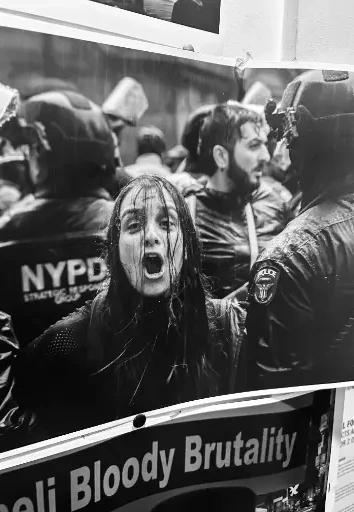
Despite these minor issues, the students persist. Just last week on April 2, 2025. Jewish students chained themselves to gates at Columbia University Wednesday in support of Mahmoud Khalil, the former Columbia student protest leader now in an ICE jail in Louisiana. Students continued their action into the early hours of this morning through the rain, even after Columbia security and New York police arrived on the scene to cut the chains and forcibly remove protesters.
Despite both operational and external issues, it is my most sincere belief that the students will not be stopped. With the amount of continued action and collaboration between various student groups, it is evident that the students refuse to be trapped in gridlock again. Only one question remains: what comes next? Is it a strike, an encampment, or some other action entirely that is most wise for these students to organize? While the answers to these questions are not entirely clear, what’s indisputable is that students of all backgrounds are working to approach them with unity, urgency, and solidarity — both with the Palestinian people and with each other.
.png)

.jpg)
.jpg)