
Hit Enter to Search or X to close

What does it mean to watch a genocide through a screen? Long before TikTok feeds, livestreams, and viral war footage transformed the way violence is consumed, Jean-Luc Godard was grappling with a similar question. In Notre Musique, his fragmented 2004 meditation on Palestine, colonialism, and historical memory, the legendary filmmaker examined not only how wars are represented, but how images themselves become entangled in systems of power. Two decades later, as atrocities unfold in real time across our phones, Godard's reflections on cinema feel startlingly contemporary, offering a lens through which to understand the politics of visibility in the digital age.
“The distinguishing features of film lie not only in the way in which man presents himself to the camera but in how, using the camera, he presents his surroundings to himself.”— Walter Benjamin
When Harmony Korine called IShowSpeed “the new Tarkovsky,” he wasn’t making a serious comparison so much as detonating a provocation inside cinema itself. The statement was engineered for outrage, but it still forces a real question: what is cinema now?
Conservative answers tend to define cinema through limitation — runtime, theaters, distribution, prestige. But these are industrial categories, not artistic ones. At its most basic level, cinema is the organization of moving images through time. In that sense, livestreaming belongs to the same lineage as film and television: not the death of cinema, but another mutation of it. No filmmaker wrestled more intensely with cinema’s changing relationship to history, violence, and image-making than Jean-Luc Godard. Though his early films transformed modern cinema, his later work remains comparatively neglected, despite containing some of his most radical thinking about the medium’s political and moral failures. No late work feels more urgent today than Notre Musique (2004), Godard’s fragmented meditation on colonialism, Palestine, historical memory, and the image itself.
Much of Godard’s career can be understood through his changing relationship to America. Like many filmmakers of the French New Wave, he emerged out of a generation raised on Hollywood cinema. American films flooded postwar France following the Blum-Byrnes agreements, shaping the tastes of young critics who would later become directors themselves. Godard’s Breathless (1960), with its gangster iconography and American pop references, was in many ways the ultimate expression of this cultural influence.
But admiration gradually became antagonism. By the late 1960s, Godard had rejected commercial cinema almost entirely, turning instead toward an openly Marxist and anti-imperialist filmmaking practice. Cinema, for Godard, was never politically innocent. Hollywood did more than entertain audiences; it helped shape the way the world was imagined. The camera does not simply serve as a document of record, it is itself a coconspirator.
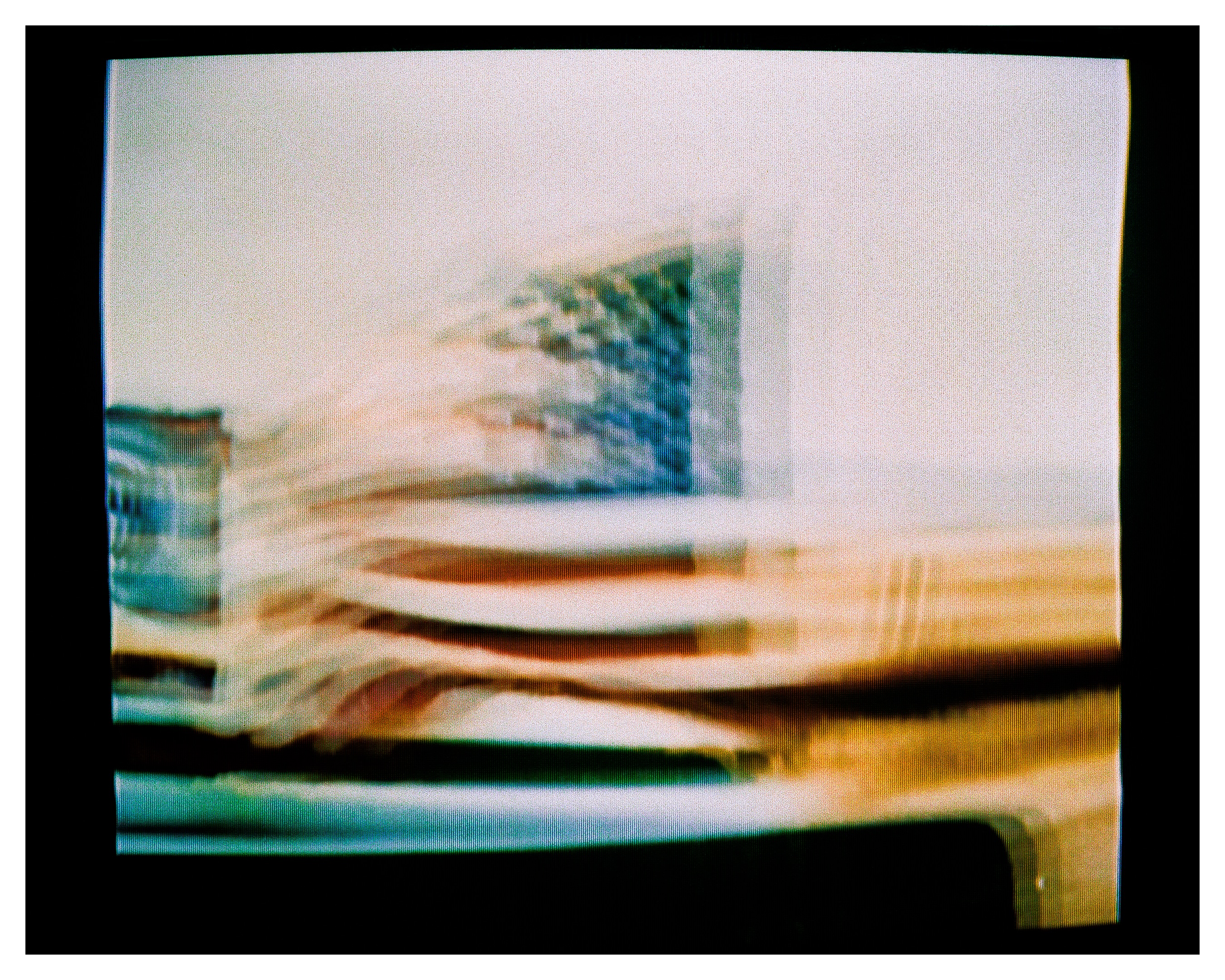
This tension animates Notre Musique. The film opens with a barrage of distorted war footage assembled from documentaries, newsreels, and fiction films. Hollywood westerns depicting the colonization of Indigenous peoples collide with real images of bombings and military violence. Fiction and documentary dissolve into one another through montage, collapsing any stable distinction between representation and reality. Beginning in this way, Godard offers a cinematic reiteration of his famous observation that “you can either start with fiction or with documentary, but whichever you start with, you will inevitably find the other.”
The line cuts directly to one of Godard’s central concerns: the asymmetry through which colonial violence becomes visible.
Set during a literary conference in Sarajevo, the film follows Israeli journalist Judith Lerner as she searches for a language of reconciliation around Israel and Palestine.At the center of the film is a conversation between Lerner and Palestinian poet Mahmoud Darwish, observed silently by an Indigenous American man seated beside them. The scene unfolds quietly, but it contains the film’s central political geometry. “Do you know why we Palestinians are famous?” Darwish asks Lerner. “Because you are our enemy. The interest is in you, not in me.” The line cuts directly to one of Godard’s central concerns: the asymmetry through which colonial violence becomes visible. Palestine exists in the Western imagination largely through its relationship to Israel, just as colonized peoples throughout history have been rendered legible only through the perspective of empire. Throughout Notre Musique, Godard returns repeatedly to the idea that truth has two faces. This becomes most explicit during the film’s lecture sequence, where he uses the cinematic shot/reverse-shot to argue that every image contains another image looking back at it. The shot and reverse-shot are not opposites but two inseparable halves of the same reality. This idea transforms the scene at the table. Darwish and Lerner appear at first to embody the two faces of the Israeli-Palestinian conflict. But the silent Indigenous observer complicates the arrangement. He is not outside the conversation. He is its reverse-shot. By looking at him, we see the result of a successful colonialism, one that has all but closed the door on reconciliation.
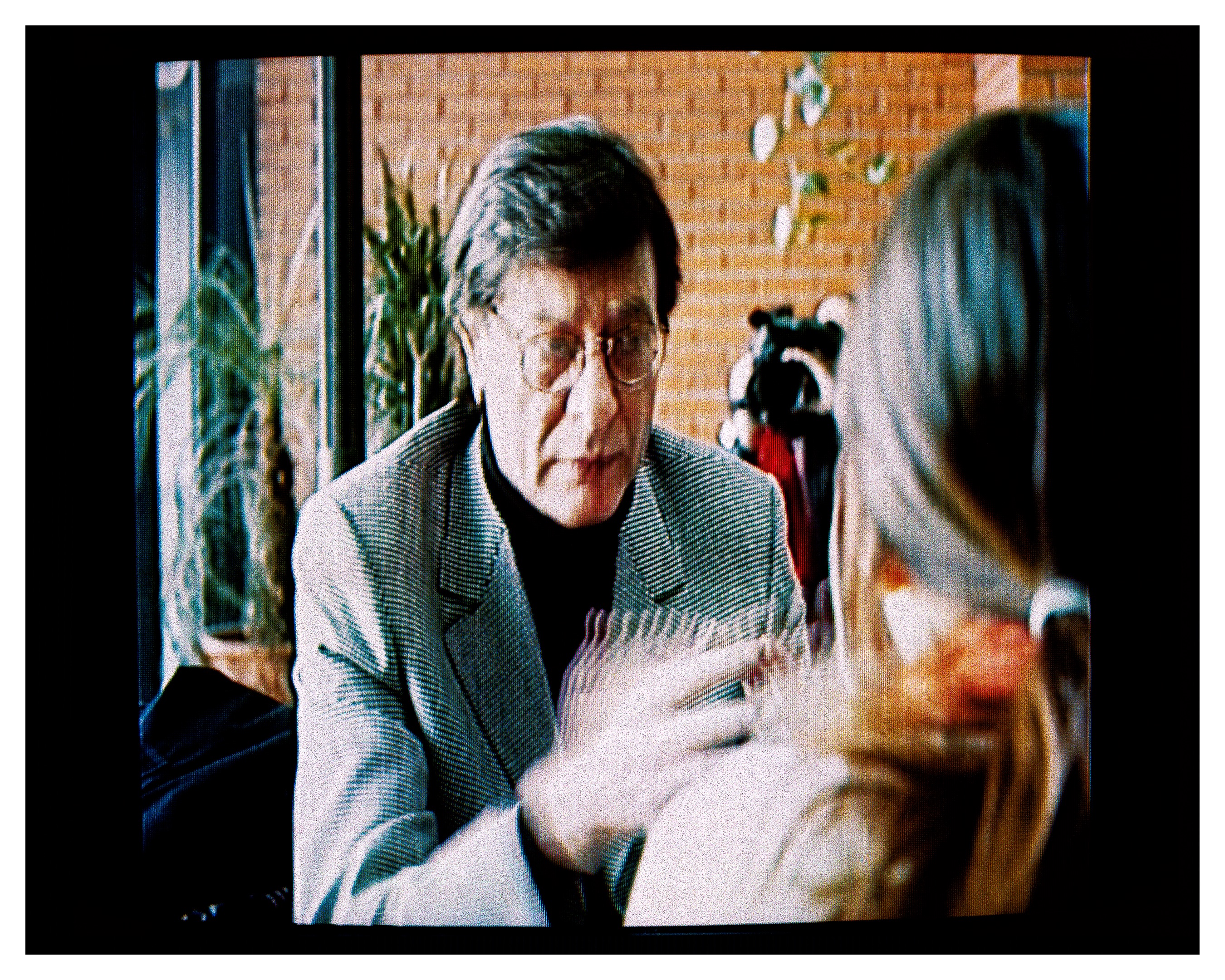
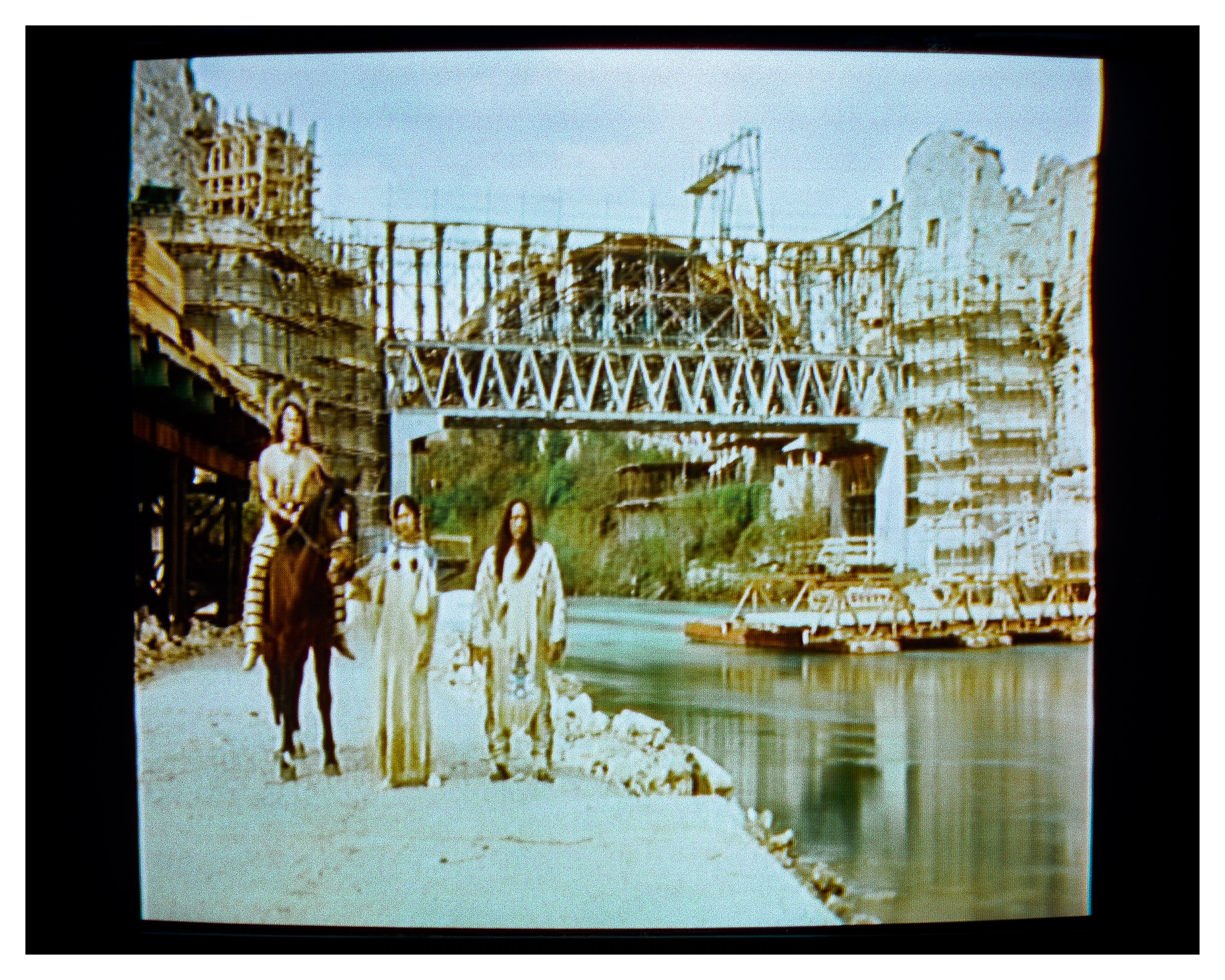
The victim of the American colonial genocide bares witness to a discussion between occupier and occupied. Along the Neretva River, Godard stages one of the film’s clearest images of historical reconciliation through the reconstruction of the Mostar Bridge. Destroyed during the Bosnian War, the bridge becomes more than architecture; it becomes a material record of violence. Before reconstruction began, each surviving stone was catalogued so that its original position could be traced. Displacement had to be mapped before repair could occur. Godard treats this process as a political metaphor. Godard treats this process as a political metaphor. Reconciliation is not achieved through abstraction or appeals to unity but through an accounting of rupture. Godard suggests that future reconciliation must take stock of how far the shrapnel of colonialism sent people from the land. This scene ends with three silent Indigenous North Americans standing in front of the bridge, looking directly into the camera. The image lasts only moments, but it reorganizes the film’s entire historical framework. Bosnia, Palestine, and North America collapse into the same colonial continuum.
“Colonialism operates through the inverse process. Rather than attaching meaning to land, it strips meaning away. The Zionist slogan “a land without people for a people without land”
He describes cinema as “an art of the ever-too-late,” a medium that arrived only after catastrophe had already completed itself.
For Godard, the problem was not simply that cinema failed to prevent fascism, but that the image itself became entangled in systems of power, spectacle, and historical amnesia. The concentration camps entered cinematic consciousness only after liberation, transformed almost immediately into representation, archive, and narrative. The image recorded horror, but only once horror had already become history.
This anxiety shadows Notre Musique. The film constantly asks what it means to represent atrocity after the fact, and whether images can do anything besides document ruins.These questions culminate during Godard’s lecture sequence on the shot/reverse-shot. Using frames from His Girl Friday, Godard argues that cinema’s most basic structure already contains a philosophical proposition: every image implies another image outside itself. Meaning emerges not from isolated frames but from their relation.
He then juxtaposes two photographs from 1948: Jewish immigrants arriving by boat to Palestine, and Palestinians driven from their homes during the Nakba. His description of the first image is inline with the story that Zionism tells of a Biblical connection to a promised land, this smokescreen for colonization is immediately subverted by the reality of the second image: a people have been violently displaced and pushed from their land.
Godard is not just comparing two photographs here.. He is exposing how historical meaning is constructed through narrative framing. One image becomes redemption; the other becomes disappearance.
Godard then retells an encounter between theoretical physicists Werner Heisenberg and Niels Bohr. On a walk, they approach Kronborg Castle. Bohr says “isn't it strange how this castle changes as soon as one imagines that Hamlet lived here?” While no material difference has occurred, the meaning of a place is transformed by the story we tell about it.
Colonialism operates through the inverse process. Rather than attaching meaning to land, it strips meaning away. The Zionist slogan “a land without people for a people without land” functions precisely through this logic: Palestine must first be emptied symbolically before it can be occupied materially.
This is why the Indigenous figure remains so important throughout Notre Musique. He silently embodies the endpoint of successful erasure. His presence reveals the historical future embedded inside the Palestinian present.
By the film’s conclusion, Godard leaves behind any simple faith in cinema’s emancipatory power. Yet he also refuses pure pessimism. A question is posed during the lecture:“
Can the new little digital cameras save cinema?”Godard never answers.
Two decades later, the question feels unavoidable. Nearly every person now carries a camera capable of recording and distributing images instantly. The monopoly once held by states, studios, and broadcast institutions has fractured. Over the last several years, the world has witnessed atrocities transmitted in real time through phones, livestreams, and social media feeds.
And yet the crisis Godard identified remains unresolved. Images circulate endlessly, but circulation alone does not necessarily lead to action. Cinema has not disappeared into the digital age; it has dissolved into everyday life. The moving image is now constant, decentralized, and ambient.
Still, this transformation also contains political possibilities that did not exist under older cinematic systems. Digital technology has lowered barriers to production while weakening traditional gatekeepers of representation. The image can now move outside the institutions that once controlled its distribution.
In a 2011 interview, Filipino filmmaker Lav Diaz described digital cinema as a potential rupture from the “feudal set-up” of traditional filmmaking structures. For Diaz, the importance of digital technology was not aesthetic but political: access itself could become revolutionary.
Godard leaves the future of cinema unresolved because the question is ultimately larger than cinema alone. The problem is not simply what images show us, but whether we remain capable of recognizing ourselves within them.


%20(1).png)

.jpg)
.jpg)