
Hit Enter to Search or X to close
%20(1).png)
Every June in the United States, major media outlets and political pundits unleash a familiar barrage of anti-China propaganda, on top of the everyday China bashing that never really stops. The exact framing has shifted over the years, but the core story has remained largely the same: on June 4, 1989, after weeks of student-led demonstrations, the People’s Liberation Army (PLA) entered Beijing’s Tiananmen Square and carried out a brutal massacre of unarmed, peaceful “pro-democracy” protesters, leaving hundreds, maybe thousands, dead. In the Western imagination, this alleged slaughter has come to symbolize everything supposedly inherent to Chinese communism: contempt for freedom, hatred of democracy, and a willingness to crush any challenge to state power with bloodshed.
The problem is that this story, at least in its most iconic form, is not true.
Despite its fictional status, the Tiananmen Square “massacre” narrative remains politically useful. It offers the Western capitalist class a ready-made moral fable, one that can be invoked whenever it becomes necessary to demonize the People’s Republic of China (PRC) and cast suspicion on its ongoing socialist development, especially in the context of Washington’s new Cold War. Yet over time, a striking number of mainstream Western journalists and observers have openly rejected the massacre narrative, including Jay Mathews, Richard Roth, Graham Earnshaw, Eugenio Bregolat, Gregory Clark, and James Miles.
One of the clearest repudiations came from Jay Mathews, who covered the 1989 protests as Beijing bureau chief for the Washington Post. In 1998, nearly a decade after the events, Mathews published a controversial Columbia Journalism Review article titled “The Myth of Tiananmen.” In it, he lamented that “many American reporters and editors have accepted a mythical version of that warm, bloody night,” referring to June 4, 1989. After surveying how major U.S. newspapers had helped proliferate the massacre story, Mathews arrived at a blunt conclusion: “The problem is this: as far as can be determined from the available evidence, no one died that night in Tiananmen Square. A few people may have been killed by random shooting on streets near the square, but all verified eyewitness accounts say that the students who remained in the square when troops arrived were allowed to leave peacefully. Hundreds of people, most of them workers and passersby, did die that night, but in a different place and under different circumstances."
He also traced the likely origins of the myth, pointing to one especially influential account first published in the Hong Kong press, in which a Qinghua University student described machine guns mowing down students in the middle of the Square. That account spread rapidly, even though it was challenged almost immediately. As Mathews noted, Times reporter Nicholas Kristof disputed the report the very next day, but his correction ran low in the paper and failed to stop the narrative from taking hold.
Mathews did not spare himself, either. Looking back at his own coverage, he admitted that he too had repeated references to a “Tiananmen massacre,” not because he had seen one, but because the phrase had become a kind of shorthand. His confession is revealing not just as a personal reckoning, but as a glimpse into how easily journalistic myth can harden into accepted historical truth.
BBC reporter James Miles later made a similar admission, acknowledging that he had “conveyed the wrong impression” and that “there was no massacre [in] Tiananmen Square.” According to Miles, protesters who remained in the Square when the army arrived were permitted to leave after negotiations with martial law troops.
Richard Roth, then a CBS correspondent in Beijing during the protests, was even more direct. In a later piece bluntly titled “There Was No ‘Tiananmen Square Massacre,’” Roth recalled what he saw while being transported through the Square in a military vehicle just after dawn. There were troops, tanks, and armored personnel carriers, he wrote, but no bodies, no wounded, no ambulances, and no medical personnel—nothing to indicate that a massacre had recently taken place there.
By then, mainstream Western language had already begun to shift. References to a “massacre” increasingly gave way to words like “crackdown,” a subtle but meaningful change that reflected the growing difficulty of sustaining the original claim in such absolute terms.
Former Australian government official Gregory Clark took up the issue in a Japan Times op-ed titled “The Birth of a Massacre Myth.” Clark cited Mathews’s work alongside testimony from Reuters reporter Graham Earnshaw, protester Hou Dejian, and Spanish ambassador Eugenio Bregolat, all of whom challenged the conventional narrative. Bregolat made a point that remains devastating in its simplicity: Spain’s TVE television crew was in the Square at the time. If a massacre had occurred there, they would have seen it and recorded it.
That absence matters. It is hard to overstate how strange it is that one of the most widely believed atrocity stories of the late twentieth century rests on such weak visual evidence. There is no photographic or video documentation of the supposed massacre in Tiananmen Square itself, despite the scale of carnage that Western retellings ask us to imagine. Earnshaw and Hou, both present when the Square was cleared, likewise reported no such bloodbath.
There is also corroboration from leaked U.S. embassy cables. One cable relayed the account of Chilean diplomat Carlos Gallo, who watched the military enter the Square and reported that he did not observe any mass firing into crowds, though sporadic gunfire could be heard. He said many of the troops entering the Square were armed only with anti-riot equipment, backed by armed soldiers, and that students and civilians had gathered around the Monument to the People’s Heroes as control of the perimeter was consolidated. Wounded people, including some soldiers, were brought to the Red Cross station, but Gallo’s account again does not describe a massacre in the Square.
So once the mythology is stripped away, the real question becomes unavoidable: what did happen in Beijing in the final chapter of the 1989 protests?
What happened was not a peaceful tableau of students being machine-gunned en masse in the Square, but a much messier and more violent confrontation across parts of the city. As political commentator and socialist organizer Brian Becker wrote in 2014, “What happened in China, what took the lives of government opponents and of soldiers on June 4, was not a massacre of peaceful students but a battle between PLA soldiers and armed detachments from the so-called pro-democracy movement.”
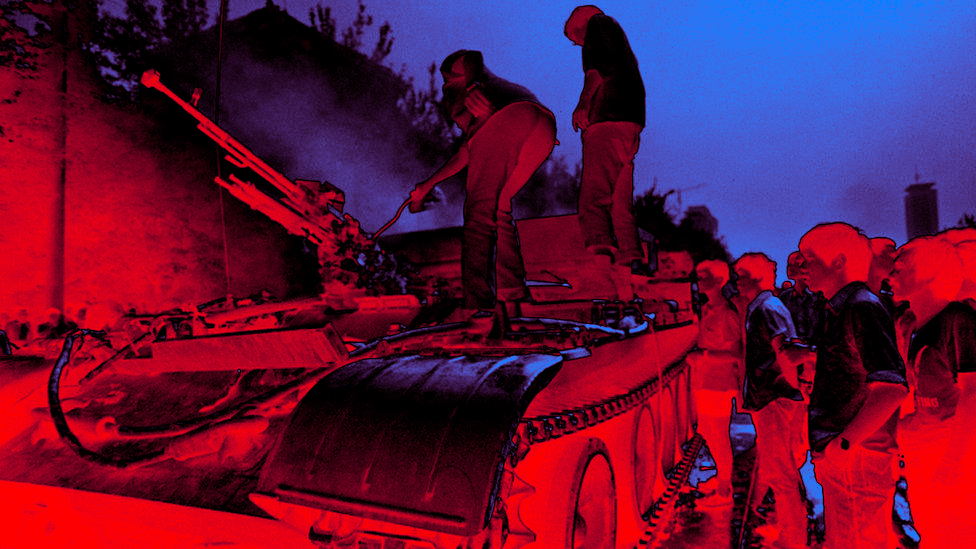
Mick Kelly put it even more bluntly, writing that “[t]here was in fact a rebellion, which was counter-revolutionary in nature, that was eventually put down by military force.” The unrest included urban warfare between PLA troops and rioters who had seized military vehicles, stolen rifles, and armed themselves with Molotov cocktails and other weapons. The Washington Post reported at the time that “[o]n one avenue in western Beijing, demonstrators torched an entire military convoy of more than 100 trucks and armored vehicles.”
The violence was not one-sided. Protesters killed and injured soldiers, many of whom were reportedly unarmed, through brutal acts such as beating, burning, and in some cases even hanging their charred bodies in public. Many in the West are unaware that roughly two dozen soldiers and police officers, and perhaps more, lost their lives in these clashes. By the end, the overall death toll was likely around 300. That number of deaths is tragic by any measure, but it is a far cry from the breathless Western claims that thousands were slaughtered in Tiananmen Square.
This is not an attempt to excuse state violence, but to show that the incident was not unique to China or socialism. It reflects a pattern that can occur anywhere when people confront state power. Consider Kent State, the Rodney King protests, or France's Yellow Vest movement.
And even that only begins to complicate the standard story. The broader political character of the protests is also routinely flattened beyond recognition.
Last year, I spoke with Qiao Collective member Sun Feiyang, whose father attended some of the 1989 protests, about the contradictions of that period. Feiyang had previously written an important 2019 piece examining aspects of the movement that are almost never discussed in Western accounts. Among them was the elitism of parts of the student leadership, which often treated workers with contempt and even blocked them from entering protest zones. Student leader Wang Dan captured that attitude with startling clarity: “The movement is not ready for worker participation because democracy must first be absorbed by the students and intellectuals before they can spread it to others.”
Other details are even harder to reconcile with the romantic image of a unified democratic uprising. Chai Ling, one of the most prominent protest leaders, explicitly expressed hope for a massacre that would radicalize the public against the government. In an extraordinary statement, she said the movement was effectively waiting for the moment when the government would “brazenly butcher the people,” because only then, in her view, would China truly awaken. Yet when asked whether she herself would remain in the Square, she said no. Her life, she explained, was too valuable to risk.
Liu Xiaobo, often portrayed as a moderate, once argued that China needed “300 years of colonialism” and later supported George W. Bush’s invasions of Iraq and Afghanistan. The protests also intersected with anti-Black racism, another dimension almost entirely erased from Western memory. And the movement did not unfold in some pure, geopolitically untouched vacuum. The CIA was involved in smuggling activists out of China through what Newsweek described as “an underground railroad run by an odd alliance of human-rights advocates, Western diplomats, businessmen, professional smugglers and the kings of the Hong Kong underworld.”
Taken together, these facts make clear that the leadership of the student movement cannot be understood simply as an avatar of universal democratic virtue. Its politics were often deeply elitist, explicitly pro-Western, and in some cases openly oriented toward regime change. As Becker noted, protest leaders erected a statue resembling the U.S. Statue of Liberty in the middle of Tiananmen Square, an unmistakable signal of their political sympathies and aspirations.
This is why the myth matters. The conventional Western narrative about Tiananmen is not just a misunderstanding of one event. It functions as part of a much larger ideological project: to demonize the PRC and discredit its socialist path. The constant stream of negative portrayals of China’s government in the West sits uneasily beside a basic fact that is almost never foregrounded: the Chinese government enjoys broad popular support. In a 2016 Harvard survey, approval ratings reportedly reached as high as 95.5 percent.
That support is not some mysterious cultural anomaly. It reflects material realities. From dramatic increases in life expectancy during the Mao era, to the elimination of extreme poverty on a scale that accounted for roughly 70 percent of global poverty reduction, to the country’s large-scale COVID response, extensive public transportation infrastructure, and periodic disciplining of billionaire power, the PRC has built legitimacy by delivering concrete gains for ordinary people.
That, more than anything, is what makes China threatening to the West. And that is why fabrications like the “Tiananmen Square massacre” have been canonized so thoroughly in the Western psyche. The possibility that a viable alternative to capitalist rule might exist is something the ruling class cannot afford to let people seriously entertain.

.jpg)
.jpg)