
Hit Enter to Search or X to close
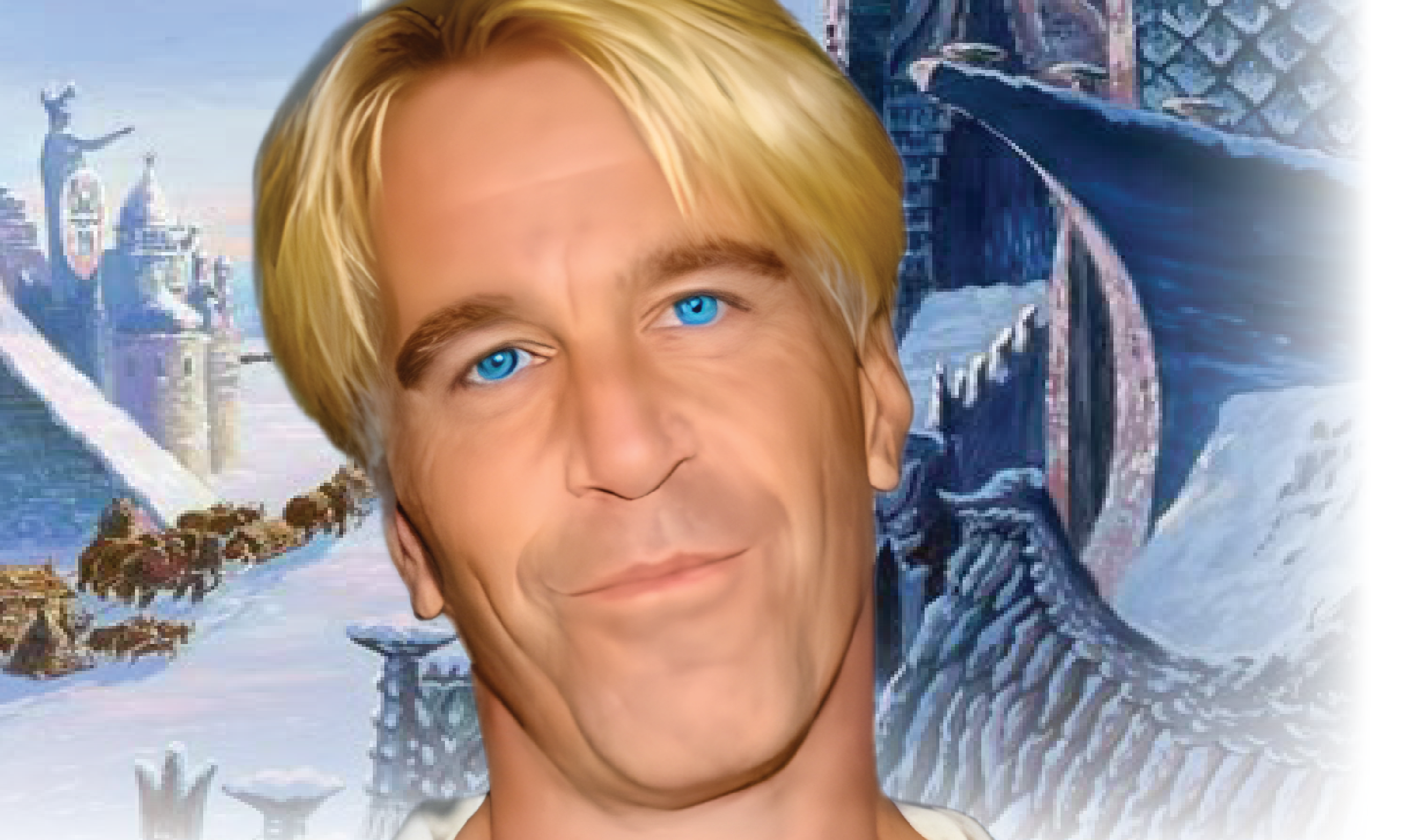
Agartha went mainstream online. *cue gasp* The once niche, almost-exclusively 4chan, in-joke has recently been averaging millions of views on short-form video feeds. A basic Agartha edit on TikTok features drone shots of Norwegian fjords and icebergs, eye-color charts, Logan Paul in SS uniform, a rotating Black Sun (Nazi symbol), and yassified depictions of Saint Germain (recurring character in Hyperborea edits). Those are mostly created by fringe teenage edgelord memers who are often algorithmically captured by neo-nazi ideology. While it is often clear they don’t believe Agartha is real, glazing Agartha is how they dog whistle and troll the “wokes”. They are aware of the irony, yet they relish its core lore: Agartha is a hidden hollow-earth utopia that only allows in Aryans who can pass fastidious racial purity tests.
Their prolific work prompted memers on the other side of the political spectrum to respond. Instead of constructing a directly antagonistic narrative or world, they undermined Agartha by exaggerating its inherent bigoted logic into absurd memetic nonsense. This is where Yakub was introduced, the iconic-forehead Black scientist who, according to Nation of Islam mythology, created white people through selective breeding. White Monster energy drink got canonized as the substance that turns you white so you’re allowed into Agartha. Supporting characters like a blue-eyed Obama, white-bearded Kobe Bryant, and blond IShowSpeed emerged. Last November, slop artist @fatfellas opened a portal to invade Wiggartha, and called it appropriation reparations.
Ironic engagement with the myth of Agartha is a vast spectrum that holds within it a buffet of beliefs. Right-leaning incels who were enamored with the Werner Herzog penguin saw it as the hero that leads them to Agartha. Yet many self-proclaimed anti-fascists find Agartha memes amusing, precisely because they mock and subvert white supremacy. MAGA memes depicted Trump’s farcical Greenland bid as another way to make Agartha real. Some white nationalists even identify as post-racial fascists, who welcome Yakub’s reign over Agartha. They believe if you master Agarthan lore you become “white” regardless of your ethnicity. Apolitical brainrot enthusiasts engage the virtual cosmology too — which explains TungTungTung Sahur in Agartha.
It was all in jest until “For Agartha” was found inscribed on a toy gun, amongst other white supremacist scribbles, linked to a Jakarta high school mosque bombing. In November 2025, a 17-year-old student detonated explosives inside a mosque at SMA Negeri 72 during Friday prayers, injuring over 50 people. He was not white, not part of any organized network — just a teenager who had spent too much time on Terrorgram. This leads us to the flip side: those who take Agartha seriously. The understandably cautious camp who see Agartha memes as volatile material that leads to extremist violence, and those who are devoted esoteric Terrorgram occultists who don’t want to see their zealotry ridiculed.

Agartha is a hollow Earth kingdom: a comically literal distillation of “hidden depth.” This makes Susan Sontag’s “Against Interpretation” (1966) a nifty analytical lens. Sontag rejects the act of ascribing meaning to form and imposing depth onto surface. She opposes what she calls the “philistinism of interpretation” — the reactionary hermeneutic reflex that treats every cultural object as a container for hidden content, something to be cracked open so that its real meaning can be excavated and tamed. To Sontag, this forced depth hermeneutic is not just epistemologically lazy; it is politically reactionary, because it always privileges the interpreter’s framework over the object’s actual operations. Her counter-proposal is an “erotics of art” — an attention to sensory form, texture, and surface that refuses the vertical descent into some buried meaning.
The entire cosmology that the Hitlerites and the Evangelists subscribe to hinges on hidden truths – racial hierarchy as occluded cosmic structure, Agartha as the invisible kingdom beneath the visible earth, Aryan purity as sublimated godhood. This is the exact dynamic of the popular “red pill” discourse. Think about the homology: making it to Agartha is escaping the Matrix. For right-wingers, taking the red pill is uncovering the truth beneath a dishonest liberal surface. The “redpilled” incel believes men are being secretly robbed of their superiority; the esoteric fascist believes the “powers that be” are concealing race science evidence; the conspiracy theorist posits a hidden network of cabalistic control beneath the veil of a democratic society.
In every case, the structure is the same — depth conceals truth, the surface is a lie, and initiation means a hero finding out. This hermeneutic structure also mirrors what Fredric Jameson described as “cognitive mapping:” Jameson argues that this hero-story impulse is inherent to the postmodern subject, who cannot comprehend or even perceive the vastness of the systems they inhabit. Conspiracy theory, Jameson suggests, is the “poor person’s cognitive mapping”: an attempt to render an unrepresentable totality legible by substituting hidden agents for complex structural forces. It satisfies the same need a genuine political analysis would, but through dumbed-down narratives. It insists that there is a hidden architecture, controlled by identifiable powers, and can be revealed through initiation. The desire to map the totality is relatable and legitimate; the degraded map, however, is the problem.
Agartha, like the red pill, is a degraded cognitive map. Its comical literalism extends to its visual and symbolic vocabulary. Snow, frozen castle peaks, Greenland, A10 blue eyes, bleached blonde hair, vanilla white skin, white hooded Hulk Hogan – all remarkably anemic aesthetic choices. There’s no metaphorical work being done — whiteness is represented by whiteness. Purity is represented by purity. A mythology that can only represent itself through its most literal signifiers has no imaginative depth, which is ironic for a myth that claims to be about hidden depth. It gestures toward esoteric symbols — but the actual content of its imaginary looks like a Skyrim mod. The “initiatory knowledge” amounts to: white thing good.
The literalness is a symptom of what happens when an epistemology of depth has no actual depth to offer. To be fair, it hasn’t always been this way. Agartha’s genealogy can be traced back to the original Hyperborea of Greek mythology — which wasn’t even “cold”. Despite their location in an otherwise frigid part of the world, the Hyperboreans were believed to inhabit a sunny and divinely blessed utopia, shielded from the effects of the cold north wind by the Riphean Mountains. Hyperborea was paradise precisely because it was warm despite being in the north. The myth held paradox — until the Ariosophists and Thule Society flattened the distinction between Hyperborea (warm, paradisal, mythical) and the actual geographic North (cold, harsh, viking-coded). Then Herman Wirth, SS founding member, envisioned a prehistoric Hyperborean culture centered on the North Pole, where a “divine race” of golden-haired, blue-eyed Aryans lived during the Golden Age. Then Robert Charroux, pseudo-historian and race science advocate, made it even more literal: according to Charroux, Hyperborea was situated close to Greenland and was the home of a Nordic white race with blonde hair and blue eyes, extraterrestrial in origin, who had originally come from “a cold planet situated far from the sun.” Miguel Serrano, prominent exponent of Esoteric Hitlerism, drove it off the metaphor cliff entirely by merging the underground world with the polar myth, placing the Aryans inside a frozen earth: which is what the memes of today inherited.
So TikTok’s Agartha is the end product of a millenia-long process of mythological impoverishment. Each iteration stripped out complexity to accommodate increasingly diminishing reactionary brains. Each generation that claimed to go deeper, produced something shallower. This version of Agartha we arrive at is where the two irony-poisoned quadrants, the Hitlerites and the Yakubites, battle it out. It is also arguably what successfully baited the Yakubites into bringing Agartha to the memeplex mainstream. Its hollowed out (pun intended) lore became too tempting not to ridicule. The Yakubites stretched Agartha’s literal “whiteness” aesthetics to slapstick, hyperliteralist extremes: Yakub created white people; raw milk, bleach and White Monster turn you white; Wiggartha portals and Thugland invasions. Agartha was so mythologically bankrupt that even AI slop, universally agreed to be the lowest-tier of creative output, made it more interesting. The Yakubites desacralized the original white supremacist narratives, but in doing so, they breathed life back into a dying myth. They took a mythology that had spent centuries shedding complexity into oblivion and injected more lore in three months than the Evangelists had managed in decades. But Hitlerites, who are well-versed in irony, now had new material to sculpt with. Agartha became funnier, denser, more generative, and thus, a lot more sharable.
Luckily, Agartha memes already peaked and are on their way out, but the residue is still worthy of study. Now it is becoming increasingly harder to discern if an Agartha meme is produced by a Hitlerite or a Yakubite; as both constantly reappropriate and cannibalize each other’s assets. Hitlerites bait with ridiculous lore, Yakubites exaggerate and desanctify it, it becomes defanged, harmless, and easier to circulate for Hitlerites to repurpose again. Post-racial facism, the ideological mutation that portrays racial hierarchy as a spiritual ladder anyone can climb, is a loop Hitlerites exploit into the Terrorgram pipeline that lead to an Indonesian bombing a mosque for Agartha.
This blurriness between the two quadrants is why the Alarmists are often correct. You might be able to deduce a meme was made by a Hitlerite if you see #freepalpatine in the caption, but it gets harder when you see Bashar el Assad partying in Agartha. When memetic intentions become indistinguishable at the level of the image, the risk of ambient radicalization is genuine — the meme moves you before you learn to decode it. But what the Alarmist framework misses is the other side of that same illegibility. If an alt-right propagandist cannot draw a line between Hitlerite and Yakubite content, between fascist recruitment aesthetic and the thing mocking it, then they have a strategic problem. The blurriness cuts both ways.
The Alarmists treat meme culture primarily as a vector for extremism, but this framework systematically underestimates the critical capacity of meme communities and the opportunities of ideological subversion they create. When they insist on excavating a radicalization pipeline beneath the surface of every Agartha meme, the Alarmists risk falling into the same trap of interpretive violence Sontag warned against.The Alarmists are correct on principle, but when it comes to method, the Yakubites exhibit a more productive tactic. I’ll explain why through Roland Barthes and Keller Easterling. Barthes writes in Mythologies (1957) that myth operates by naturalizing history — draining the sign of its contingency and presenting it as sacred, inevitable, eternal. The fascist deployment of Agartha follows this logic: Aryan purity, hollow earth, hidden kingdom — all structured as cosmic truths rather than constructed narratives. Barthes understood that a strong myth is debunk-proof, that facts are futile in the face of affect. He identified the most effective counter-move: the artificial myth, the myth that announces its own construction and refuses sanctity. The Yakubites are Barthesian mythologists, building lore that is visibly and humorously fabricated. Everyone knows Yakub’s forehead is a joke because they watched it get built, in real time, through collective riffing. There is no space for a hidden author, no depth to excavate, no moment of revelation.
Keller Easterling argues that power often operates not through the content of declarations but through the disposition of networks — the spatial and logistical arrangements that determine how things move. Her figure of the “superbug”, which she elegantly attributes to Trumpism, describes an agent that doesn’t confront a system head-on but mutates within it, exploiting its own logic against itself. The Yakubites, or high-fluency memers, are Easterling’s superbug expressed as creative practice. They don’t counter Agartha’s declarations with opposing declarations. They alter the disposition of its imagery — rerouting its signifiers, clogging its channels, and transforming the infrastructure through which the myth itself circulates.
Aidan Walker, in his Substack “How To Do Things With Memes”, argues that images today function as posts before they function as pictures — they are live sites of engagement, monetization, and algorithmic attention rather than static evidence of reality. Who controls the image is, in Walker’s account, a crucial lever of power in new media. Consider the distinction between Kirkinator and Kirkification — two opposing meme operations performed on the same face. Kirkinator was a series of AI-generated videos depicting Charlie Kirk as a reborn cyborg hero, part of the George Droyd universe — itself a racist meme popular on right-wing channels. Kirkinator is celebrated in Agartha as one of its protagonists, mostly on the Hitlerite quadrant. The Kirkinator memes constructed lore, built narratives, and attempted to sanctify Kirk as a martyred icon. Kirkinator was also created to pump a memecoin on Solana — solidifying the reactionary politics of hidden depth as the perfect vessel for crypto grifts. Kirkification is the antithesis. When people put Kirk’s face on everything — on Clairo, on the Mona Lisa, on Deleuze, on themselves — there was no lore to decode, no narrative to follow. Kirk’s face proliferates until it is fully detached from any interpretive demand. The meme lives entirely on the surface, in the pattern of circulation itself.
Of course, the 6-7 meme is this phenomenon in its purest form. A phrase with no fixed meaning that went viral through basketball TikTok edits, hand gestures, and schoolyard repetition, till it made it to the Jimmy Fallon show. As Walker and Ruby Justice Thelot observed, 6-7 is “meaningless as evidence but eminently meaningful as engagement” — or as Thelot put it, “it’s playing with the physics of the internet but with no particles.” It is our generation’s John Cage’s 4’33,” peak anti-content. The interpreter looks for meaning; 6-7 is meaning-proof. It’s virtuosity in the key of nonsense. It plays with the medium of platforms and circulation itself — pure surface, pure form, Sontag par excellence. This is where the Sontag thread completes itself. Sontag wanted attention to form rather than content. Meme lore is medium-first. It has the shape of a mythology — origin stories, cosmologies, hierarchies, sacred objects —without any of the meta-physical commitments. It is mythology as pure aesthetic structure, hollowed out (another intended pun) of the claim to truth that would make it dangerous. The best memes don’t reward depth reading. They deride it.
Kirkinator is a Hitlerite tactic: it wants you to go deeper, to believe, to ultimately buy the coin. Kirkification illustrates the potential of the Yakubite tactic: it seizes the image and makes depth impossible. While Yakubites did not see the level of subversive success Kirkification memes had, they demonstrate a process I call Mythmaxxing. Mythmaxxing is the deliberate overproduction of mythology around a dangerous signifier until its original territory becomes uninhabitable. It forces the myth from vertical to horizontal, from depth to surface, from hierarchy to the shared ground where humor flourishes. The limits of white terror are intrinsic to its own structure — it can only propagate through depth. Fascism relies on verticality to produce rank, be it through secret initiation, race, or power status. Mythmaxxing exploits horizontality, by stretching the myth against its depth. It takes the vertical structure of Agartha — the descent, the hidden world, the initiatory ascent, the secret — and lays it flat by mixing in infinite nonsense. Mythmaxxers do not interpret the lore because interpretation would imply there’s something to find. They extend it outwards, which is a fundamentally different operation — additive rather than extractive, playful rather than paranoid.
Mythmaxxing is Barthes’ artificial myth scaled by platform infrastructure, Easterling’s superbug expressed as creative practice, Sontag’s erotics of the surface enacted as collective play. It does not argue against the myth. It reterritorializes the myth so aggressively that its esoteric core, its secret promise, its hidden world beneath the surface — can no longer take root. That’s why the Yakubites are doing something the Alarmists cannot: they’re not arguing against the hierarchy, they’re making it impossible to feel. The Hitlerites are disadvantaged because even as they satirize their own lore, they believe in its core premise. Mythmaxxing is not a solution to the problem of online radicalization. But it can make rabbit hole descents much less frequent.
“it’s not that deep bro.” - Mythmaxxers
.jpg)

.jpg)