
Hit Enter to Search or X to close
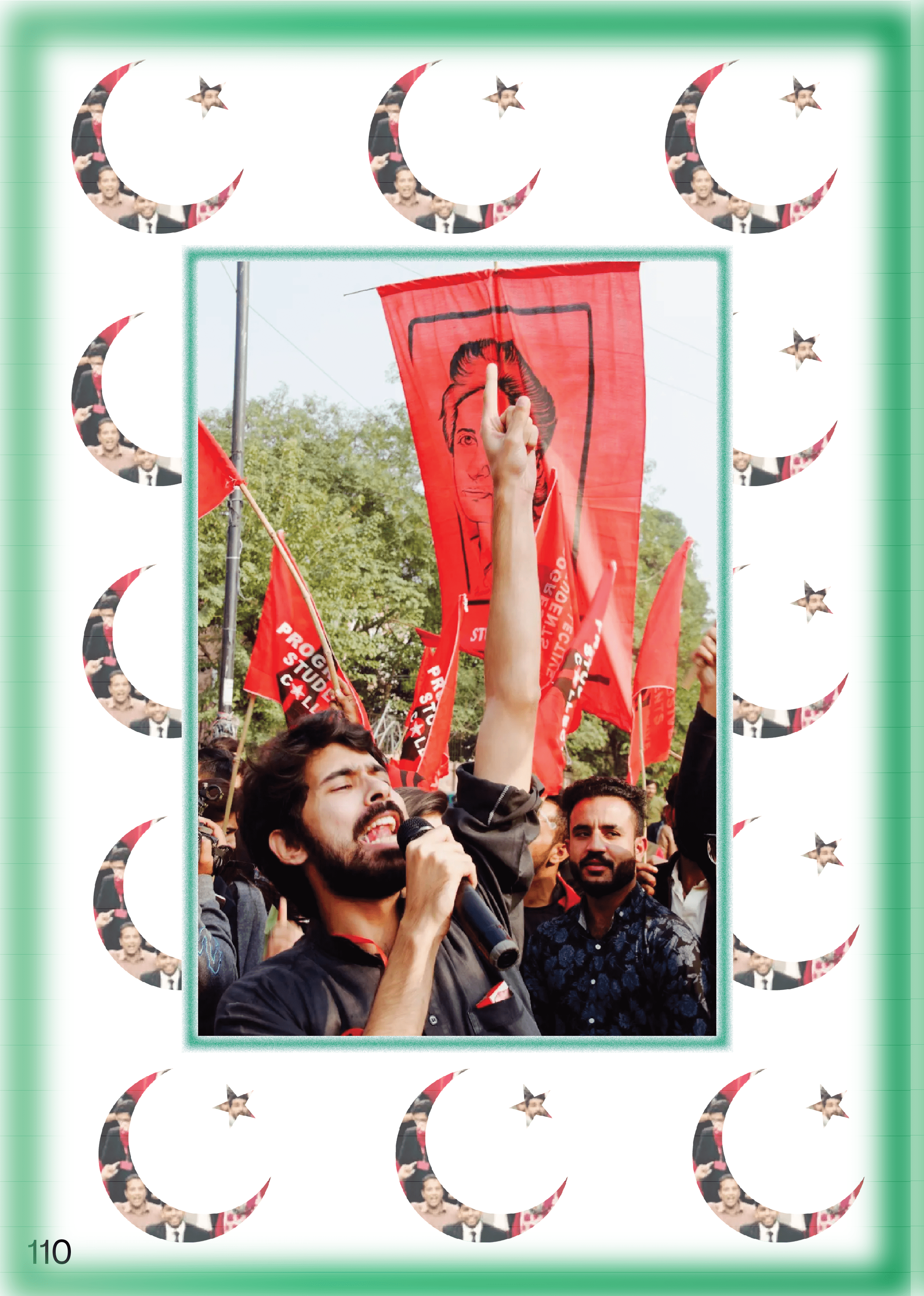
Raza Gillani is a political organizer, writer, and former student leader who began his work in Lahore, Pakistan, and now lives in New York City. Originally trained as a journalist, Gillani’s trajectory took a turn amidst the upheaval of global politics, personal disillusionment, and grassroots movement-building. From co-founding Pakistan’s Progressive Students Collective to organizing in the diaspora today, Gillani brings sharp clarity to the limits of liberalism, the role of the state, and the stakes of student and working-class struggle. Contributor Karamvir spoke with him about his journey, the rise of the right in Pakistan and abroad, the hollowing of journalism, and what it means to stay committed to political struggle—regardless of hope.
Karamvir: Tell me about yourself and the work you do now.
Raza Gillani: Well, I am an immigrant from Pakistan, and I am currently living in New York. I was a journalist back home, was in the student movement when I was in college, and later helped found a political party. I am an organizer here. I was a reporter for a local magazine in Pakistan for about a couple of years. I came to NYC when I got a scholarship at NYU for a Master's in journalism in Near Eastern studies. Journalism didn’t work out, but most of my life revolves around politics and just trying to make the world a better place here.
K: What do you mean by journalism didn’t work out?
R: What I mean by journalism didn't work out is that before coming here, I hadn't moved out of Pakistan. So it was like, I'm going to a different part of the world so you have all these expectations and ambitions, most of which are unreal because you don't know what the other side of the world looks like. So the first two years are just the process of realizing and readjusting your expectations because most of them don't work out. I came here with the expectation that I don't know, it's funny to say, but my ambition was that eventually I would get into being a writer in the New Yorker, you know, or a big magazine, and move around the world and write about real public interest issues. But then October 7th happened at the start of my second year of school, and everything changed. It shifted my understanding of what journalism was and what my ambitions were. By the time I graduated, I wouldn’t say I no longer wanted to work in publishing, but it no longer held the same appeal.There’s a very linear way South Asia is covered in formal legacy media here. A lot of what's happening on the ground—especially in the periphery—isn’t accurately reflected. That creates a vacuum, and the right-wing groups have filled it by hegemonizing the flow of information. You won’t read much about what's happening in Pakistan in the NYT or even in Pakistani media because of state and self-censorship. So these right-wing groups become the main mediators between back home and the diaspora. When all your info comes from one side, it's easy to fall into their politics. And the Left struggles here…there aren't enough accessible publications, especially for the working-class diaspora. There's still a lot to be written, especially with everything going on between India and Pakistan. That’s the kind of work I hope we’ll be able to do.
K: The differences between the Right and the Left are access to information and who is disseminating that information.
R: And I think, how do you package your day-to-day politics? I think the Left has been strong on the first front. But I think the problem with that is that knowledge does is that it humbles you. What social media has done is that it has destroyed everything. You know, you only need a phone and you can make a video and you can claim anything about anything. And if you have a good marketing strategy, it works even if it is factually inaccurate.I can at least speak about Pakistan. In the early 2000s, Pakistan, under a military dictatorship, saw a liberalization of media, whereby new TV channels were formed, private TV channels, and they took over the news market. Newspapers started to become subservient to these news channels. And for about a decade and a half, electronic channels essentially hegemonized how information was spread to the masses. And I would say that the left has a lot to do in that regard. The right wing has had success in terms of expansion because they were able to tap into this resource pretty early. Say, in Pakistan, there's a right-wing party called the Pakistan Tehreek-e-Insaf (??), which is led by Imran Khan, who's in jail right now. They were quick to invest in social media—full offices, high-end equipment, full-on strategies. And you can see it across platforms. If you were to criticize Imran Khan at the height of his popularity, you would be fighting with an army. Just writing a simple post against Imran Khan, you would have to confront this massive load of people who were just coming after you with all sorts of stuff.
K: Speaking of Imran Khan, can you share more of your thoughts about him? I know many Leftists in the West have romanticized him over time.
R: Yeah, Imran Khan was a hero for almost everyone growing up, because he won Pakistan the only World Cup in cricket in 1992. And it was a special victory. It was one of those moments in our history when people were together to celebrate something. Imran Khan was also a big philanthropist. He crowdfunded and built Lahore's first cancer hospital in his mother's name, which provided free-of-cost cancer health care to people who can't afford health care.
He started his political career in the early 2000s. He has had a long political career, but he was an extension of the military policy in terms of managing civilian governments. And at the same time, he became a very violent sort of rupture. Imran Khan was brought to power in 2018, quite evidently with the support of the military. Even though it wasn't just the military, he had a popular base for himself because he rallied against what he termed an anti-corruption campaign against the traditional mainstream political parties, many of whom were funded by some of the biggest capitalists in Pakistan. They had a love/hate relationship with the military, whereby the military would support one party in an election, then it would have a fallout, and then the military would move to prop up another party. In reality, there wasn't really a choice that the people had. Imran Khan was really looked upon as this choice that could deliver for people, especially because of his anti-corruption campaign. However, he was in power for about two and a half - three years and, during that time, his policies were not very different from anybody else's.
Also, his economic performance was pretty bad. Inflation was rising, the currency was devaluing pretty rapidly, and there was a general discontent among the people. The other political parties in the opposition got together with the military to introduce a vote of no confidence against Imran Khan, making him the first prime minister in our history to be ousted through a vote of no confidence. In Pakistan, no prime minister has ever completed their term. The prime minister was previously disqualified by the Supreme Court over corruption cases. In those cases, the leaders would take a step back, renegotiate with the military, and then make a deal, ultimately returning to power five to ten years later.
But Imran Khan — when I say it was a rupture — was that Imran Khan refused to do that. As soon as he got ousted, he initially blamed the United States for orchestrating his ouster. And then later on, he changed the narrative slightly to say that it was the military, who weren’t happy with him, at the behest of the United States, that wanted him out. He went to the people and said, “You voted for me. This is an unconstitutional, undemocratic institution, and they ousted me through an unconstitutional, undemocratic measure.” And so the people rallied behind him in 2020.
Last year, he won the election by a landslide victory, but the results were delayed for about eight hours. And when the results started to clear again, it was quite clear that he had won the elections. But now he is in jail, facing more than 30 years in prison on cases that don't make sense.
So I am not really a big fan of Imran Khan. I think he is certainly the most popular political leader in Pakistan, and in many ways, he is different from the traditional elite political leaders we had. But I think you can make criticisms about him from a Left perspective the same way you can make them about other states — in terms of policy, in terms of political economy, in terms of how their politics and their rule impacts the lower, the lowest, you know, levels of society — there isn’t much of a difference. What you see is a different face with a slightly different political history, but not an entirely different political project. Imran Khan was no different.
K: And while he was in power, you were involved in student politics?
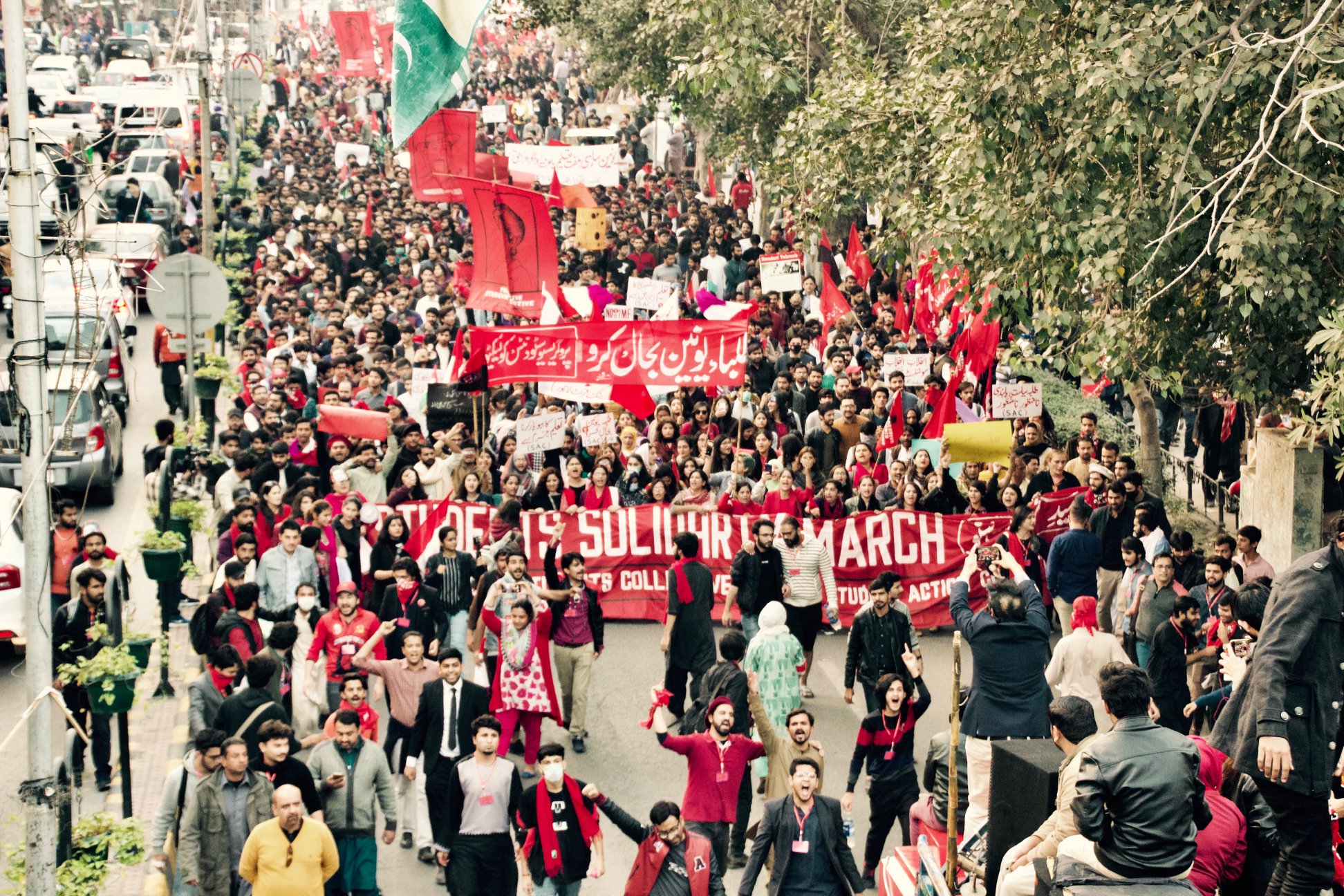
R: During his government, I was in student politics, and we organized student solidarity marches in more than 50 cities to demand the revival of student unions, which have been banned in Pakistan since 1984 during a military dictatorship. Many of us were charged with sedition, which is a colonial law. Some of my comrades still have pending cases.
But during our marches, our friends — the people who were organizing with us — got picked up from their homes, taken into torture centers by military intelligence. And this was in Lahore, which is one of the most visible areas in Pakistan. In Balochistan, in other areas or provinces that we traditionally term as peripheries, people were getting murdered, people were being forcefully disappeared for years and sometimes even decades, and their tortured bodies would be found in dumpsters on the side of the street.
Imran Khan and his party remained silent about the military's power that was exposed in these instances. But, he gave, you know, the cosmetic sort of statements about how student unions are the bedrock of democracy and that we need to revive them. Imran Khan was hand in hand with the military. And it was only after he got ousted that he came up with this anti-military stance.

K: What brought you to organizing? What radicalized you?
R: Personally, it was December 2014 . There was a school in Peshawar that was attacked by the Taliban, and they killed 134 children between the ages of 15 and 16. And these were children. There was a huge public outcry, and I remember our university was closed down. Everyone was dissolved because, you know, children had been killed before in terrorist incidents, but this was the first case where they were particularly targeted in an attack. Gunmen just went into the school and started shooting in an auditorium filled with students. I didn't know anything about politics, but I was a supporter of Imran Khan. I even attended rallies for him when he lost the election in 2013. Anyways, I remember going to a candlelight vigil for the children because there wasn't much political activity. There were protests, but the nature of these protests was not radical in that sense. At one of these vigils, I met this very weird kind of a character talking about things that I didn’t quite understand. He was talking about revolution, taking over the ruling classes, etc. I did not know much about Communism or Marx, but of course, I was intrigued by it. After the protest ended, we sat down and he introduced himself as part of the Awami Workers Party(??), which is a socialist party. He ended up inviting us to a study circle deep in the city. When we got there, it was like on the, I don't know, third or fourth floor of a rundown building. Rats were running around when we were walking up, and it was like in an old school Russian communist office, where there were pictures of Lenin and others that I was seeing for the first time.
The brutal killing of the children had shocked us and moved us to be involved in something like this. We just started going there, and we quickly became radicalized. We would say things like, “We're gonna smash the ruling class! We're bringing about the revolution!” Slowly, we began to bring what we learned to our university and to other student groups. There was a group called the Young Hegelians (??). And they were also talking about Pakistan's political economy, and after a few meetings, we realized we got along and began to organize together. In 2015, we started this organization called the Progressive Students Collective. And then it just took off within. Within a couple of years, we began to march. The other reason we were radicalized was the fact that we were studying at a public university that had students from the middle and lower middle class. There were even a few from the working-class families from all around Pakistan. With an environment like that, you get to talk to people you hadn’t before. You get to learn about a lot of things about your country that the media won’t tell you. For example, what is the actual situation in Balochistan? Why is there a constant war in the Pashtun areas? Why is there so much military on the Pakistani side of Kashmir? To be clear, most of us grew up in challenging circumstances. Some grew up in neighborhoods that are run down by gun and drug culture. Some women grew up facing gender based domestic violence. They had to fight to even get the right to get educated after high school. University became the sort of place where we would not only have a space to express ourselves, but also to make sense of the world, learn from each other's experiences, and develop connections based on empathy. It was probably the first time that most of us realized that the pain that we had gone through was not ours alone. It's not something that has befallen our particular family alone. It's how our society is. It's a broken social system where everyone is facing various forms of pressure.
And because we were on the campus, we were having these discussions, and during that time, our organization came about. Our political strategy at that time was to show up at any protest that was happening in Lahore. We would go to these protests, help lead chants, and make connections. Through this process, we eventually became part of a nationwide alliance of student groups in 2019 called the Student Action Committee. It brought together nearly all progressive, left-leaning student organizations across Pakistan and its administered territories. At its peak, the alliance was active in 55 cities.
K: Did you find that the teachers and administration were supportive of the work you all were doing?
R: The larger context was that Pakistan had become increasingly militarized. There were wars between countries and between the state and its citizens. Within these peripheral areas, the economy had reached a point where farmers and workers were committing suicide. It was generally not a good time. Universities became a central point of everything because it was the only place where you were supposed to talk about ideas. But the problem was that ironically, Pakistan did not have student unions at all. So, when we would be accepted to a university, you would have to sign a contract which would say that if I were to be a part of political activity of any kind, the university has the right to expel me. This, theoretically, also included voting. In reality, the contract served primarily as a legal pretext for university authorities and law enforcement to target students they deemed a threat to the social order they worked to preserve. So, no, there wasn't any support from professors or the university administration. On the contrary, university administration acted as fronts for the state and the military intelligence officials. There were many times when our university officials and security officers would pass on student information to intelligence agencies to be targeted. Military dictator General Zia-ul-Haq in 1984 banned all student unions 1984 except for one, Islami Jamiat-e-Tulba (IJT), which was a right-wing Islamic extremist student group. It still retains its influence on many campuses to this day. This group was really embedded in a few universities, and as a result, some of the professors were former student leaders from this particular group. So they were not going to help us in any context. And even further, the faculty would teach you outdated materials and would not allow you to speak about the military, which is the core of Pakistan's problem. Overall, there was censorship, control, and moral policing.
K: What was your measure of success?
R: I believe that if your political stance is not centered on a single issue, but rather focuses on broader goals like resource redistribution, ending national oppression, and dismantling a violent state, then you cannot have a simplistic, linear definition of success or failure. As students, we wanted to build coalitions with working-class groups and parties. We knew that building politics around an issue would be the vehicle to get you into this larger avenue, or be an end in itself. We often had to redefine success. At university, your first goal is to introduce the idea and make it into a conversation. Your larger goal may be that by the end of these four years, you want this campus to be a place where people talk about everything, where people resist oppression, and where there is an active political process present. I don’t believe there is any option but to keep moving forward. Questions around what gives me hope, etc are not very relevant because I will have to do this work even if there is no hope. I mean it is nice to feel hope, don’t get me wrong, but my work is not contingent upon a few emotions. So, whether I have hope or not, I will do the work. It is actually when we don’t have hope that we should be doing this work.
K: Do you have any regrets about this work you were a part of?
R: Yes. I think my biggest regret would be that, after everything, we weren't able to get the student unions back. A huge reason for that was COVID-19. These marches began to happen in November 2019, and during that time, we were able to have talks with political leaders and lawmakers, who really respected our work. There were even drafts of a bill that would legalize student unions going around. But when COVID-19 cases started to show up, the political energy around this sort of thing dissipated. The lockdown went on for a few months, and the death toll put a huge burden on the healthcare system, so the conversation of student unions went into the background. And once the energy is dissipated like this, it is really hard to start it up again. As Lenin says, “Sometimes decades pass and nothing happens. Sometimes a day passes and it feels like decades are one by time travels in these different streets.”But I think one of the political insights that I got from there, which is probably one of my regrets as well, is that people will start to romanticize the struggle in itself. It was no longer important whether the student unions happened or not. The fact that we were able to pull a major demonstration was enough for some. I see this with the Left in general, where there is an obsession with romantic loss. In certain cases, it just goes to the point of being a fetish, where people, not actively, but unconsciously, don't want to win because the loss keeps them going. The loss is beautiful because it brings you together, which then brings you the struggle to resist. For me, that's not a very politically informed position. I saw people who were organizing for something bigger than their lives, and they sacrificed a lot. They could have chosen to be like corporate royals and make a name for themselves, but instead, they chose to leave it all behind and dedicate their lives to trying to make the world a better place today.
Politics is an art. Sometimes you take two steps forward and one step back. It requires compromise, building both popular and unpopular coalitions, knowing when to assert yourself and when to hold back. But today, politics has become a way for people to feel good about themselves. Many adopt a radical identity with a polished biography, eager to say, I was part of this, I was part of that, without ever engaging in real political discourse. That’s how politics becomes harmless to the ruling class, allowing them to maintain the illusion of democracy.
K: How do you engage with people who are disengaged & skeptical?
I think that's sort of the work that organizing is nowadays. People who are actively thinking about politics and engaged with it are already halfway there. So, talking with them strategically is easy. The real point is to organize people who are impacted by politics but have no power to hit back. And then you have to try and understand why people do that. Why is it that people are comfortable living in the situation that they are in? If, say, you're talking about people who are, say, from the elite, then the answer is they're comfortable with the scheme of things because they benefit. Whereas if you look at these tendencies within the working class, with the middle class, then the answer is quite different. For me, it's more resignation than disinterest. Not because they’re not interested in politics, but because they feel powerless.
K: What advice would you give students who are involved in movements today?
R: Well, I don't have any advice for the students because I don't consider myself up on that level to be giving out advice to students. I learn from the student movement. I try to be part of it as much as I can, and I think that students have recently been one of the major frontiers of confrontation with the empire.Coming to New York was initially exciting because I never thought I’d be able to come here. But due to state censorship, it has started to feel like I am back in Pakistan. People here love to talk about the Global South restricting speech and democracy, yet this country mirrors exactly that. If you're an international student or on an insecure visa, you're not allowed to criticize the country. Your right to speak depends on your visa.I also think that Americans' understanding of global politics, especially culturally, really needs to improve. There's this belief, especially among the right, that the U.S. is the greatest nation in the world. But half the world’s problems are the result of U.S. imperialism. You can't even count the number of countries this country has gone to war with—not out of necessity, but fear. People here don’t know what it’s like to live under real occupation or threat, like the people of Vietnam in the ’60s, or now Iran, Hezbollah, Hamas. It's a bubble of imagined enemies.And this narcissism exists not just on the right, but in liberal culture too. For example, Americans believe it was their antiwar movement that ended the Vietnam War. It wasn’t. It was the Vietnamese people resisting imperialism, facing death and destruction, who defeated the U.S. Empire. Yes, the movement here helped, but it wasn’t the deciding factor.
Similarly, Palestine won’t be liberated because a few liberals protest in Union Square or make Instagram videos. It will be because people on the ground fight back by any means necessary. And no empire gets to dictate what forms of resistance are acceptable. Liberals' failure to take strong positions, even on something as clear as genocide, creates space for the right to grow. People who don't engage in politics aren’t stupid or uncaring. They’re rational. They don’t see joining us as solving their problems; they see it as risking more trouble. So if we want to win, we have to show that our politics benefits them materially. The right wing understands this. They offer people reasons, material explanations. They say, "Your life is bad because immigrants took your job," and people believe it. That’s the model of fascism in Pakistan, India, everywhere. It’s not just identity; it’s material interest.We have to realize that resistance isn’t just about feeling righteous. It’s not about saying the right thing during dark times to feel proud. Our job is to build power. To create conditions where people see us and believe joining will improve their lives. Without that, it’s all just romanticizing suffering.

.jpg)
.jpg)