
Hit Enter to Search or X to close
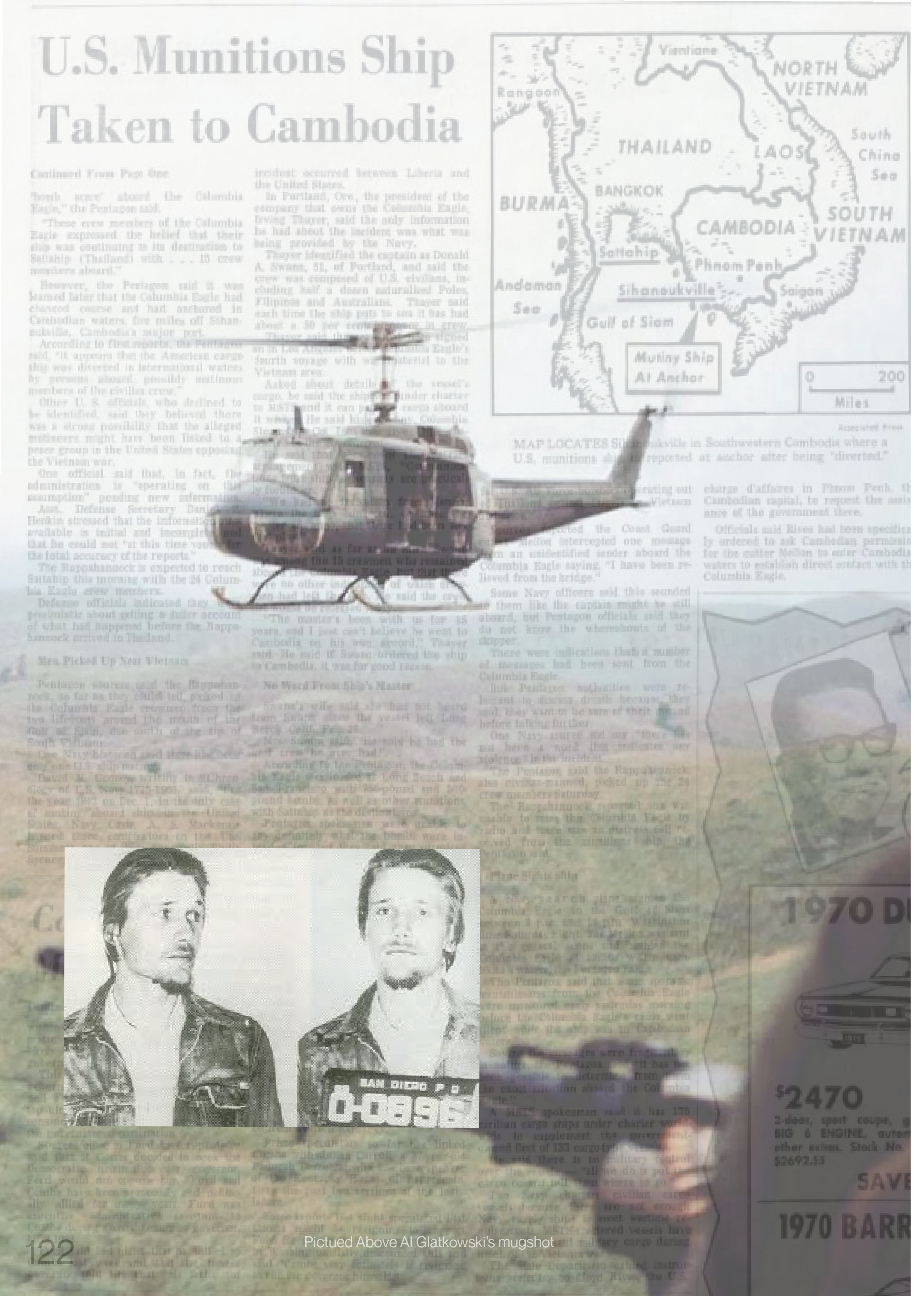
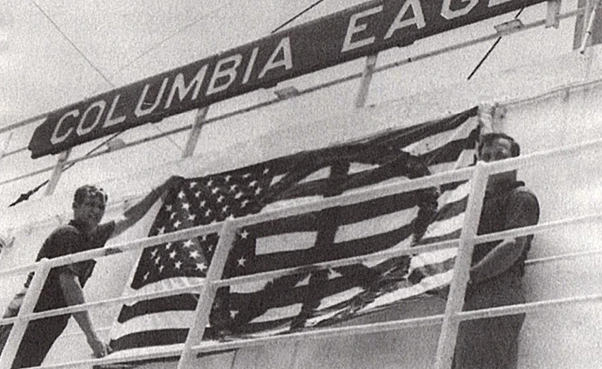
Al Glatkowski was one of two merchant mariners who seized control of the SS Columbia Eagle in 1970, diverting the U.S. ship carrying napalm to Thailand in protest of the Vietnam War. In this conversation, Glatkowski reflects on his upbringing in a military family, as well as the political awakening that led him to resist the war and eventually take radical action.
SHADOWBANNED: Can you tell me a bit about your background? What were the experiences that shaped your political development?
GLATKOWSKI: Well, I grew up in a military family and was born at Fort Gordon, Georgia, in 1949. When I was 18 months old, my mother separated from my birth father after he abandoned us and went AWOL. My mother and I moved to California, where her great-aunt helped her find a place to live and a job.When I was about six, she remarried a sailor who was stationed in Long Beach, California. My stepdad was in the Navy, and we lived mostly on or in military bases or military housing. The culture I grew up in was entirely military. We were called “military dependents” — you weren’t exactly a civilian, but you weren’t always welcomed, either.
S: How did your upbringing influence how you thought about the Vietnam War?
G: At first, I didn’t think I had much of a choice. Everyone in my life at the time assumed or told me I’d go into the military. I was registered for the draft at 16 because I joined the Merchant Marine and that was a required draft classification on my seaman’s ID — I was classified 1Y. That meant I’d only be drafted if there was a declared national emergency — and I would be automatically called up. I was “in,” whether I liked it or not. Every very night on TV, we saw the war — not like now, where it’s all sanitized. Back then, mid sixties,they showed you the bodies, the burning villages. That’s why many people turned against the war — because they could see it. The military learned a big lesson from Vietnam: never allow a free press at the frontlines again.S: You mentioned being prepared to leave the country?G: Yeah. By the time I was 18, I was already thinking about fleeing to Canada. I didn’t want to go to Vietnam,but was forced, by law, to actually register for the draft. I was trained in resistance — not just by SDS, but through churches and community networks. We were serious. Some of were ready or claimed to be ready to take direct action. Which perked up my ears, since I was unfamiliar with the term and had to learn what they were talking about.
S: So even then, you were already thinking about mutiny?
G: Not at that time, but later, Yeah. With the Columbia Eagle, the plan to divert or sink the ship was made before we ever left the United States. Both McKay and I had a strong political relationship regarding the political clarity on what was necessary to stop those weapons: Direct Action.The ship was carrying napalm to Thailand for use in the Vietnam war, in particular on Laos and Cambodia, both neutral countries, and along the Ho Chi Minh Trail. We couldn’t let that happen. We had the skills and the will —and we had the political clarity. It wasn’t just saving ourselves from the draft. It was about stopping the war machine.
S: You knew you could die, yet you went through with it. Can you talk about the moral conviction that outweighed the risk?
G: I didn’t want to die. But we were convinced—this wasn’t just theory for us. We were on a ship full of bombs, munitions headed straight into the war in Vietnam. It wasn’t abstract. We were fueling it and directly responsible for the delivery of those Napalm bombs..There was another ship, the Maui, that had been seized at one point, I think by the North Koreans, and the U.S. went in and took it back. That was after what we did. Today, they’d probably call us terrorists. We would’ve been charged under anti-terror laws—life, death penalty, whatever. But back then, no one expected resistance like this from inside the empire. The U.S. was supposed to be untouchable. And anyone who tried? They weren’t supposed to get away with it.
Before the mutiny, we’d both already gone to Vietnam once. I had been part of that machine. I came up around other young guys, some older than me, some already drafted or trying to dodge it by staying in school. One guy I knew had a dishonorable discharge framed on his wall. I didn’t understand why at first, but he and his military comrades explained it to me—why he wouldn’t kill for this country, why he wore that discharge like a badge of honor. At that time, I was hanging out with a mix of people—some vets, some just kids, civilians, hippies. It was around ‘67, Summer of Love. People were tripping, fucking, protesting. A few of them were deeply political, most weren’t, I was the youngest in that circle, a high school dropout. But I was listening.
I went to a couple protests. Not just rallies—places where veterans were standing up and saying what they’d done. Men who admitted to pulling triggers on civilians, torching villages, killing livestock, women, children. I remember watching them break down as they talked. These weren’t activists; they were soldiers. And they cried. That hit me hard. I’d grown up around the military. You didn’t cry. After one of those protests, I told my girlfriend and her friends, “I have to go to Vietnam.” They thought I was nuts. But I couldn’t sit with what I was hearing and not see it with my own eyes. I needed to know if it was true. I couldn’t believe we’d actually do that. That wasn’t how I was raised. That wasn’t how we were trained—or so I thought.So I went. I joined a ship carrying bombs.
S: What was it like on the ground? Did it match the way the war was being portrayed in the media?
G: One of the first things I saw when I landed in-country was a “relocation center.” Barbed wire everywhere, guard towers with .50 cals. But those guns weren’t aimed out—they were aimed in, at the people inside. These were supposed to be civilians, refugees. But as far as command was concerned, they were all the enemy. Women, kids—it didn’t matter. “Free fire zone” meant anything that moved could be shot. And when I asked about it, people laughed. The only ones who gave me a straight answer were the brutes who’d say, “They look like women and children, but they’re the enemy.”
S: How was it like to come back to the states after that experience?
G: When I came back, my friends didn’t want me around anymore. They didn’t trust me. “You volunteered. You weren’t even drafted.” I became more radical. More militant. At one point, my girlfriend convinced her friends to let me back into their space. And I mocked them. Said, “You think holding a sign is doing something? At least I know where the bombs are. I can get you on base if you want to do something real.” Of course, they didn’t want to hear that. I was “crazy”—traumatized, whatever. They wanted to get high and feel like they were doing something righteous. But for me, that was a turning point. That, and growing up around racism and the military my whole life. That’s when I started reading Marx. Started understanding that this wasn’t just about war—it was about empire. It was about class. That’s what pushed me. Not just the horror of what I saw, but the betrayal.
S: You’ve talked about how the military framed Vietnamese civilians as “the enemy.” I think we’re seeing that same logic with Israel today—dehumanization as justification. From what you witnessed firsthand, how far did that rhetoric go?
G: I saw it right away—immediately—when I stepped off the ship and visited a so-called relocation center. I was maybe 16, 17 years old, and I was asking: why are the machine guns pointing inward, not outward? If these were refugees, civilians, why were the guns aimed at them? That’s when I started hearing the language: gooks, slopes. Once you reduce someone to a slur, something subhuman, it becomes easier to kill them. That’s the first step. You call them animals, laugh at them. And once you’ve done that, you don’t have to reckon with what you’re doing. You’ve already stripped them of humanity. What’s happening in Palestine now—it’s the same playbook. Hamas was basically built up by the Israelis to divide the Palestinian movement. And now they use its existence to justify annihilation. Who really believes the Zionists are going to leave that land? They’re expanding into the West Bank right now. Settlers can shoot a Palestinian dead in the street and maybe serve a year—maybe. Most don’t even get that. I protest for Palestine because I saw this before. I lived it. I was in Cambodia. I drank Mekong River water while bodies floated by after bombing raids. U.S. bombs. Illegally dropped in Laos and Cambodia—neutral countries. That’s a war crime, plain and simple. And yet, people still ask why we did what we did with the Columbia Eagle. That’s why. That’s the only defense I had left.
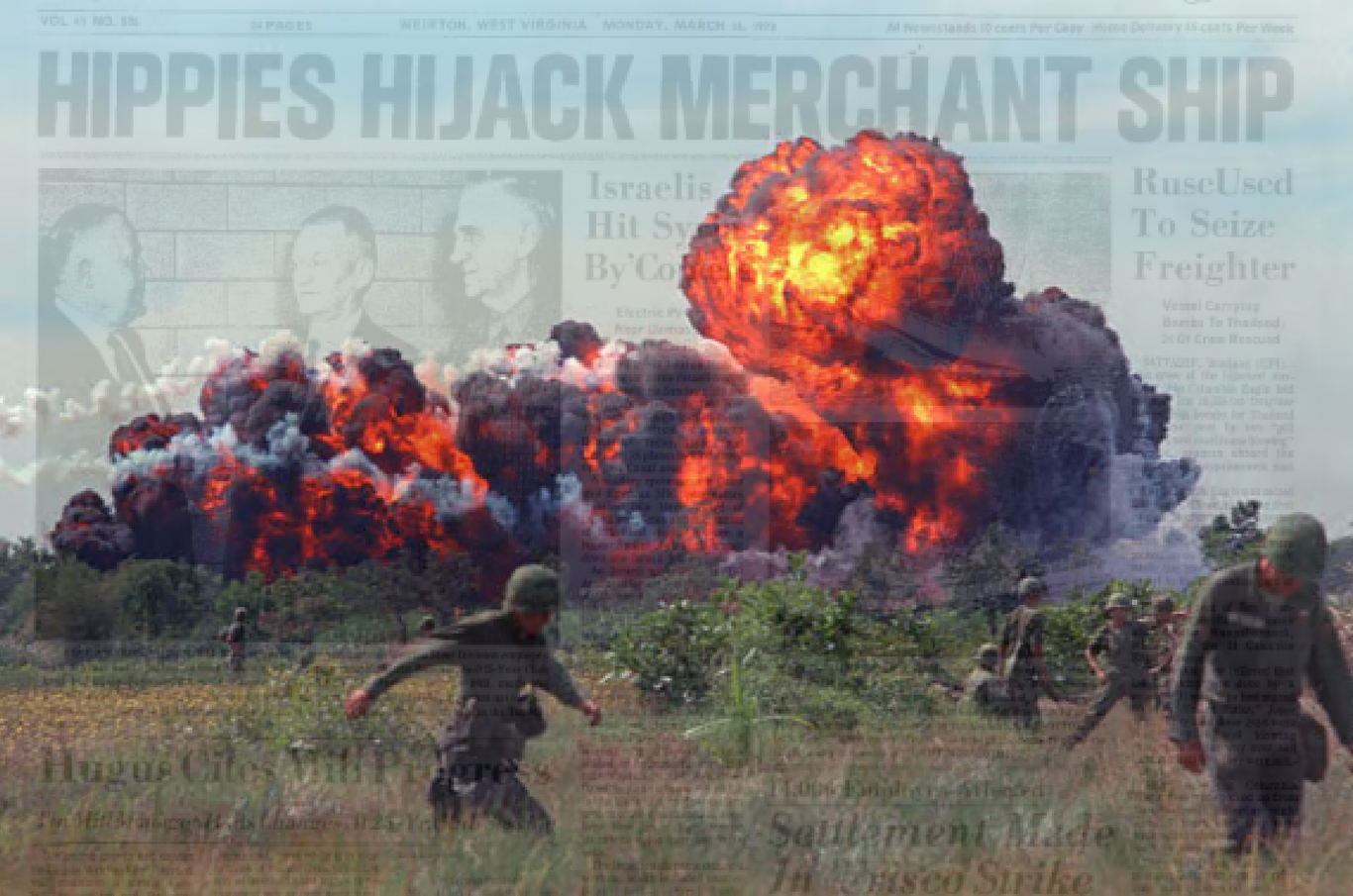
S: Let’s go back to the beginning. How did the mutiny on the Columbia Eagle actually happen?G: We called it a revolutionary hijacking. There wasn’t even a legal category for it at the time—no one expected a U.S. merchant ship carrying bombs to Vietnam to be commandeered. Plane hijackings were just starting to happen, but ships? No precedent. When we took the bridge, I commanded it. My comrade Clyde knew the politics but didn’t know the radar, didn’t know how to read charts or navigate. I’d worked up there before. We maintained strict radio silence for 24 hours after seizing control. Then we broke silence to send a message to the Cambodian government. We demanded two things from Prince Sihanouk: political asylum, and that the Cambodian Navy hold the ship for the duration of the Southeast Asian War.
He agreed.I brought the ship in as close to port as I could—we were near Khlong Bok Som, Cambodia’s only deep-water port, even though it was still shallow. We had to dump ballast just to get close enough. Eventually, a Cambodian vessel approached us. We surrendered our weapons, but strangely, they gave them back. They said they weren’t taking the ship yet. That scared us—we’d been awake for three days straight by then. The mutiny took place on March 14, 1970. By March 18, Sihanouk was overthrown in a U.S.-backed coup. We were then transferred back to the US and I was sentenced to 10 years in prison.
S: And what happened after that? What was the fallout like for you?
G: That’s where things got dark. We were already ashore when the coup happened. The U.S. press called it a “bloodless coup,” which was a lie. We saw people being rounded up, tortured, executed—some in the building next to where we were held under house arrest. Before that, they’d kept us aboard a prison ship. Below deck, it was an old ammunition storage area; above, it held members of Prince Sihanouk’s cabinet and their families. I was locked in a barred cell—walls, roof, floor. No food or water for a while. When they finally gave me water, it was barely enough. That’s when I think I had a nervous breakdown. I was slipping mentally, unable to function with my comrades. Eventually, we were moved to a house in Phnom Penh under guard—six soldiers at all times. Clyde and I planned escapes multiple times. On one attempt, I tried swimming across the river, knowing the Khmer Rouge or South Vietnamese Liberation Front might be on the other side. I failed. But later, we planned again. We dressed as journalists, and I gave Clyde my professional cameras and a Grundig shortwave radio that looked like a tape recorder. I created professional cameras and a Grundig shortwave radio that looked like a tape recorder. I created a diversion. He escaped. He stayed free for almost a year before the Khmer Rouge assassinated him.
“Bloodless” Lies: Media Spin, Disinformation, and Abandonment
S: I know you were already pretty politically aware before the mutiny, but did what happened afterward—how it was reported—change how you thought about journalism or narrative control? Especially given what you’d once trusted figures like Cronkite?
G: Absolutely. I mean, seeing how they covered what happened to us—it opened my eyes wide. It made me afraid, honestly. You didn’t know who you could trust. I was up until 3 a.m. last night, my mind racing about doing this interview with you, wondering if I said something wrong, if the feds are going to come knocking now.You start to realize how tightly controlled stories can be. Editors, producers—they all have their biases, and if you’re not one of them, you’re not getting your version of events told. When I got out of prison, I shut down. Disappeared. Because my comrades warned me: Al, you’re exposed. Anyone around you will be exposed too.
S: The press even ran with the idea that you two were CIA agents?
G: Yeah. That came out of nowhere. It was actually the Russians who threw that out—said maybe we were CIA. And somehow that became the story. Not what we did, not the mutiny, not the war. That narrative made it in the international press.Think about that: every news service in the world covered what we did. Even China. Even Russia. But instead of seeing it for what it was—a revolutionary act against U.S. imperialism—they cast us as infiltrators. Even the U.S. left cut us off. That hurt the most.
S: Do you think the CIA accusation was deliberate? Meant to divide or discredit?
G: Oh, I do. I believe the FBI, the CIA—they all had a seat at the table with the president. There was a major cabinet meeting right after the mutiny. Nixon got up for a press conference and said something—I’m paraphrasing—but he said, “It’s like bringing the ship into port.”He never named us. But that was clearly about us. The language was about control. Narrative control. Making it seem like the U.S. was steering the ship, not losing it.
S: And meanwhile, the press here was calling the Cambodian coup “bloodless,” right?
G: Yeah. And it was anything but. We were right there, in Phnom Penh, under house arrest. We saw people rounded up, tortured, executed—next door. And U.S. journalists were there too. They knew. But that didn’t come out. Instead, they played along with the State Department line.
S: Did any part of the left try to push back against that version of events?
G: The radical left understood it. Groups like the Black Panther Party, the Weather Underground, the SLA [Symbionese Liberation Army]—they got it. They didn’t denounce us. But the “respectable” left? The Communist Party, the socialists? They went quiet. The narrative had already been twisted. My comrade and I weren’t deeply plugged into the movement. We weren’t deeply plugged into the movement. We weren’t tied into the leadership of any left org. I was a sailor—gone for 90 days at a time just to make money. So when it happened, we didn’t have a network to defend us. And the press painted us as hippie deserters, or drugged-up weirdos. That stuck.
S: How did you stay grounded in your values during all that—especially in prison?
G: You do the work wherever you are. Inside prison, I organized. I taught. I recruited. I built connections. I worked with veterans inside—people who could see through the lies. And I keep doing it now. I’m going to a gathering on the 6th. It’s mostly Democrats, mostly vets who support the party. Do I support the Democratic Party? Hell no. But I’m going anyway—with pamphlets, newsletters, trifolds about the VA. I’m printing them, I’m paying for them, and I’m giving them out. Why? Because someone has to speak up.
Fighting Repression
S: What would you say to people today who are afraid of speaking out or taking radical action—especially because of fear of being doxxed or surveilled?
G: Do I have sympathy for people getting doxxed? Absolutely. But guess what? We’re already fucking doxxed.
S: Yeah, it feels a bit naïve to think we can fully protect ourselves. Might as well lean in, right?
G: You’ve already been exposed. That doesn’t mean you can’t still try to protect yourself—but don’t fool yourself into thinking you’re hidden. When I got my degree in electronic communications, they handed it to me and said, “This is already obsolete.” That’s how fast the surveillance state moves. You think you can hide in this environment? Good luck. The only way is to fully drop offline, and even then, you need a network—people who know where you are, how to reach you, how to keep you safe. Most folks don’t have that anymore.
S: So what should the next generation of leftists do in your view?
G: Build support systems. Big enough that when you get that call—they’re coming, you’ve got to go—you’ve got a safe house. And you need to already be thinking about where you’re going next. You need that before the repression starts.During Vietnam, before I took that last ship, I was already mentally prepared to disappear. I was waiting for my draft classification. I had already accepted: I might have to leave my wife and vanish underground. That’s what you have to be ready for.
S: How does the anticipation of repression affect movements? We’ve seen it before—like the Weather Underground folding under pressure.
G: Repression destroys movements when people don’t understand the stakes. You need layers of comrades. First-level, second-level, third-level. And if you get taken out, each time you’re exposing everyone in your circle unless they know how to handle it. That’s not on you. That’s on people not preparing. We are living under a fascist oligarchy. And that system has its hands on everything—narratives, tech, state violence. You want to know why they want AI so bad? Because AI is already being used to identify and target people.
S: We’re all under surveillance, whether we realize it or not.
G: I had to dox myself just to get a handicap placard for my car. New license, new state. There’s no way around it anymore. People think they’re safe, but it’s a false illusion. And I’ve got a red star tattooed over my heart. You know why? So when they come to kill me, they don’t fuck up my face. I want them to shoot the star, so I can still stare at them. That’s how real it is to me. That’s not “dedication,” that’s just what it means to be in struggle. To live with eyes wide open.
S: You’ve seen movements fall apart under pressure. What stays with you?
G: I’ve seen comrades assassinated. I’ve seen the Klan come into North and South Carolina and murder organizers—leftists, communists, socialists—and working-class people who just wanted rights. I’ve seen the state wipe people out. I’ve seen what it does to hope.That’s why I told people before Trump’s first election: this is going fascist. And I said then—I expect to be executed. Now we’re in his second run. Will they come for me? Probably. Will I get out fast enough? I doubt it. With my health now, they’ll just let me rot.
S: It’s brutal. But you’re still speaking. Still resisting.
G: These are the realities. If you accept them and still move forward, congratulations—you’ve just joined the Underground Railroad. Because I don’t even like to talk to people John Brown would have shot.
Keep at it : Advice to the New Generation Refusing Complicity in War
S: There’s a new generation refusing complicity in war—students, workers, even some service members. What would you want them to know from your experience?
G: Keep it up. Don’t stop. That’s it. Keep at it. You’ve seen me out on the streets. You stay in their face.
S: Even, at the risk of being arrested, beaten, or killed?
G: We all already have a chance of getting killed crossing a damn street. You don’t know when you’re going to die. So don’t let that stop you. But here’s what you don’t do: don’t take actions that will set the movement back. That’s what happened with the Weather Underground. That’s what happened with the SLA. They stepped up—but every time they did it without building with the working class, it retarded the real organizing we needed. If you want social change, it won’t come from blowing something up—it comes from building labor power and working class legitimacy. That’s where it starts. I’m not talking about some gift from the goddamn Democrats. I’m talking about a socialist revolution—and it won’t happen without trust and organization. When I got out of prison, within six months I was already starting a Marxist study group. People had The Manifesto. People had readings. We built a space to actually learn together. But the media? They said I was a clueless hippie. Said I knew nothing about Marxism. Said I was just a drugged-out idiot. Same with Clyde. We were lumped together and dismissed. Meanwhile, I was recruiting veterans inside prison to organize. Black, brown, white, red, Asian—it didn’t matter. We talked. And we saw: we have a common enemy.
That’s what people today need to remember: we are not stupid. We are not alone. But we do have to build unity. If we can’t build that, we’re just scattered slogans.
What It Takes to Build a Resistance Movement
S: What does it take to build and sustain a resistance movement under repression?
G: Organization. And knowing who you are. We are working class.
S: Would you say the left is disorganized right now?
G: Yes. Partly because so many leftists are still Democrats—or at least tied to them through social networks. They’re stuck in a two-party illusion. But this country isn’t a two-party system. It’s wide open. You could run for office on any platform you want. “The rent’s too damn high.” Boom, there’s your slogan. But people don’t believe they can. They’re stuck. The only way we grow resistance is through community organizing—and workplace organizing. And if your union is too cozy with the Democrats, then you need to push leadership that’s independent. That doesn’t mean telling people how to vote. It means creating space where people aren’t steered back into the party that helped build this mess.
S: It’s just so frustrating. How do we get people to give up on the Democrats?G: Yeah, you could run for president, but folks will still vote blue no matter what. It’s maddening. And the truth is, this country is in worse shape politically than Nicaragua. A so-called poor country that’s ahead of us in so many ways. It’s imperialism in decay. That’s why Trump’s movement is packed with millionaires and billionaires. We’re in the endgame of empire. Even Jimmy Carter said it—we’re not a democracy anymore. We’re an oligarchy. That’s where we are. And if you understand that—really understand it—then your job is clear: Don’t stop. Stay in their face. Organize. Build power from below. That’s the only way we win.
Al Glatkowski’s story reminds us that resistance is never clean or easy. It’s full of loss, betrayal, misinformation, and long stretches of isolation. But through it all, he stayed committed—not Al Glatkowski’s story reminds us that resistance is never clean or easy. It’s full of loss, betrayal, misinformation, and long stretches of isolation. But through it all, he stayed committed, not just to an ideology, but to the people, to justice, to humanity, to a better future.

.jpg)
.jpg)