
Hit Enter to Search or X to close
.png)
From the moment the occupation’s planes flew over Gaza in 2023, raining bombs down on the homes of defenseless civilians and shaking the ground beneath their feet, it was clear that this war, like every war before it, targets not only bodies, but also the social fabric and communal structure of Palestinians. The aim is not just killing, but dismantling Palestinian society from within by destroying its tools of resilience and striking at its pillars.
At the forefront of these pillars stands the Palestinian woman, who by force of history, geography, and politics, has become the backbone of society in Gaza. She preserves the cohesion of family, community, and memory. She stands in the background, or rather, in the invisible front lines, confronting total collapse through the details of daily life, details that the West and most distant observers fail to see as the very essence of the battle itself. Women carry the burden of safeguarding the family as a unit and the homeland as memory, and they do so more through the details of daily life than through lofty speeches.
This applies to Gaza today, where the will to survive is crafted through cooking without gas, making dough without flour, organizing children’s education amid blackouts, and soothing a terrified child at the very moment a mother feels certain that death is near. What Gaza’s society endures today is a reproduction of what Palestinians have faced since the Nakba, indeed since the beginning of the Zionist colonial project. Women find themselves confronting an endless repetition of catastrophe: either the family collapses and the new generation is lost in the whirlpool of displacement, or they rise to embody the roles of father, mother, provider, educator, and psychological refuge all at once.

This is why the Gazan mother who has lost her husband, brother, or son in bombardment or captivity instinctively becomes the anchor of her family. She swallows her fear so her children won’t see it, hides her tears so they won’t break down, and treats the lack of water, electricity, and food as daily challenges she must urgently solve, as though life or death depends on them. And indeed, it does. In countless testimonies from shelters, women recount beginning their day by searching for bread and water, then organizing the children for study, even on scraps of paper, and staying up through quiet screams and nightmares. These details, which may appear marginal to some, are in truth the very core of resilience. They embody the idea that survival is an act of daily willpower, not mere coincidence.
And when the infrastructure collapses, when the home, the hospital, and the school are destroyed, Gaza’s society reorganizes itself instinctively, and here the role of women emerges as a social safety net. The woman who has lost her house does not hesitate to host her neighbor, who has also lost hers, sharing with her what little space or food remains. In major crises, women spontaneously organize into small groups to prepare food collectively, to provide clothes for children, or to offer first aid. These initiatives are not part of any institutional framework, but rather an authentic form of popular resistance rooted in a culture of solidarity, and they are what prevents society from collapsing entirely. While the media’s lenses focus on images of rubble, they overlook this invisible infrastructure that brings life out of the ashes.
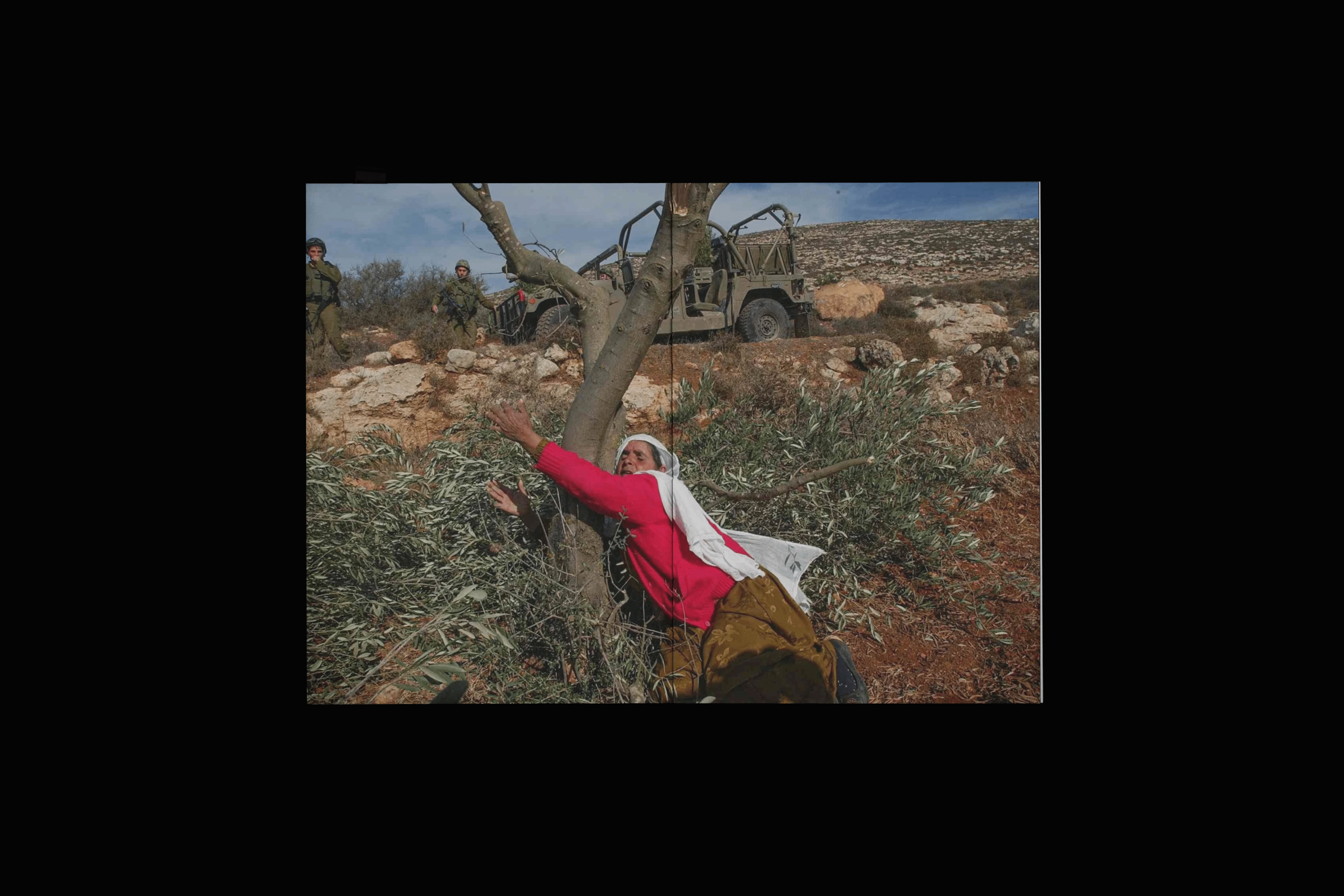
But sustaining society goes beyond food and medicine; it is tied to collective memory and national identity. Palestinian women have not confined their role to feeding children and healing wounds. They shoulder the burden of transmitting memory and passing it on to future generations. On long nights of darkness, when children gather around their mother or grandmother, stories begin: about the village from which the grandparents were displaced, about the olive trees that resisted bulldozers, about the Nakba, the Naksa, and the Intifada.
These stories are not simply recollections of the past, but political acts that bind the new generation to its roots, affirming that what is happening today is not the end, but another chapter in the saga of resistance. Fatma Kassem, in her book, “Palestinian Women: Narrative Histories and Gendered Memory,” relies primarily on direct interviews with Palestinian women, documenting their accounts of the Nakba and the discrimination that followed, and presenting them as witnesses and historians of their homes, language, and bodies as sites of resistance. As Kassem states, “In narrating the forbidden stories of historic events, the women I interviewed reflect memory as both a personal and a collective experience. Moreover, the articulation of these forbidden stories serves to resist and subvert the Zionist national narrative.”
Through this reliance on oral memory, the Palestinian mother becomes a historian without papers or archives, preserving a history the occupation seeks to erase, and building a wall stronger than any physical barrier, than any apartheid barrier. It also provides a tool for understanding the present. The testimonies of Gazan women today under bombardment and destruction are an extension of that same tradition. As Kassem writes: “These women’s experiences serve as a window for examining the complex intersections of gender, history, memory, nationalism and citizenship in a situation of ongoing colonization and violent conflict between Palestinians and the Zionist State of Israel.” The Palestinian woman’s voice not only preserves memory, but resists colonialism.
In facing the mental trauma, women become de facto therapists in the absence of professional support too. They are the ones who sing to children to drown out the sounds of explosions, who whisper prayers and Qur’anic verses to calm hearts, who encourage children to play even amid ruins so not drown in fear. These seemingly simple acts are, in practice, protection for an entire generation from psychological collapse. In this unrecognized role lies the essence of resistance: society does not break, even if its houses do.
Beyond homes and shelters, Palestinian women in Gaza are within the very institutions targeted by Israel. In hospitals, they work as nurses, doctors, and volunteers despite shortages of medicine and the risk of airstrikes. In schools turned into shelters, teachers strive to continue educating children. Rather than a mere academic function, it has become an act of resistance to preserve the future. Teachers’ insistence despite danger confirms that Palestinian society in Gaza refuses to be reduced to victimhood, even amid ruins.
Yet Western media, dominated mostly by Zionist narratives and stereotypes, sees Palestinian women only as victims weeping before cameras. The reality on the ground is entirely different: women do not wait for anyone to rescue them, but engage in public work, organize relief campaigns, coordinate with international organizations, expose truths through social media, and even lead demonstrations. This puts them in confrontation not only with the occupation but with Western narratives about them. Palestinian women craft symbolic tools of resistance just as they fashion material means of survival.
At the family level, women remain the guardians of Islamic values and social traditions. In a society constantly threatened with uprooting, women insist on praying together, even in secret, celebrating occasions, even symbolically, and serving iftar meals in Ramadan, even with their few rations. These rituals, though seemingly small, protect both family and homeland. Through these practices, women prove that resistance is not only a rifle or a stone, but also the insistence on living life as it should be, not as the occupier dictates.

Amid the collapse of the labor market, women resort to creating small projects to support their families: sewing, preparing food, selling handicrafts, and so on. These initiatives not only provide income, but grant women relative independence and reveal the community’s capacity for adaptation. Palestinian women transform poverty into an opportunity for creativity, proving that household economic resistance complements political, military, and cultural resistance and affirming that the occupation cannot suffocate life, no matter how harsh its siege.
On the level of political consciousness, Palestinian women have developed a deep critical awareness of international discourse, reflecting their daily recognition of the world’s contradictions, where their families are killed while the West raises slogans of human rights. Kassem writes, “Palestinian women have created counter-sites of collective memory, in the private sphere, where they politicize and collectivize language, home and the body.” This political awareness is no less significant than any academic or media analysis, because it emerges from direct experience: blood spilled and hunger endured moment by moment. It is precisely this that makes Palestinian women’s testimonies a mirror of truth, free from the distortions of Western media.
None of these roles erase the heavy price women in Gaza pay. They lose husbands and children, suffer physical and psychological wounds, and live in an environment of constant fear. Yet their persistence in performing these roles stands as the greatest testimony to the strength of human will in the face of a colonial project determined to uproot them. What is happening is not simply an attempt to remain alive, but to transform survival itself into a political and moral act that confronts war and extermination by rebuilding society day after day.
The image of the Gazan woman today encapsulates every contradiction. She is fragile before the machinery of war yet strong in the face of annihilation; sorrowful yet sowing hope; a victim yet an active agent. This image affirms that women are not a marginal detail in society but its essential guardians. Through them the home endures. Through them the child lives. And through them memory is passed from one generation to the next. It thus becomes clear that preserving society in Gaza is not a secondary role for women, but the primary condition for Palestine’s very survival. Women do not merely safeguard what remains. They reinvent, each day, a new form of life amidst death, proving that resistance is not a choice but an existential necessity, and that survival itself has become a form of defiance.
Freedom of the press is under attack! Support our work and let us continue to uplift marginalized and working class voices. Become a member or subscribe to our print publication today. Tiers range from $3-15/month.

.jpg)
.jpg)