
Hit Enter to Search or X to close
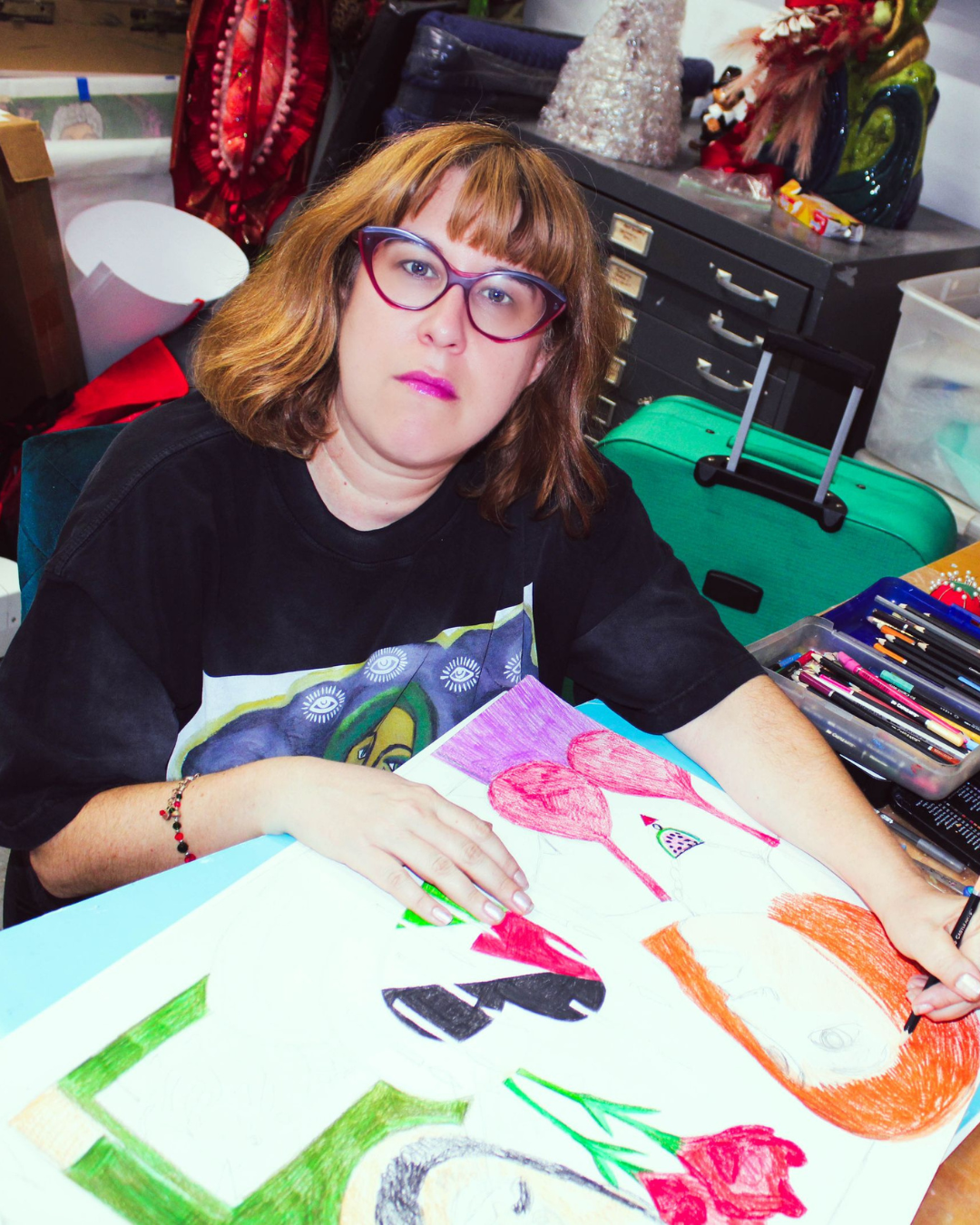
Shadowbanned Magazine: Thank you so much for joining us today, Rebecca. We’re excited to dive into your journey as an artist and activist, especially with your recent work on the Gaza Quilt project. Let’s start with the big question: how did your experience as part of the Missile Dick Chicks shape your current approach to art activism, particularly in relation to Palestine?
Rebecca: Thank you for having me. My activism really began after 9/11 when I joined the Missile Dick Chicks, an anti-war protest group. At the time, what concerned me most wasn’t just the Iraq War but the rise of Islamophobia. I’ve always been deeply involved in community-based education and working with marginalized groups in New York City, and that definitely influenced how I approached activism. With the Missile Dick Chicks, I often found myself speaking up about racism within the movement, especially how it was affecting Muslim communities. My focus was on highlighting systemic racism, and I think that brought a different angle to the group. I also learned a lot about the power of collaboration—how art and activism can come together. We had this giant missile truck we drove around the country, and I got to paint it! That hands-on experience, working with artists from different disciplines like dancers and singers, made me fall in love with the collaborative process. It set the stage for my later work, especially in filmmaking and curating collaborative actions.
Shadowbanned Magazine: That experience clearly laid the groundwork for your activism. Fast forward to now—how did you first become involved with Palestine’s struggle?
Rebecca: It was a gradual process. Before I fully understood the depth of the issue, I was following activists like Linda Sarsour, whom I admire greatly. I didn’t fully grasp the gravity of the situation in Palestine until after October 7, when everything erupted. But I’d been working in movements like Black Lives Matter and the Women’s March, and I had been out in the streets with people like Linda, who had been pushed out of the Women’s March for speaking out on Palestine. I knew something wasn’t right about that, and it was the start of my awakening. Once October 7 happened, I realized I needed to fully educate myself on Palestine. Why didn’t I know this already? Why was this information hidden from me? I went down a rabbit hole of research, and once I was better informed, I started speaking out immediately. Of course, I received backlash, but I had people like Linda and my understanding of systemic oppression to back me up.
Shadowbanned Magazine: That awakening led to some powerful work. How did the Gaza Quilt project come about?
Rebecca: The Gaza Quilt was born out of a conversation with a group of artists who were struggling with losing work because of their pro-Palestinian stances. The project grew organically from there. I knew I wanted it to be both a collaborative art project and a direct act of resistance.
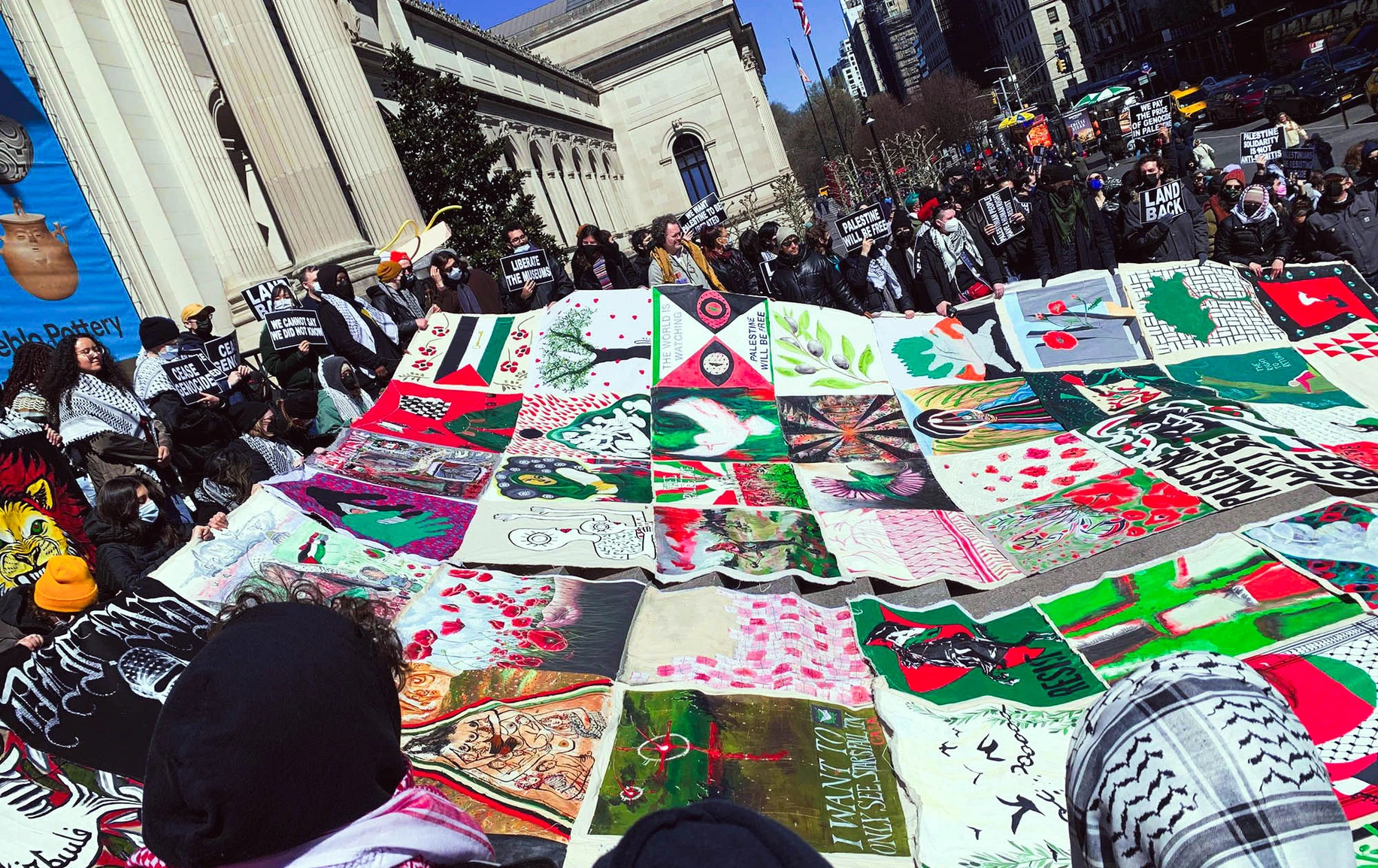
One day, someone in the group suggested making a quilt. I immediately thought, Hell yeah, let’s do it. Quilting is such a communal act—people from all over the world could participate, contributing their unique voices. We decided on a square size of 40 by 40 inches to give it a large, striking presence. The idea was for people to create their own artwork expressing their feelings about Palestine, with the colors of the Palestinian flag as the unifying theme.
Shadowbanned Magazine: And the response was global, right? Did you expect that kind of participation?
Rebecca: Honestly, no. The international response was overwhelming in the best way possible. It started in our online group, Hope in the Art World, which included artists from Europe, Canada, and beyond. Many of them were from places where it was hard to show support for Palestine, so this became a way for them to be part of something bigger. The quilt became a symbol of solidarity—not just among artists but among people looking for ways to express their anger and grief.
Some contributors were established artists, while others had never picked up a paintbrush before. That range of voices made it all the more powerful. The quilt became a platform for conversations about complicity, colonialism, and decolonization.
Shadowbanned Magazine: The quilt’s unveiling at the Met must have been a pivotal moment. Can you tell us about that?
Rebecca: It was unforgettable. We planned an action at the Met where we unfurled the quilt. There was so much energy and anticipation. It wasn’t just about us—it was about what the quilt represented: claiming space and saying, We’re not backing down. There was a little tension with the police, but we made it happen. It was an emotional moment when the quilt was finally unfurled on the steps of the Met. It wasn’t just art; it was resistance. The Palestinian dancers and activists who participated brought an incredible energy that made it even more powerful.
Shadowbanned Magazine: That sounds like a defining moment. How did the quilt continue to live on after that?
Rebecca: It became a tool for further action. After the Met, we took it to other demonstrations and events. It’s modular, so we could take it apart and bring it to different places. It became an active piece that connected different actions. The quilt wasn’t just something that sat in a gallery—it became part of the street-level resistance. We also shared the stories behind the squares. Many artists, whether Palestinian or not, shared personal connections to the cause. That’s what made the project resonate so deeply. It’s not just a visual piece of art; it’s an ongoing conversation, a living document of solidarity and struggle.
Shadowbanned Magazine: The art world is often seen as a space for radical thought, yet there’s been significant hesitation around Palestine. How have you experienced this?
Rebecca: The silence has been staggering. I remember when a publication ran its first article about Palestine under a new editor. It was sweet but honestly pathetic—they didn’t even attach a byline. It was just a generic “staff writer” credit like they were hiding. Meanwhile, the Gaza Quilt got coverage in Hyperallergic, Artforum, and even a feature on Democracy Now, which was heartening. But the broader art world? Mostly silent.
Shadowbanned Magazine: Why do you think that is?
Rebecca: Fear. People are scared of losing jobs, commissions, and opportunities. Early on, we stayed anonymous with the quilt because I didn’t want anyone facing repercussions. But eventually, I reached a point where I thought, I couldn’t live with myself if I stayed quiet. If this were the Holocaust, I’d want to be the person who spoke up. So I started posting openly, even knowing the risks.
Shadowbanned Magazine: The quilt clearly resonated widely. Do you know if people on the ground in Gaza are aware of the quilt?
Rebecca: Actually, one day I got a message from a man named Mo’min. He said he loved the quilt—it meant a lot to him as a Palestinian. He told me he was a dentist in Gaza and missed his work deeply. We connected over our shared passion for what we do. Then I saw his GoFundMe on Instagram. I told him I wanted to help. My group had been selling prints from the quilt to raise money for UNRWA. However, After, watching the Instagram Lives of activist Eman Mabrouk who was raising funds for families one at a time. She inspired me to do the same thing for Mo’min and his family. Now Mo’min and I sell prints and tees on Etsy under the shop name HopeWorldTees. We are total partners in the operation and we have developed a very close relationship.
Shadowbanned Magazine: Your connection with Mo’min seems to have deeply influenced your art. Can you talk about that?
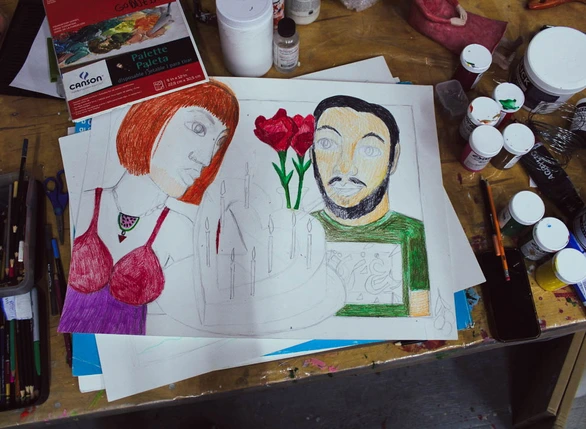
Rebecca: Oh. Lately, I’ve been drawing him all the time. The first one I made—I still have it here—and I have smaller ones too. I’m trying to collapse the space between us in these drawings, to create this fantasy space where we’re together. It’s like a form of defiance against the separation.
Shadowbanned Magazine: How does the distance shape your creative process?
Rebecca: It’s frustrating. He can’t go anywhere, which is heartbreaking. So, I imagine what could be. Like, he mentioned picking olives the other day, so I thought of surrounding a birthday drawing with olive branches and foods we’d have if we could celebrate together. My work always fixates on stories from my life, transforming them into drawings, videos, costumes, ceramics—sometimes even books. This one feels different because it’s rooted in a physical obstacle: occupation and violence.
Shadowbanned Magazine: The quilt continues to have such deep resonance. Given the shifting landscape of activism and increasing repression, how do you see the role of art in resistance going forward?
Rebecca: Art is always a tool for resistance—it can bypass censorship and speak directly to people’s emotions. Right now, we’re seeing an intensification of fascist policies, not just in the U.S. but globally. That’s why it’s so important to keep finding new ways to circumvent the systems that try to silence us. Activism today might look different than it did a few years ago, but one thing remains the same: the need for solidarity. The quilt showed me that when we come together, we can make something bigger than ourselves, and that’s what makes it impactful. Even in the face of increasing repression, we keep pushing forward. We keep creating because, as long as we keep telling the truth and supporting one another, that’s the most powerful form of resistance we have.
Shadowbanned Magazine: Thank you, Rebecca, for sharing your journey with us. Your work is a reminder that art can be a powerful force for change, and the Gaza Quilt is a testament to that. We look forward to seeing where your activism takes you next.
Rebecca: Thank you for the space to share this story. I’m grateful for all the people who came together to make the quilt a reality, and I’m excited to continue using art as a form of resistance in the future.
You can support Mo'min and his family in Gaza by purchasing a HopeWorldTee here.

.jpg)
.jpg)