
Hit Enter to Search or X to close
)-min%20(3).png)
Conservatives have spent years warning that queer and trans people pose some vague threat to public morals, bathrooms, schools, and, depending on the news cycle, the very fabric of civilization. But, if you look at the actual data instead of the moral panic, a far stranger picture emerges: The very states passing the harshest LGBT laws in the country are also consuming the most gay and trans pornography. The Bible Belt isn’t just “finding Jesus” it’s also finding PornHub, often with remarkable enthusiasm.
In 2025 alone, more than 1,000 anti-trans bills have been introduced across 49 states, and 124 have already passed, according to the Trans Legislation Tracker. Transphobia is not just policy now; it’s a full-time legislative hobby, an annual competition to see who can most thoroughly criminalize someone else’s existence. New Hampshire’s HB712 makes it illegal to perform top surgery on minors unless it’s for things like gynecomastia, a condition that causes people assigned male at birth to grow breast tissue. Turns out it’s totally fine to “mutilate children” if it conforms to the status quo, even in blue states like New Hampshire.
North Carolina, meanwhile, dragged itself back to 2016 with Senate Bill 516, yet another proposed bathroom bill that not only would require trans people to use restrooms at certain state-funded facilities, like public schools and violence shelters, based on their sex assigned at birth, but embolden transphobes to sue said facilities if they suspect someone has broken the law.
But, while these conservative states try to legislate queer bodies out of public life, their residents can’t seem to stop seeking out queer bodies in private. According to PornHub’s 2025 Transgender Day of Visibility Report, users in Missouri, Iowa, and Georgia—all of which went red for at least three out of the four most recent presidential elections—watched more trans adult content than the national average. Likewise, PornHub’s 2025 Gay Pride Insights found that North Dakota jerked off to more gay porn than any other U.S. state. This year, Iowa banned teachers in grades K through 6 from acknowledging that there is anything other than heterosexuality. Yet perhaps Iowan policy-makers are in denial about their preferences, since “straight guys” was the state’s most viewed gay porn
category.
This raises the question: If conservatives are so terrified of the “queer agenda,” why does the data show conservative states consuming queer porn at some of the highest rates in the country?
The tension between public morality and private desire is nothing new, especially in places where repression passes for virtue. In the 1970s, sociologist Laud Humphreys’ classic book “Tearoom Trade” documented clandestine sexual encounters in various St. Louis, Missouri public restrooms. Over half the men he interviewed were married; many were devoutly religious. Two were even members of the John Birch Society (a right-wing extremist group). Humphreys noticed something still true today: the louder the moralizing, the more likely there’s a browser history full of “forbidden fruit.” As he put it, “the Bible on the table and the flag upon the wall” were less signs of righteousness than props to disguise “secret deviance.”
Fifty years later, the tearoom has moved online, but the pattern hasn’t changed. As researchers Samuel Perry and Andrew Whitehead found in 2020, there’s evidence to suggest that evangelicals in politically conservative states, versus those who live in progressive ones, are consuming more porn.
So what does that tell you? While Mississippi and North Carolina work overtime to legislate queer and trans people out of public life, queer content consumption behind closed doors goes through the roof. It says repression works. Just not how its architects intend. The contradiction doesn’t end when they shut the PornHub tab. Because when the speeches stop and the lights dim at conservative gatherings, that’s when the gay hook-up apps light up.
During the most recent Republican National Convention, Grindr activity surged by 166 percent, a spike so dramatic it practically turned the app into an honorary delegate. At the Charlie Kirk memorial event, the thirst was reportedly so intense that some users claimed Grindr even crashed, though the company denied any official outage. Alleged glitch or not, a clear pattern emerges: conservative spaces routinely become temporary escape hatches where repressed men indulge the very desires they spend the rest of their lives trying to legislate out of existence. These conventions are not just political rallies. They operate as unintentional queer festivals stripped of pride flags, leaving only a current of shame as attendees scroll through a parade of headless profiles pleading for anonymity and validation at the same time.
When people don’t have access to accurate information about sex, healthy relationships, or their own desires, shame fills the gap. According to the Guttmacher Institute, 43 states still mandate that in their sex education, abstinence be covered—or even emphasized above other forms of contraception. At the same time, only 16 states require students be taught about consent. And that’s to say nothing about the millions who grow up not learning about pleasure, sexual health, or queer existence. Many are never even taught how to use a condom. In places where LGBTQ communities are sparse or effectively prohibited by law or social pressure, porn becomes not just
entertainment but the only available classroom, confessional, and conversation. For some folx, the closest option may be a seven-hour drive to South Dakota, or a four-hour drive if they’re cool with crossing into Canada, according to Uncloseted Media.
Without affirming spaces, people turn inward—toward isolation, secrecy, and shame. But shame is a poor regulator. It doesn’t extinguish desire; it weaponizes it. As researchers Cara MacInnis and Gordon Hodson found, conservative and highly religious states show markedly higher search rates for “sex,” “gay sex,” and other stigmatized content. People aren’t simply seeking porn, they’re seeking the education they were denied.
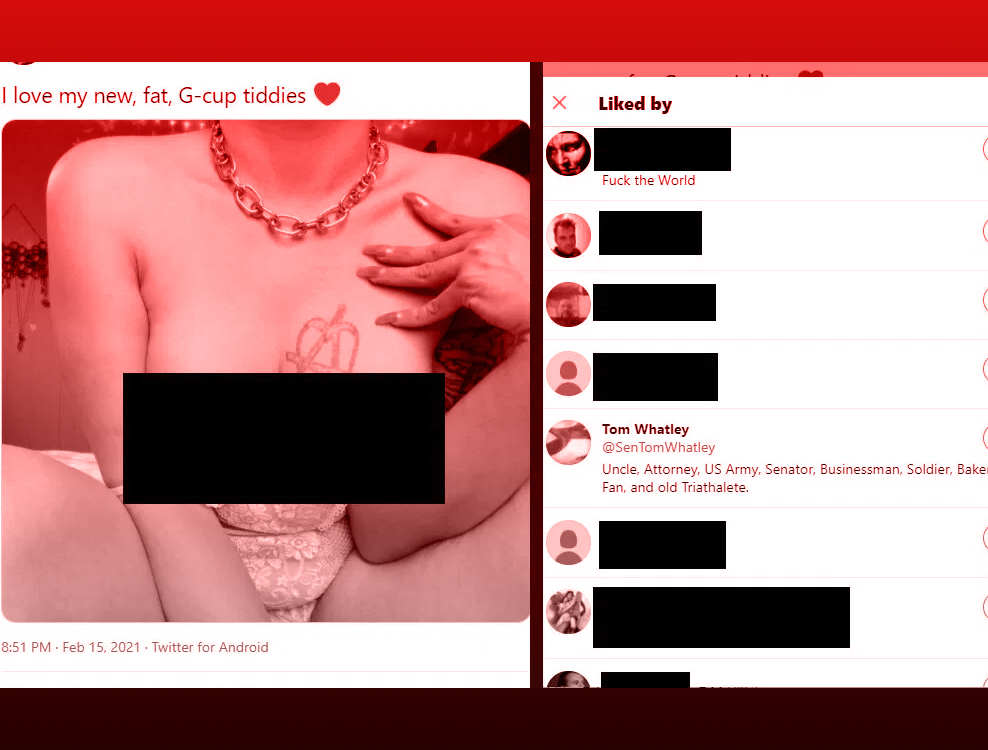
This is where repression curdles into something more dangerous.The same culture that hyper-polices sexuality and gender expression produces people who harbor private desires they’ve been taught are monstrous. Instead of interrogating their shame, many displace it outward and onto queer and trans people who embody the very freedoms they were denied.This is how you get the spectacle of public figures like former Alabama State Senator Tom Whatley “accidentally” liking trans porn on Twitter, or Alex Jones claiming trans porn “just pops up” on his phone “hundreds of times.” Or North Carolina’s former Lt. Gov. Mark Robinson, who has compared LGBTQ people to “maggots” and commenting on his love for transgender porn on adult website message boards.
Julia Serano’s work on the eroticization of the “Other” helps explain why. Stigmatized identities become taboo objects of desire—desired because they are taboo. The more violently a society represses trans people, the more intensely certain members of that society eroticize them. The line between hatred and arousal becomes disturbingly thin, this also explains why conservatives view trans-people as solely being sexual objects,because that is the only way they are used to seeing them, which futher contributes to their dehumanization.Instead of confronting their internal conflict, many conservatives turn it into a crusade. They write laws to punish others for the desires they cannot control themselves. They conflate visibility with temptation, equality with threat. The shame that should belong to their own hypocrisy gets displaced onto queer and trans people. A scapegoat to bear the sins of a nation that refuses to have an honest conversation about sexuality.
Sure, it’s tempting to mock the hypocrisy and laugh at PornHub analytics or note how the loudest moral crusaders somehow always have the busiest browser histories. But the consequences of their repression are not funny. They’re deadly. Trans people are losing lifesaving healthcare. Queer kids are being outed, punished, or erased in schools. Anti-trans violence keeps rising. This is what happens when the private shame of a few powerful men becomes public policy. Their refusal to confront themselves turns into a campaign to control others. Repression doesn’t stay private, it metastasizes. What begins as self-hatred becomes stigma, then hatred, then law. Along the way, the same culture that forbids healthy sexuality breeds the very abuses it claims to oppose. When people are taught their feelings are sinful, those feelings don’t vanish—they sour. They leak out through addiction, obsession, coercion, and misconduct. The long history of sexual exploitation and abuse among pastors, politicians, and “family values” leaders is not a collection of flukes; it is the natural byproduct of a system built on shame.
In the end, this isn’t a story about porn or platforms. It’s about anti-LGBTQ+ crusaders whose careers are built on denying their own humanity. Their obsession with policing queer and trans lives isn’t moral—it’s fear. Fear of desire, of vulnerability, of parts of themselves they won’t face.That fear becomes policy. Kids lose health care. Families lose safety. Communities lose dignity. Private shame turns into a political project that punishes anyone who lives honestly. Repression isn’t conviction; it’s collapse. And until we stop mistaking their self-loathing for principle, the harm will continue.


.jpg)
.jpg)