
Hit Enter to Search or X to close
Over the past five years, Americans have increasingly engaged in community care, mutual aid, solidarity, and collective action in response to a series of overlapping crises. At the same time, we are witnessing a global surge in authoritarianism, climate disasters, and the deepening impacts of racial capitalism. We continue iterating and articulating more radical community-driven crisis response, learning and implementing compassionate harm reduction interventions and methods under a capitalist system. We, BIPOC and/or others with marginalized identities, are experiencing an activation of our ancestral knowledge as descendants from survivors. From a global pandemic to the LA fires to the liberation of Palestine we are accepting that community is faster than government, and the phrase “we take care of us” has been at the forefront of crisis response and resistance. One thing is clear to me - we cannot do anything in isolation, and community strength is critical to survival. Like mycelium, we need to work our networks underground, and connect with each other to form strong, expansive units.
The more things unravel in Empire, the more I embody and draw upon the strength of my belligerent Manobo indigenous ancestors, who fiercely modeled resistance and continue to defend our land from multinational corporations to this day. For hundreds of years, our tribe in Southern Philippines resisted Spanish colonization, American occupation, Japanese occupation, Christian missionaries and now,multinational corporations who are exploiting our natural resources. On the other side of my lineage are more current ancestors, who were disappeared by the Marcos Regime (a US-backed kleptocracy) in the 70’s and 80’s, because they organized the People’s Power Revolution, ousting a (US-backed) dictator from power. Today, as a Filipina woman in the diaspora doing liberatory work, I find myself responding to the boomerang effect, a concept, actually, a warning, from theorist Frantz Fanon. The theory that colonialism and imperialism will eventually haunt the Empire, which is happening now, as violent American foreign policy comes home to roost in Trump’s America. Filipinos - like many brown people from the global majority, are accessing internal tools, ancestral wisdom and experience to guide us through yet another period of turmoil. It has been heartening to watch other immigrant or second generation comrades similarly rise up and dig deep within themselves to organize their communities, the way our ancestors did. It is my belief and hope that we all rise up together to build a new world. I am reminded of our very own Larry Itliong, one of the “manong” farmers from the Philippines, brought to the US to be a union scab as Mexican farmers organized themselves against exploitative labour practices. He led Filipino farmers who instead, teamed up with the United Farmers Workers Movement in Southern California, building a coalition with Cesar Chavez and Dolores Huerta. The Tagalog slogan, “isang bagsak!” means “we fall as one!” was the movement’s battle cry, a reminder that community defense requires us to be in solidarity with one another.
My background has been in global disaster relief and communications, but in 2020, Ifound myself meeting the moment in my own hometown - New York. As the Regional Head of Communications for a disaster relief organization during the onset of COVID-19, I worked with BIPOC and immigrant communities to provide and promote mass testing in NYC when it was not widely available and skepticism was rampant. Our government had failed our communities on the city, state and federal levels in responding to the novel virus. This scrappy organization, led by a Hollywood actor and my mentor, a seasoned urban planner, Korean-American woman and disaster relief responder, stepped in across the nation to mitigate the humanitarian crisis that was unfolding. The strategy in New York was harm reduction through behavior change, which was contingent on a hyper-local level, with each individual making decisions towards the collective and according to our local context and needs. What emerged was the normalization of neighbors checking in on others, organizing food and necessities distributions, formation of mutual aid groups and a consciousness which put capitalism and institutions under a microscope. There was also a consciousness that while we were quarantined, we were all still interdependent. While responding to COVID-19, our messaging at it’s core hinged on community care and cohesion - we wear masks, distance ourselves, wash our hands, so the elderly woman down the street - someone’s mother, sister, auntie, wife, who we drop groceries off to, will not get the virus and suffer or die. All of our materials were translated into the appropriate language to serve the population, all of our staff reflected the communities we served, because we were FROM those communities.
In the backdrop of the pandemic, there was civil and racial unrest, as Americans confronted the American myth and systems of oppression and racism which lies underneath…everything. Between BLM and Anti-Asian Violence, more and more BIPOC became acutely aware of systems of oppressions and their intersections, but on the other side of that, we were building coalitions. At work, I had a weekly call with my counterparts in other cities - Chicago, Atlanta, LA, NOLA and Navajo Nation, as we shared interventions that worked for our communities, crystallizing the idea that community strength is at the heart of any effective response to crises. I am extremely proud of the work I’ve done, but I can not forget the day-to-day experience of uncertainty, anxiety, and an intangible “enemy” we were fighting against. I can’t forget it, because under the Trump Administration it has returned. A former co-worker from my COVID-19 response days, who now also works in immigrants rights remarked, “the intensity of this work feels like our COVID days.” As this mix of dread and courage, despair and hope, comes back to my corporeal reality, I now have the frameworks to understand how to resist and organize, and the principles which need to be at the forefront of any community defense strategy. I feel the same sense of urgency I’m sure my indigenous ancestors experienced when finding unmelanated foreigners setting up camps on their land and threatening their way of life, and even now, when they see large mining machines and detonating devices destroying our ecosystem and extracting from the land. It’s time for me to call upon my experience and ancestral wisdom to meet this moment again as Trump threatens mass deportation of immigrants like me, many of whom are in far more vulnerable positions than my naturalized citizen status.
A few months ago, I got a job offer as Director of Development and Communications at a Filipino migrant workers association The organization I work for started 20 years ago, the organization started as an anti-war, anti-imperialist and anti-US intervention group, founded by Marcos-era activists turned domestic workers in NY. The founders-The Titas - knew the importance of community through experiencing oppression in the Philippines AND the US. They organized under the (US-supported) Marcos Regime as brilliant young minds of the nation, then fled to the Empire, mostly to earn US dollars and provide for their families, as the Filipino economy was absolutely ruined. They joined the diaspora, where their circumstances as undocumented, low wage workers gave way to exploitation in the capitalist system of the US. They founded the organization to politicize and organize other Filipinos in their position, holding each other up. The organization now has thousands of members. While the organization provides legal, health and immigration services and assistance to migrant workers, the backbone and north star of our mission is political.
My role has shifted to focus on preparing for and addressing worst-case scenarios since Trump took office.. Most of our members are low wage migrant workers, 90% of whom are undocumented, anxious and worried for themselves, their livelihoods, their families and what a second round of Trump means going forward. Many have been trafficked to the US illegally, many live in the margins of society. They became new Americans, caught in the extractive push/pull migration between homeland and Empire. Now, they in constant fear of these men in uniforms in their neighborhoods, whose aggressive presence is seen and felt, threatening to deport them and separate families. I myself, a naturalized citizen, could potentially be targeted by Trump’s racist wet dreams of deporting millions of immigrants, including naturalized citizens during his first year. Today, with the issue of mass deportation under Trump, our strategy is to build community defense by empowering every single Filipino migrant worker with the knowledge and confidence to protect themselves and each other from I.C.E. We, as an organization, are not saviors - we can never be - instead, we give people training to protect themselves and their communities, realizing their own collective power against paper tigers (who can not even enter any premises without a warrant from a judge). We imagine a scenario where worker leaders organize and prepare their apartments, buildings, work places, block by block, street by street, to deflect I.C.E. raids. To make their own safety plan and build their own rapid response teams in case others are detained, and so those with relatively more safety and privilege (i.e. having documentation) can advocate to authorities and call in legal counsel if needed. Again, it’s a preventative strategy that hinges on decisions made by individuals towards the collective, on a hyperlocal level.
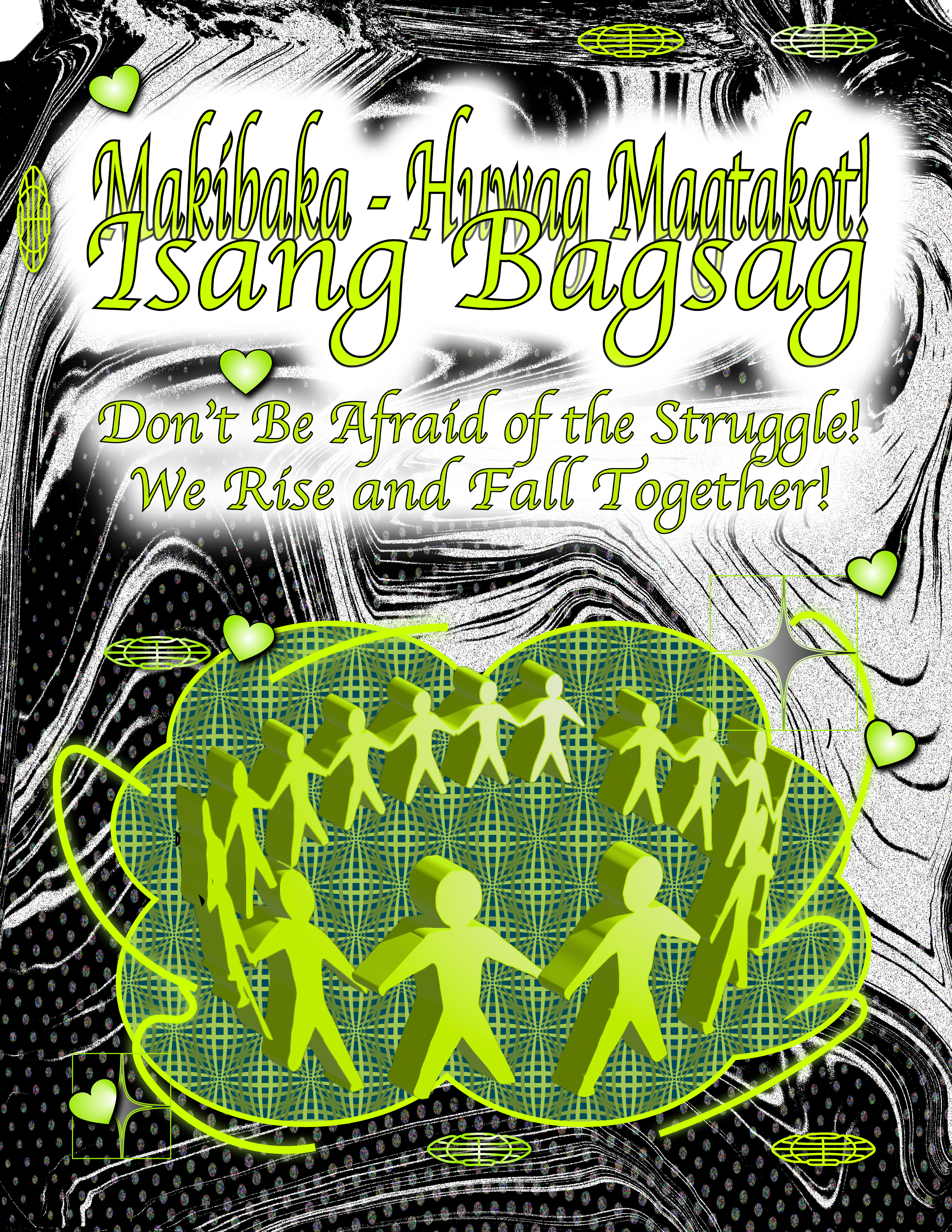
“Makibaka - huwag magtakot!” was a phrase used in the 70’s and 80’s by activists organizing against the (US-backed) Marcos regime, which many of our organization’s members and founders have lived through. The slogan translates to, “Struggle - don’t be scared!” I find myself echoing this in my head, joining the cosmological chorus of ancestors and fellow organizers and the Titas before me who fought against a dictatorship and continue to navigate life in a capitalist system that wants us dead. Decolonizing and re-indigenizing are no longer buzzwords - they are the way forward. This is the “controlled fall” or the “managed demolition” of the US empire and the American myth. Principles such as the Iroquois seventh generation decision-making and community-driven interventions hold us accountable to our descendents AND the earth. Our Black and Brown communities have the antidotes and practices to thrive, however removed we are from these skill sets due to colonialism. It is a cold comfort to know that these values are deeply apart of our history. Our communities have resisted, continue to resist, and continue to survive. No one has ever done it alone. We build our capacities and knowledge, ensuring nobody is left behind, no matter what age or situation, antithetical to the way institutions and systems of oppression tend to neglect or weaponize our differences. We make sure we empower communities by framing the situation in the larger context and sharing knowledge in ways people can understand to empower us to face what is directly in front of us. We also place OURSELVES in the context of the larger picture of our family constellations and the planet earth, dedicating our lives for the good of future generations. Resistance is set in our DNA we have experienced centuries of occupation, and with that, defiance, fearlessness and other-wordly love. Please - if you haven’t already started, get to know your next door neighbor. Develop liberatory frameworks - don’t just read it, practice it and apply it to your daily life. Get involved locally. Learn how to protect yourself and others in your community. Learn how to BE in community. Huwag magtakot, isang bagsak - don’t be scared of the struggle, we rise and fall together!
I have a checklist of things I need to do and gather to protect myself - it’s a checklist that we encourage our worker members to prepare for themselves and their families, and it’s a similar checklist recommended by UNHCR for populations under threat of displacement, because baby, we are in a crisis here in the US. As I gather my documents - passport, IDs, birth certificate, medical records, put them in an encrypted file, make copies, give them to a few trusted loved ones, put away cold hard cash and invest in crypto (sigh), it dawns on me that this is the exact thing my parents have done(except where I have crypto, they had a gun) during (the US-backed) Marcos dictatorship, and then as new Americans. I used to think it was hyperbolic, but our situation in the United States is hyperbolic, isn’t it? As we face uncertainty and roll up our sleeves yet again, we draw upon our earned experience from the past 5+ years or Makibaka -huwag magtakot! Isang bagsak! I am not afraid of the struggle, as long as we rise and fall together.

.jpg)
.jpg)