
Hit Enter to Search or X to close
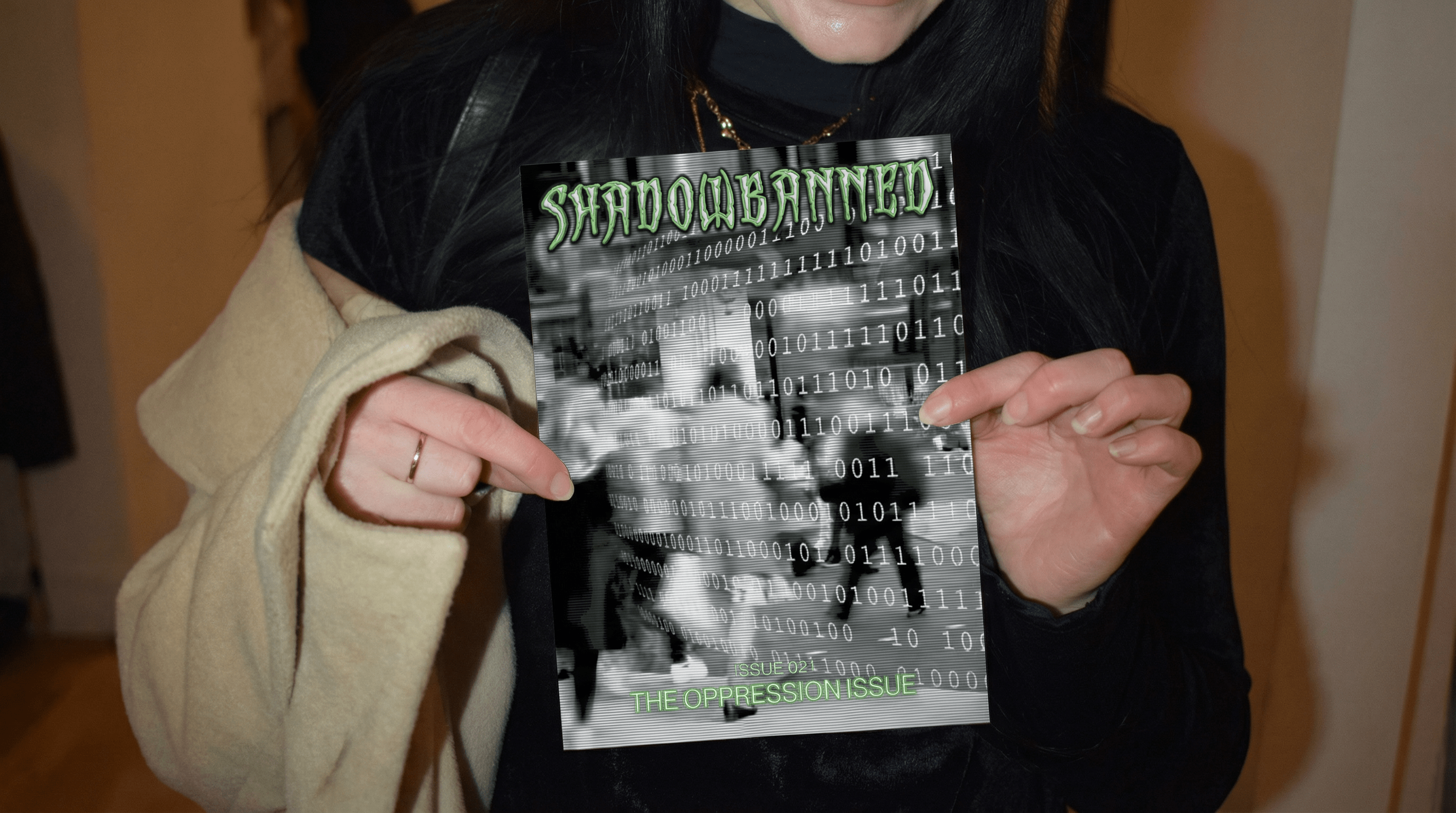
Working on issue 03 of Shadowbanned Magazine forced me to look much closer at the Christian nationalist movement. Spending time with the ideology behind it strips away the easy caricatures. It is convenient to imagine a movement made up of loud televangelists, hypocritical pastors, and people who treat politics like church camp. That picture is comfortable because it makes the movement seem unserious. But when you look at the intellectual and political infrastructure behind it, the center of gravity becomes much clearer. The engine is not faith in Jesus, salvation, or even the idea of building a better world. The engine is white supremacy.
For some people that observation might feel obvious. I used to think about their racism as something that sat beside the belief system, a kind of ugly companion belief that tagged along with evangelical politics. What became clear over the course of reporting is that the hierarchy is reversed. Racial supremacy sits at the center and theology wraps itself around it. The church becomes the cultural language through which that hierarchy is justified and protected.
Understanding that distinction matters when thinking about the current push toward confrontation with Iran. The rhetoric that is coming out of Washington is becoming increasingly unhinged. Politicians like Mike Huckabee have repeatedly described the struggle in the region as part of a civilizational battle grounded in biblical prophecy. If a war is understood as prophecy unfolding, then human suffering stops functioning as a deterrent and violence becomes confirmation that the story is moving in the “right” direction.
For anyone who did not sign up to participate in a death cult, that rhetoric should feel terrifying. The question that follows is why now?
The motivations behind escalation in the Middle East are not uniform. Several overlapping camps are pushing toward the same outcome for different reasons.
One camp is made up of Jewish Zionists in Washington and Israel who see the expansion and security of Israel as a national and strategic project. Their commitment is tied primarily to the preservation of a Jewish state and to regional power. Within Israel’s governing coalition there are also religious nationalists who view territorial expansion as part of a biblical mandate. Parties aligned with or orbiting the Likud government have increasingly pushed that interpretation into mainstream politics.
At the center of that political machine is Benjamin Netanyahu, a leader who has spent decades balancing nationalist ideology with personal political survival. Netanyahu’s political position has often depended on the continuation of conflict. He has faced corruption charges at home and an arrest warrant request tied to the war crimes he committed in Gaza. A prolonged state of emergency benefits a leader who survives politically by presenting himself as the only person capable of managing crisis.
A similar dynamic is unfolding in the United States around Donald Trump. Trump has spent much of his political life navigating legal exposure and political instability. He has faced repeated calls for prosecution tied to business practices, election interference, and other legal challenges. At the same time he governs over a deeply dissatisfied public dealing with rising costs and institutional breakdown. Pressure is also mounting for greater transparency around the Epstein files and his past relationship with convicted sex trafficker Jeffrey Epstein.
Constant political crisis becomes a useful for these autocrats to maintain their power. It fractures public attention and shifts the national conversation away from themselves. This is where the alliance with religious extremists becomes politically valuable. Like Netanyahu, Trump has demonstrated a remarkable ability to identify ideological movements, flatter them, and then use them as vehicles for his own survival. Evangelical Christians and Christian nationalists became one of the most important pillars of his political coalition.
During his first presidency, Trump delivered a series of symbolic victories that carried enormous significance within evangelical prophecy circles. Moving the U.S. embassy in Israel to Jerusalem and recognizing Israeli sovereignty over the Golan Heights were celebrated by many evangelical leaders as milestones in biblical prophecy. These moves strengthened Trump’s bond with religious conservatives while reinforcing the geopolitical goals of Israel’s nationalist government.
Those relationships point to another powerful camp driving the alliance: Christian Zionists in the United States. Their influence in Washington is enormous. The largest and most organized example is Christians United for Israel (CUFI), which has built a massive lobbying network around evangelical support for Israel.
For Christian Zionists, Israel occupies a central role in a prophetic narrative. According to their theology, the Jewish people must return to the land of Israel and establish control over it before the events described in the Book of Revelation can unfold. In that story, the gathering of Jews in Israel precedes the final war of Armageddon and the return of Christ.
Most Jewish political leaders do not share that theological worldview. But they understand its strategic value. Evangelical support in the United States translates into lobbying power, political pressure, and a reliable pro-Israel voting bloc. The result is a long-standing alliance in which each side quietly ignores the other’s ultimate motivations.
What we are witnessing now is the peak of this alliance: a war in the Middle East being fought under the banner of holy war. Independent journalist Jonathan Larsen reported that the Military Religious Freedom Foundation received more than 110 complaints from service members whose commanders framed conflict with Iran in overtly religious terms. According to those reports, the complaints came from personnel in every branch of the military across more than 40 units and at least 30 installations. Service members described briefings and messaging that treated the conflict not simply as a strategic operation but as a civilizational battle infused with biblical significance. Michael Weinstein, president of the Military Religious Freedom Foundation, told Larsen that the service members’ reports shared a consistent theme: their commanders framed the conflict as “sanctioned by the Bible” and portrayed it as a definitive sign of the approach of the fundamentalist Christian “End Times,” as described in vivid detail in the New Testament’s Book of Revelation. Weinstein noted that many commanders seemed particularly enthusiastic about the battle’s violence, emphasizing the extreme bloodshed they believed necessary to fulfill the expectations of fundamentalist Christian eschatology.
That kind of framing does not emerge from nowhere. It comes from a specific intellectual tradition within American evangelicalism.
One of the most influential figures in that tradition was Cyrus I. Scofield. Scofield helped popularize a system of biblical interpretation known as dispensationalism. Unlike earlier Christian traditions that treated biblical prophecy symbolically or as spiritual allegory, Scofield argued for a literal reading of prophetic passages. In his interpretation, the modern nation of Israel had to be physically restored before the final events of history could unfold.
Scofield’s ideas spread widely through the publication of the Scofield Reference Bible, released in 1909 by Oxford University Press. That edition embedded Scofield’s theological commentary directly alongside the biblical text, giving his interpretations enormous authority among readers. The book became deeply influential within American evangelical circles and shaped the worldview of generations of pastors, politicians, and voters.
Scofield himself was hardly a universally respected theologian during his lifetime. Before entering ministry he worked as a lawyer and was connected to a forgery scandal. He had served in the Confederate Army and spent years moving through different professional identities before establishing himself as a religious teacher. His work gained legitimacy in part through connections with wealthy patrons, including the Wall Street lawyer Samuel Untermeyer, who helped facilitate the publication and circulation of Scofield’s Bible. It is in this connection that the seeds of the unholy alliance between American evangelicals and Zionist political interests were first sown.
The theological framework Scofield helped popularize contains a particular view of world power. Nations that support Israel are understood to be favored by God. Nations that oppose Israel or fail to embrace Christianity are interpreted as cursed and inferior beings. In this worldview, geopolitical hierarchy reflects divine approval. Wealth, military power, and technological dominance are taken as evidence of God’s blessing.
For much of the twentieth century, the global position of the United States appeared to reinforce that belief. America possessed overwhelming military power, dominated the global financial system, and presented itself as a moral beacon. Truly living up to the idea of being “a shining city upon a hill.”
But the twenty-first century has complicated that narrative. The United States is experiencing declining life expectancy, deteriorating infrastructure, stagnant education outcomes, and deep political fragmentation. Internationally, American influence faces increasing competition from rising powers such as China. At the same time, economic anxiety and technological bubbles, particularly around artificial intelligence speculation, have created a sense of instability at home.
For people whose worldview depends on the idea that America’s dominance reflects divine favor, this shift produces intense cognitive dissonance. If the United States begins to look less like god's favorite and more like hell on earth, the theological narrative starts to break down. If non-Christian countries achieve technological or economic superiority, the hierarchy that once felt self-evident begins to wobble.
Faced with that contradiction, believers have two choices. One option is to reevaluate the belief system itself. The other is to reinterpret world events in a way that preserves the prophecy.
Armageddon solves the problem.
The contradictions in their worldview vanish when framed through prophecy. When the world starts falling apart, it does not mean their belief system is wrong. Instead, every sign of decline confirms that the final battle has begun. Economic instability, political chaos, and military conflict are not failures or mistakes—they are proof that prophecy is unfolding. War becomes a necessary step toward the divine victory they have been waiting for, a way to make reality match the story their ideology has already written. In this framework, catastrophe is not something to avoid but something to welcome, and the more the world unravels, the more it reinforces their sense of certainty.
This is what makes the current moment so unsettling. The United States contains powerful political networks shaped by a theology that reads catastrophe as validation. Leaders like Trump understand how to weaponize those beliefs for political gain, just as Netanyahu has learned to mobilize nationalist fears to extend his own grip on power. Each man benefits from a permanent atmosphere of crisis. Each relies on ideological allies who see conflict as destiny.
History shows that empires rarely collapse quietly. But the possibility that some leaders might prefer an apocalyptic finale to confronting the limits of their power introduces a darker possibility. If the collapse of a racial and religious hierarchy feels intolerable, some will choose destruction over adaptation.
We are watching that process unfold in real time.

.jpg)
.jpg)