
Hit Enter to Search or X to close

Since returning to office in 2025, Donald Trump has escalated his administration’s war on immigrants. Through sweeping executive orders, mass deportations, and the expansion of ICE’s power, his policies have torn apart families, criminalized asylum seekers, and turned cities into battlegrounds for immigrant rights. In the face of this repression, grassroots organizers are fighting back. NYC Ice Watch, a coalition of abolitionist activists, has been on the frontlines—tracking ICE raids, and building networks of protection for undocumented communities. I sat down with a founder of the group to discuss their strategies, the impact of Trump’s policies on the ground, and how their work fits into the larger struggle for justice in a country that has always treated immigrants as both essential and expendable.
SHADOWBANNED MAGAZINE: What drew you to intervene specifically with ICE?
NYC ICE WATCH: A lot of the founders met each other during the pandemic, organizing protests to demand the release of people in jails and ICE detention centers who were exposed to COVID-19. We started the “Freedom All” protests in the spring of 2020, happening every Friday. Then, during the George Floyd uprising, our group chat exploded. Everyone wanted to know where the action was, and out of that chaos, ICE Watch was born.
SM: Can you speak to the intersection of George Floyd’s murder and ICE’s actions?
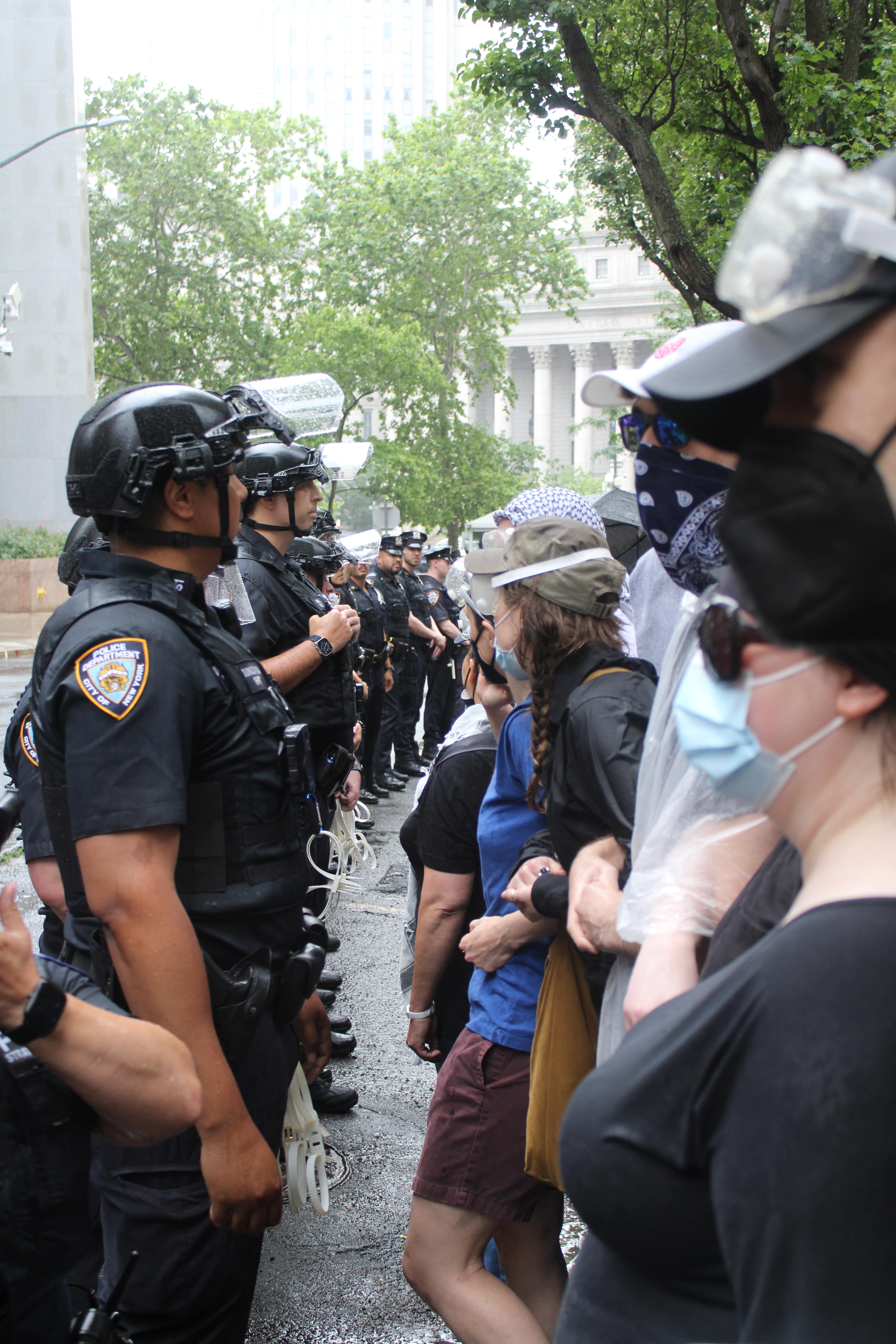
NIW: These systems of oppression are connected. One of the times we spotted ICE was when they were guarding the DeKalb Avenue precinct during the George Floyd uprising, which is a violation of sanctuary city laws. The police captain had directly called ICE. It’s clear what ICE gets away with—violating sanctuary laws, using drones, tracking people—sets a precedent for other agencies like the NYPD to follow.
SM: What about other struggles like labour rights and climate change?
NIW: Everything is interconnected. Immigration justice is racial justice, and if you really want to engage with immigrants, you need to talk about labour. Standing up to an employer isn’t so different from standing up to a police officer or an ICE agent. That solidarity, those political education conversations, need to happen on a deeply personal level and then be tested in real-world actions. Climate change adds another layer of urgency. As the climate crisis intensifies, more people will be displaced, creating more refugees. This will exacerbate existing injustices, from racial profiling to exploitative labour practices.Shadowbanned: That reminds me about how employers weaponize ICE In 2001, Tyson Foods, one of the world’s leading chicken processors, was indicted on charges that it recruited undocumented migrants to work in its plants across the rural United States. In the following years, Tyson engaged in an operation to purge the largest chicken plant in the country of hundreds of unionized immigrant workers, relying heavily on the Social Security Administration’s controversial “No-Match” program to shape its termination practices
SM: What are some effective ways to challenge employers who might call on their employees to squash labour rights?
NIW: Raids in New York City haven’t happened in a long time, luckily. Yeah, that would be a regular situation if that happened here. I think the difficult thing is that very often labour organizers stay siloed in labour, and immigration organizers stay siloed in immigration. We need to bring together all the different tools. For example, in Westchester, there was a Home Depot where a lot of migrants hung out to do day labour, and the store called ICE on them. The National Day Labourer Organization and United Community Center of Westchester Inc. showed up with several hundred people and a mariachi band to protest outside Home Depot, targeting both the racial and immigration aspects of the issue. Actions like that are going to be necessary if corporations are going to be held accountable for collaborating with the fascist machine.
SM: How do you empower communities to resist ICE and anti-immigration policies?
NIW: We train communities to stand between ICE agents and the people they’re trying to detain. We focus on educating people about their rights without being condescending, encouraging them to document ICE actions, organize neighbourhood defense, and intervene safely. ICE watching is like Cop watching—it’s about being organized, reacting quickly, and ensuring operational security while avoiding paranoia
SM: What was your reaction to Trump’s re-election news?
NIW: One of our comrades put it best: “We’re going to have Eric Adams for two years and then Trump.” We weren’t surprised. Honestly, a lot of it has come from Democrats. For example, Eric Adams has been talking about getting rid of sanctuary city status since the Venezuelans kicked the cops’ asses in Times Square last year. It’s been coming, and it’s been obvious. Anyone who doesn’t see that just has too much love for Democrats. So, we’ve been preparing as best we could. I do think a lot of people are being reactivated now that Trump is back, and instead of scolding them, we’re focused on giving people the tools and building the infrastructure to resist.
SM: What are your main priorities moving forward?
NIW: We’re focused on sustaining working-class involvement and avoiding burnout. This means offering practical support like childcare and ensuring we’re prepared for long-term struggles. We’re building for future generations, not just for short-term victories. Our priority is creating resilient structures that can withstand the pressure of systemic oppression.How can allies support immigrant communities?NIW: Cut the virtue signalling. Focus on making material differences in people’s lives. Do they need a place to live? Squat them in an apartment. Do they need a lawyer? Find them a lawyer. And I think the important thing is: what would you do? How far would you go to stop somebody from getting kidnapped by the deportation police? Would you put your body on the line? There are plenty of people who show up to protests and get arrested for nonsense reasons because they weren’t paying attention, like screaming at a cop. It’s like, do that when ICE comes to pick somebody up from the neighbourhood, you know? Join an organization so that when they arrest you for doing that, you’re out quickly and facing minimal charges. Perhaps you’ve even stopped someone less privileged from getting picked up.
SM: How do you anticipate Trump utilizing ICE for the next four years?
NIW: He is trying to push boundaries and see what he can get away with. We are monitoring, and part of the training tonight was about getting people to be very detail-oriented when they report police or ICE activity to us. Like, what are they doing? Where? What unit or department are they from? Because we’re looking at things like whether they respect the sanctuary city laws—will they avoid entering a migrant shelter? Will they stay out of an elementary school? If they don’t, that’s huge news, and the gloves are off. The shelters are a scary deal because there’s no privacy there. If ICE isn’t supposed to go to shelters but does, it’s going to be harder to hide. We see them already trying to poke holes in those defenses. Such as going to the schools in Chicago. The Board of Education even released a document reminding teachers to call their supervisor if ICE shows up. People mobilizing, staying alert, and sharing information is how we can protect migrants and ultimately drain their resources until this no longer serves them. There are reports that he might mobilize the military and is trying to deport migrants to a detention center in Guantanamo Bay. But, another line of defense is how the countries he is trying to deport these migrants react. For example, Cuba already said they would not approve housing migrants on Guantanamo Bay. The president of Mexico has been adamant about not receiving migrants.
SM: How are you helping people in your community navigate through fear and anxiety?
NIW: It’s challenging. We’re focusing on helping people differentiate between what’s real and what’s rumour. This involves encouraging them to be very specific about what they see, what they don’t see, and where they see it. We’re also teaching people about their rights, how to engage in cop-watching safely, and how to report incidents immediately and effectively. We emphasize documenting everything clearly and tagging others in written updates, so the information is accessible to the entire group rather than relying on private messages to one trusted person who might be unavailable in an emergency. This way, we’re building a collective response system. The goal is to empower people to operate as part of a coordinated unit rather than feeling isolated and vulnerable as individuals.
SM: What stories or perspectives are the most effective in shifting public opinion about immigrants?
NIW: There’s a lot of jealousy. And I’ll tell you a story, right? We were canvassing a primarily African American building complex, and you asked them what the issues were. A lot of them said, “They’re picking Black people out to get apartments tonight.”We were doing some housing justice work to essentially ask them for permission to take over these empty apartments in this housing complex to move people in. And, you know, there was a process in which we asked them, like, if they knew people who needed a place to live, and everyone did. Instead of waiting in a line that never ends to get into this complex, what if we just moved them into these apartments without asking, right? Once we really talked to people about how direct action could affect them very personally, they started coming around. Later on, if they didn’t have someone ready to take over an apartment, we’d say, “Hey, you know, we know some migrants that need a place to live. Is it okay if we move them here?” I literally had someone say, “I’m a Trump voter because I think the border should be closed, but if you get here, you should get free checks and housing. So yes, I’ll help you spot an apartment for a migrant.” Once you empower people in the conversation, their ethical rules about who’s more deserving start to shift. It’s an interesting process.
SM: Since 2020, how have you perceived public opinions about immigration, and how does that affect your work?
NIW:Well, it’s the story of America that immigrants will turn on the next generation of immigrants. We literally have deliveristas or bodegueros who have been in the country for five years saying that the newest Venezuelans and Africans aren’t worth their salt. That’s a process that normally takes a generation, and it’s happening a lot faster now. I blame Eric Adams for exacerbating this on purpose. He and Laurie Cumbo, the former city councilwoman, have been specifically working to drive wedges between African Americans, Black migrants, and Latino migrants. The economy is shit, so people are looking for explanations about why the world is so shitty. We have a lot of internal introspection to do, and these are very rough conversations. The best thing white allies can do is get the fuck out of the way with their sensitivity because these are really raw, intimate conversations to be had between Ecuadorians, Venezuelans, Dominicans, Puerto Ricans, Peruvians, Mauritanians, Senegalese, and even people within various sects of Mauritania. Immigrating to this country has always been both a liberating and brutal process. That’s what I want NYC ICE Watch to focus on—giving people the tools to have those conversations and be aware when those conversations are happening. When you organize real working-class people, like at the Amazon picket line this weekend, you see Black, Brown, and White working-class people and how they talk and process the world. With things like the assassination of the United CEO, you see a vast swelling of uncensored, impolite shit-talking. That’s how real people feel, and we’re in a place where we are aiming to turn those mass expressions into intimate conversations.
SM: For those who want to contribute to your mission, what resources or support does your organization need most?
NIW: We need connections to community groups like block associations, churches, and trade unions to facilitate ICE Watch training. Financial support is essential in covering vehicle expenses, legal fees, and mutual aid initiatives. Follow us on Instagram for real-time updates on our needs, whether it’s clothing, furniture, or monetary donations. Technical skills in areas like data security and communication are also highly valuable.

.jpg)
.jpg)