
Hit Enter to Search or X to close
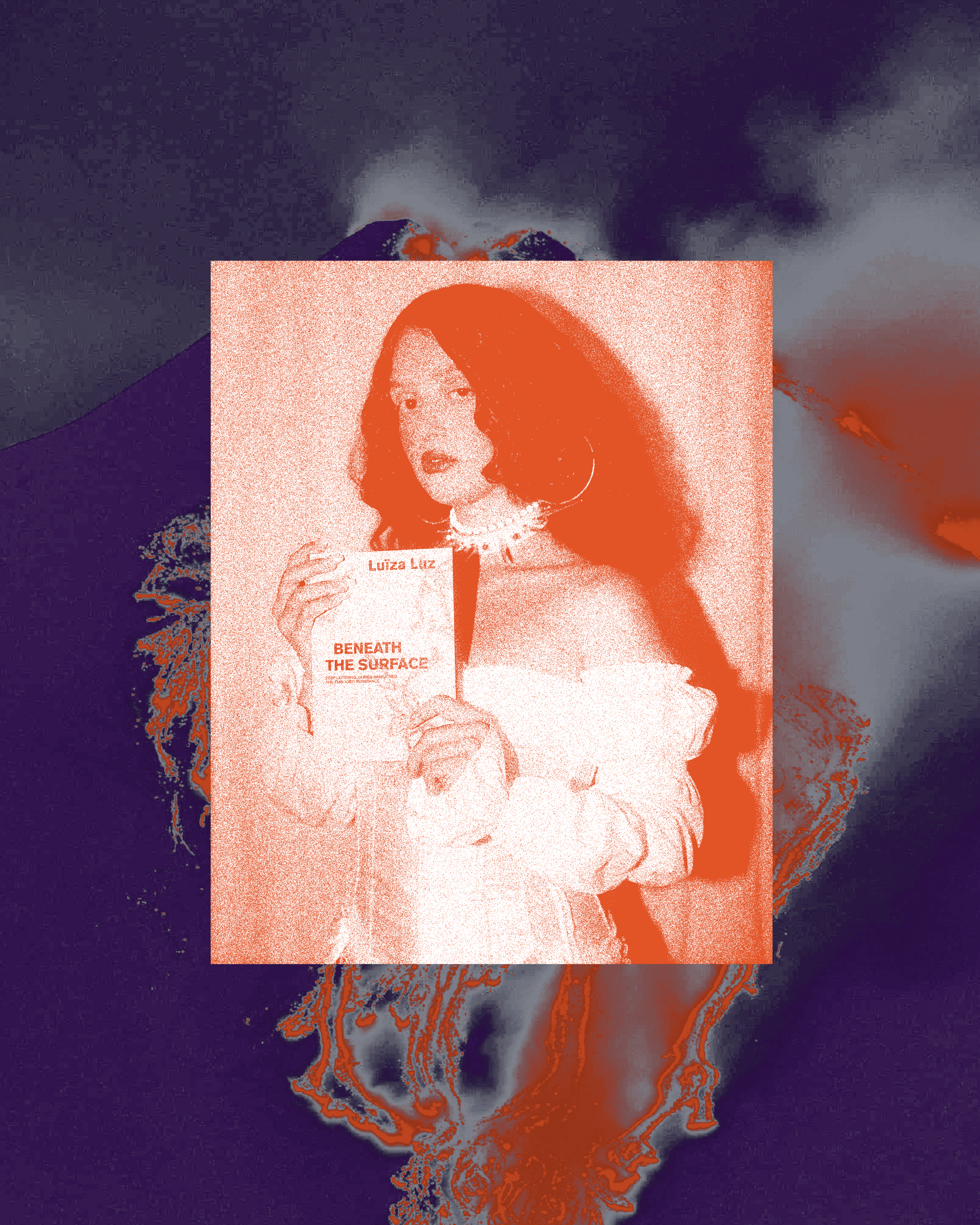
In Beneath the Surface, Luïza Luz offers a powerful meditation on how our bodies hold memory, history, and possibility. At a time when disconnection and noise shape so much of our lives, their work calls for a return to deep listening. Not just to others, but to ourselves. Drawing from experiences across Germany and Brazil, Luz examines how systems of domination are felt in the body, how silence is enforced, and how reclaiming our inner knowledge can become a form of resistance. This conversation explores the politics of embodiment, the radical potential of listening, and what it means to honor the stories our bodies carry.
SHADOWBANNED: In your book you describe the body as a kind of school as a site of deep knowledge and memory. Why do you think the Western world has so profoundly alienated us from our bodies, and how does that disconnection serve existing systems of power? Especially in societies that still rely so heavily on our bodies for labor?
LUZ: If I had to answer in the simplest possible way, I’d say: if we were truly aware of the immense power we carry within us, we would never allow this level of destruction to happen. If we were in contact with the power of our bodies, we would never accept our voices, our narratives, our ways of perceiving the world being manipulated so easily.
But a more complete answer begins with the question: what is the body? For me, the body is multiple. The ways we perceive and relate to the body shift according to our histories, cultures, environments. The body is not only human – it’s also more-than-human. There is the individual body and the collective body. The body is not just matter or flesh; it is sensation, feeling, mind, experience, wisdom. It is living, dying, transforming. It is political. It is also magical.
In the book I describe the body – human and more-than-human – as a living archive of knowledges, in plural: physical, emotional, spiritual, mythical, scientific, magical. It’s where listening occurs, and through that listening, liberation takes place. The body is a mediator between the core of the earth and the universe. It’s a messenger, receiving, holding, transmitting the wisdom needed for transformation and liberation.
I’m always speaking from my own experience and positionality, with all my limitations and privileges. But I also know my body is composed of many bodies – ancestrally, politically, spiritually. When you practice deep listening, you realize you are both an individual body and a collective body. Taking care of yourself becomes inseparable from taking care of the collective body – human and more-than-human.
Systems of oppression know this. Systems based on power over others thrive on separating us:
from our own bodies
from the body of the earth
and from each other
They create dichotomies to categorize and control: worthy/unworthy, superior/inferior, good/bad, Black/white, man/woman. They put us into boxes to maintain a fantasy of control over life. A disembodied being is easily manipulated. That’s why these systems need us disembodied. If we were present in our bodies, listening, aware of the power we hold, we would be far less governable.I also think of our generation as cycle breakers. We have the possibility to look back and say: where did I come from? Who was oppressed, and who was the oppressor in my lineage? What privileges do I have? What are my dreams, challenges, potentials? What feels uncomfortable in my body? All these questions are part of breaking cycles – not just individually, but collectively.
On fear, shame, and meeting the “shadow”
S: A lot of people seem afraid to fully inhabit their bodies. Many avoid therapy, introspection, or anything that might confront them with themselves. Why do you think that is?
L: There’s so much fear, shame, and guilt around naming what lives inside us. We avoid what is difficult. Many of us go through our entire lives pretending we don’t have a shadow – that there are no darker or more complicated parts of us to engage with.
Through my own practice, I’ve learned there is tremendous power in turning toward these difficult parts, spending time with them, trusting they can transform. That process opens space inside us. It shifts how we listen, how we speak, how we relate to others and to struggle. Deep listening is not just about being “nice” or “empathetic”; it’s about having the courage to face what we don’t want to see in ourselves and in the world.
.png)
On interdependence and the planetary body
S: Based on this journey of deep listening and somatic work, what truths have you discovered about yourself or the world?
L: This journey brought me closer to myself, to the planet, and to struggles that, at first glance, might seem like they have nothing to do with me.
Through the practice, I understood interdependence. From there I understood intersectionality. And then I realized: everything that is happening everywhere is one thing. That’s what I call the planetary dimension – the planet as a living organism beyond borders.
Borders are fictional inventions. If we center the idea of a planetary body, then what is happening in Palestine, in the Amazon forest, in the U.S., in Germany – all of it directly affects me, even if I am geographically far away. My experience and my freedom of expression here are intertwined with those struggles.
So the question becomes: how do I center care? I begin from my own experience – offering myself the right to dream, to imagine what is good for me – but I have to expand that to: what is good for us as a collective body? What is good for the body of the planet?
That is why I write, why I teach, why I speak. The practice has emancipated me from many oppressive ways of thinking and being, and I feel a responsibility as an interdependent being to share what I learn.
On somatic practice, Brazil, and rupturing Western epistemologies
S: Did somatic work come first for you, or did it emerge from your research into deep listening?
L: My somatic work is very personal. It didn’t start as a theory; it started as a practice in my own body.
I’m from Brazil, born and raised in São Paulo – a huge, industrial city, not unlike a smaller version of New York. It’s a place built on top of everything more-than-human. Rivers literally suffocated under asphalt. I studied art and education there, and my research began around ten years ago.
Through academia, I started noticing how academic thinking largely serves the imperial, colonial, Western project. I kept asking: how did we get to the point of believing there is a right and wrong way of being? A superior and inferior way of living or creating? The arts world made this especially visible – extremely competitive, obsessed with surface, constantly ranking whose expression is “valid.”
From there, I began to feel very clearly the separation between ourselves and the earth. Western thought invented “culture” and “nature” as separate categories. I found myself craving the forest, craving time away from the city. I became more curious about Indigenous wisdom in Brazil – wisdom that is powerful, but largely erased or exoticized in academia.
Back then, it wasn’t “trendy” to talk about Indigenous cosmologies in the art world. Now we see a lot of institutional interest, but also a lot of tokenization: land acknowledgments without land back; Indigenous aesthetics without Indigenous power.
I’m careful not to say that everything Western science produced is evil. But Western science has been used to justify horrific things: colonization, eugenics, extractions. It has been used to declare that some ways of knowing and being simply do not exist, or are irrational, primitive, unscientific. And that denial sits at the root of why some nations feel entitled to colonize others.
So, somatic work for me is part of refusing that epistemic violence. It’s a way of reclaiming knowledge that is not strictly visual, measurable, or “objective.” It’s about remembering that we can also learn through sensation, relation, intuition, and connection to more-than-human beings.
Listening vs. hearing
S: You describe listening as an act of resistance. Many people assume they’re “good listeners.” What are they missing? How do you define listening?
L: First, I don’t want to assume people are wrong about themselves. But I do think there’s a crucial difference between hearing and listening.
Hearing is involuntary. It’s passive. You can hear someone and still be half-checked-out, thinking of your reply, scrolling your phone, or fitting what they say into your preexisting narrative.
Deep listening is something else. In the book, I talk about listening and speaking as practices that go beyond words. They include:
non-verbal communication,
more-than-human communication,
attentiveness to bodily sensations, and
recognition of diverse narratives and voices.
Deep listening is a way of being present that prepares us to refuse the narratives of the oppressor. It prepares us to refuse to fit our bodies and lives into systems actively destroying life. It’s not just “I listen better in conversations”; it’s a political practice. It’s about staying present with what’s happening in your body, in the body of the planet, and in the bodies of others – and then acting from that awareness, rather than from numbness or denial.
Beyond “decolonize your mind”: embodiment as refusal
S: “Decolonize your mind” has become a popular phrase. Your work pushes further, toward disembodying ourselves from colonial systems and re-embodying something else. Why is it important that the work doesn’t stay just in the mind?
L: I think this is the crucial practice. We are living through crises that we couldn’t have imagined a few years ago – and they are going to keep unfolding. Grounding in the body is what allows us to stay. To not collapse, not disappear, not numb out.
Systems of power are actively trying to manipulate narratives and erase stories. We’re watching this in real time. So the question becomes: how do we keep going while being fully aware of that?
Coming back to the body helps us remain present, to feel what’s happening instead of just consuming it. It helps us question what we see and are told. It helps us refuse the idea that “this is just how the world is.” If we only “decolonize the mind” but remain disembodied, we are very easy to re-colonize.
Embodied practice gives us the capacity to receive information, question it, and then propose alternatives that make sense for a collective political and ecological body — not just for a small privileged group.
Why Beneath the Surface had to be written
S: What ultimately led you to write Beneath the Surface?
L: The book is the culmination of many years of research and practice, but it was catalyzed by my experience inside European academia.
I realized: we are very progressive at the level of speech, but not at the level of practice. We speak about decolonization, care, justice, but our pedagogies are hierarchical, disembodied, competitive, non-collaborative. They still prepare students to fit into the imperial, capitalist, colonial project – just with more sophisticated language.
We create “decolonial institutes” to study historical crimes, but we don’t support students to actually feel, process, or act in relation to ongoing ones. Students aren’t being helped to find their listening and their voice in a way that prepares them to confront the present.
So Beneath the Surface is my way of saying: we need another pedagogy. One that starts with the body, connects the individual body, the planetary body, and the collective body, and helps us refuse participation in systems that are actively destroying life It’s a methodology, but also an invitation to practice together.
Palestine, grief, and finding our voices
S: You’ve written about the weight that comes from silencing yourself. In this moment, how do you think the movement for Palestinian liberation has helped people find and own their voices, despite intense repression?
L: I feel that Palestine is holding a mirror up to the world.
They are showing us our level of disconnection, our level of insanity, our individualism, our selfishness. They are exposing the incoherence of our systems – politically, spiritually, ecologically.
We are being forced to confront ourselves: our ancestries, our histories, our complicity, our silences. Palestine is linking struggles that many people preferred to keep separate: climate, borders, policing, imperialism, media, all of it. They are teaching us how to listen differently and how to speak differently, at a planetary scale.
I won’t romanticize this. What is happening is unbearable. I have processed so much grief in the past two years. Every time I open my phone, I feel it in my body. The words “wrong” or “unconstitutional” or “not supposed to happen” are not enough. It is still happening.
But in the middle of that grief, I see how many people are being moved into speech: people who never engaged politically before, people who are risking careers, status, safety to speak out. That’s part of the mirror: it forces us to ask, what will I do with my voice?
Silence, the nervous system, and the harm we already live inside
S: As repression grows globally, some people treat silence as protection. From your perspective, what are the long-term physical, spiritual, and collective harms of enforced silence?
L: I think the long-term harm is what we’re living right now.
The harm of disconnection from the body. The harm of disconnection from the spirit. The harm of disconnection from the body of the planet and the bodies of others. This is what has enabled the world we are in now. Silence is not neutral; it’s deeply shaping what becomes possible.
One of my favorite texts is Audre Lorde’s “The Transformation of Silence into Language and Action.” She gave that speech in the late 1970s, and we still haven’t fully understood it. She asks: what are the words you do not yet have? What do you need to say? And she reminds us that we will die anyway – whether or not we speak – so what are we losing by staying silent?
That text is short, but it’s a lifetime’s work.
I also think about the nervous system here. A lot of people talk about somatics now, which I’m happy about. I truly believe we all need to learn how to regulate our nervous systems. And not as a purely individual self-care project. Regulating our nervous system is part of regulating the planet’s nervous system.
What happens inside us – our freeze, fight, flight, collapse – is linked to how we show up politically. If we’re always numb, always dissociated, always overwhelmed, we are easier to control. Somatic practice can support us to stay present enough to act, without burning out completely.
Decay, destruction, and revolution
S: You’ve mentioned that you think a real revolution is necessary – and already underway. What does active, embodied resistance look like to you, especially when uprisings can also involve fire, destruction, and chaos to our planet?
L: I’m still thinking this through, and I don’t pretend to have a full answer.
I do feel that in many places, people have reached the point where they say: enough. And there is a level of embodiment required to go into the streets, to face police, to risk your life or freedom. That’s not disembodied. That’s a very strong sense of dignity in the body.
At the same time, I think a lot about the difference between decay, decomposition, and destruction.
In ecological systems, nothing is wasted. Death becomes nourishment for new life. There is collapse and there is flourishing, but the process remains regenerative. Life continues.
Human systems, especially under capitalism, produce waste that has nowhere to go. We extract in ways that don’t allow ecosystems to regenerate. Our ways of dying, grieving, and transforming are not in conversation with the planet’s ecologies. We make it impossible not just for other beings to live, but for ourselves.
So embodied resistance, for me, is about:
actively refusing oppressive systems, and
protecting our connection to our bodies, to the earth, and to one another,
while remembering that the goal is more life, not just more rubble.
It also means recognizing that resistance has many forms: some are on the front lines; others are organizing, teaching, writing, healing, archiving, imagining. We are not all in the same position. We don’t all carry the same risks. But we all have a role.
And yes, I think the revolution is already in motion. It’s visible in the global South, in Indigenous movements, in Palestine, in student occupations, in workers’ struggles. The West is slower to catch up, but it’s part of the same planetary movement.
My hope – and what I try to keep alive in myself – is that all this pain and incoherence we’re witnessing is not just an ending but part of a transition. That we are being forced to see what is not working so we can finally refuse it and make space for something else.
We don’t know exactly where we’re going. But as long as we’re here, in these bodies, on this planet, we have a responsibility to keep listening, keep speaking, and keep acting in the direction of collective liberation.

.jpg)
.jpg)