
More to read
Keep independent media alive.
Shadowbanned is self-funded through sales, subscriptions and memberships, with no institutional support. Members keep it going.
Become a memberGet the free newsletterEssay
What Goes Around Comes Around: The Complicated Politics of Karma
How Western pop culture transformed Karma while overlooking its relationship with caste and inequality.
Is Karma a system where you get what you give? Or is Karma your Kink? Maybe Karma is the justice system that punishes the men who hurt women? But, wait, isn’t it about the person, the Karma Killer, who you truly detest and who deserves Instant Karma? A cosmic system of punishment was created to ensure that those who hurt you get their due one way or the other, which is why you keep the side of your street clean.
The Karma Police are aimed to keep you in check, warning you what every person who follows organized religion has been warned about; if you do bad, the ramifications of your actions will be a devastating punishment. But is this what it truly means? When people use it, whether in the song lyrics referenced above or daily life, to remind themselves that wrongdoers will be punished, they aren’t thinking of more than three thousand years of systematic oppression that is based on a theory called “Karma.” The caste system, based on the idea of Karma, is known as a silent apartheid where communities are segregated according to the castes they are born in, based on the deeds of their previous life.
Today, in TV shows, music, books, and movies, we see the concept being used to talk about instant punishment based on someone’s bad deed. Even Instagram’s poetic and spiritual quotes often have themes talking about universal punishment if a person hurts you. What goes around comes around? In Western pop culture, Karma has become a reward and punishment system exercised by external forces, but always in the immediate future.
What is Karma?
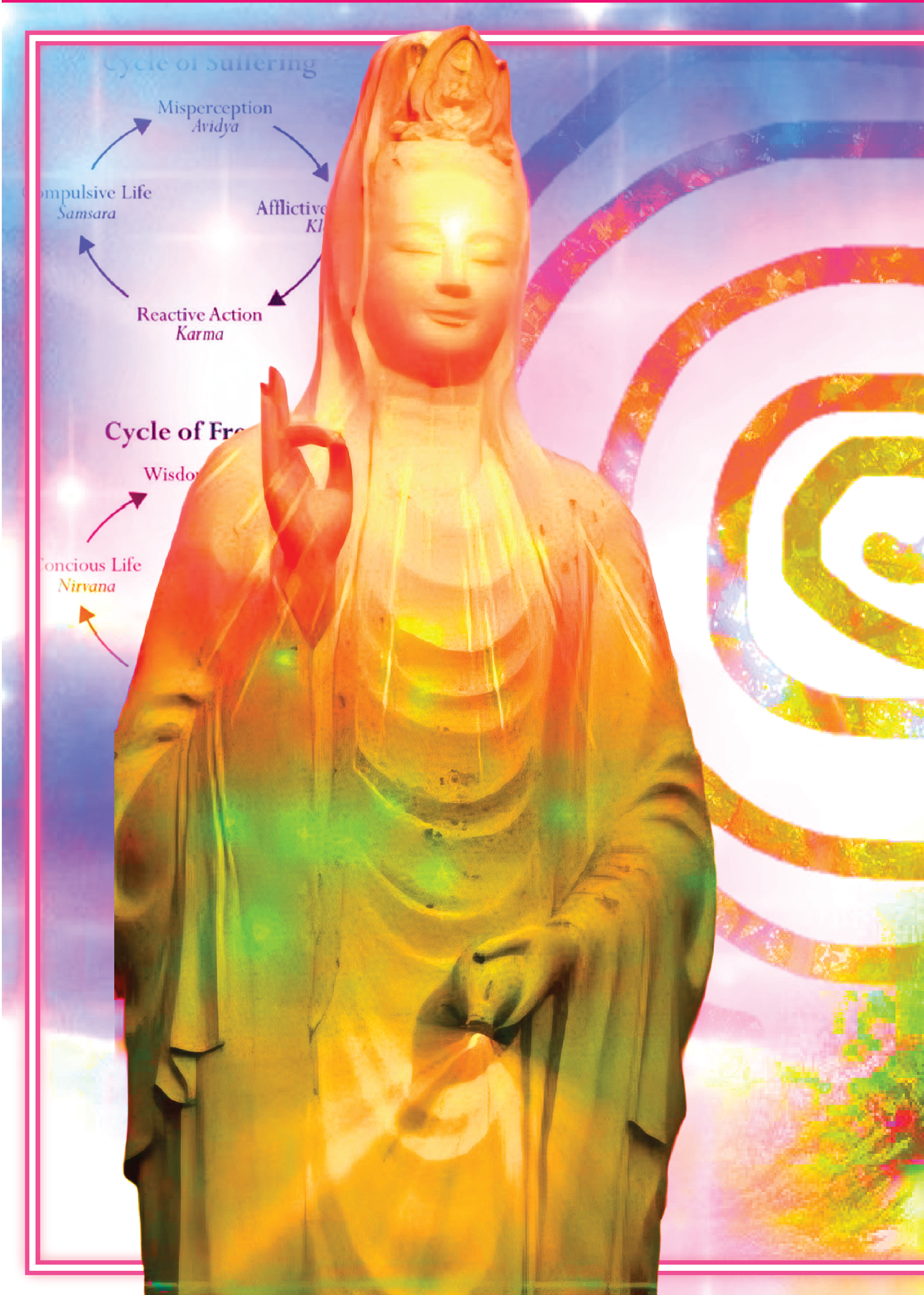
Karma is derived from the Sanskrit word karman, meaning “act.” Pronounced Kuhr-Maa and not Kaar-mah, the words signify if you are enjoying privileges in your present life, it is due to the deeds you did in your past life. In understanding this, it is recognized, for a contemporary essence, that Karma may “legitimize inequality by suggesting that the beneficiaries of positive social value (e.g, well-paying jobs, healthcare) are merely reaping the rewards for good deeds in previous lives and, conversely, that recipients of negative social value are justly paying for past wrongdoing.” As one of the leading ideologies of Hinduism, this thought process penetrates within the caste system, explained later.
One of the first understandings of why the West would prefer a simplified meaning of Karma can be rooted in its rejection of the depth and complexity of the term. Karma is an interwoven web of complexities, that speaks about receiving the fruit of your deeds in your next life, and not in the way Instant Karma is envisioned. How much discomfort would it cause to know that any form of Karma would not be instant, and if it is a real concept, would only come to form as a reaction in the next life? Karma is not a form of revenge that the universe is taking on your behalf; if anything, in its authenticity, it would only happen beyond our understanding of the average human experience. While Karma is also a theme that exists in Buddhism and Jainism, Hinduism has a more dominant narrative to it and is credited as the original creator of this concept.
If we were to look at Justin Timberlake’s song, we can see how the understanding of Karmic privilege might have seeped into pop culture. What Goes Around Comes Around explores a relationship where a man’s heart is broken by a woman he loved very much. He paints her as toxic and warns how, “What goes around comes around,” implying Karma. One particular line that stood out was, “And I was ready to give you my name.” Rooted in patriarchy, the giving of the man’s name to the woman is akin to providing the woman with a privilege, because someone is willing to give her the security and safety of a marriage. The song further goes on to shame the woman, blame her for asking him to move on, and let her know how she would be punished for what did. On top of this, Karma is illustrated visually in the song’s music video. In its conclusion, as she attempts to escape Timberlake in a high-speed car chase, she is punished by dying in a fiery crash. Of course, this is a heartbroken man’s symphony, and he probably did not think about the marginalized identity of Dalits when singing this. But this is the feeling the upper casts hold into; Dalits deserve to be mistreated, because they did something horrible in their past lives that brought them here.
Karma and its 20th Century Pop Culture Ambassadors
In the 1960s, musicians such as George Harrison and John Lennon (Instant Karma) were enamored by Hinduism, bringing concepts like Karma to the public. George Harrison developed a deep love for Hinduism, spending a long time in India learning about it. His understanding did seem to encompass the original meaning, yet the usage of it, post the immigration of the word he facilitated, failed to measure up to its original meaning and also failed to recognize the consequence of endorsing a concept like Karma.
In the 1960s and 1970s, Hinduism had captured the imagination of the West. Many scholars, Gurus, and religious leaders traveled to America to open a channel of communication regarding the religion. Some names include Sathya Sai Baba, A.C. Bhaktivedanta Swami Prabhupada, and the famous “Hare Krishna,” Guru Maharaj Ji. This went hand in hand with new immigration policies like the 1965 Immigration and Nationality Act that attracted many Indians, especially professionals and students, according to the Pluralism Project at Harvard University, to immigrate from India to the US. As an advantaged group, Upper caste people migrated in much higher numbers, something that is reflected in the US today. “The overwhelming majority of Hindus with a caste identity — more than eight in ten — self-identify as belonging to the category of General or upper caste,” says a paper published in Carnegie Endowment for International Peace.
How is the Caste System Connected to the Idea of Karma?
The caste system divides Hindus into different sections, from lower to upper. “Caste encompasses a complex ordering of social groups based on ritual purity,” The Human Rights Watch reports. Your caste is the social group you are born into, and the justification for the access you are given. If you are born into a higher caste, it is because of the good Karma you did in your previous life and if you are born into a lower caste, it is because of bad karma. Adhering to the duties that are determined by your caste, called Dharma, is integral to your religion, and those who stray are disbelievers. Brahmins are supposed to be intellectual leaders, and the Dalit community were termed as “untouchable,” forced to only work inhumane jobs such as sewage cleaning.
If it is believed that life’s privilege, especially in terms of belonging to the higher caste, is due to a good Karmic past life, then the feeling of entitlement, and justifying social privilege is something that also creeps in. Dr. B.R. Ambedkar, the father of the Indian Constitution and the most prominent Dalit leader in history, questioned the reason why Karma exists.
On October 14, 2023 Ambedkar’s statue was unveiled in the US, but does the Hindu Diaspora incorporate his thinking into their system of existence? “It is a proven ploy of assigning blame on the victim,” writes Vikash Singh in the journal Ethnic and Racial Studies . In his opinion, Karma is used to justify an ideology that oppresses, suppresses, and is violent in the name of “social equality.” Karma is a form of justice, the ideology would have you convinced. The victim of oppression is to be blamed and so is their past life; there are no structural defects that can be fixed here, rather the power resides with the universe.
If it’s popular and relevant, it is still in existence. If the atrocities against the Dalit community had ended, the impact of Karma would have been less significant, but the atrocities persist.
Dalits Facing Oppression in the World
To state why it matters so much what meaning we make of the word, or if the word “Karma” can be harmful, one must look at how it is still being used as a tool to oppress. Surely none of us root it in its oppression but rather in its liberation. Yet, is there no harm caused?
A report by Al-Jazeera shared how a 14-year-old Dalit girl in Bihar, one of India’s most populous states, was gang raped and murdered, found “naked, bloodied and with her hands and legs tied.” While rape is common, violence against marginalized people with intersectional identities, like being a woman belonging to lower caste and class, is rampant, reports feminist organization COFEM. About two-thirds of hate crimes happens against Dalits in India, according to a 2018 database compiled by Amnesty International.
Members of the Dalit community are often subjugated to inhumane degradation and violence. As Human Rights Watch puts it, “They are made to dig the village graves, dispose of dead animals, clean human waste with their bare hands, and to wash and use separate tea tumblers at neighborhood tea stalls, all because — due to their caste status — they are deemed polluting and therefore ‘untouchable.’ Any attempt to defy the social order is met with violence or economic retaliation.”
Dalits in the West Today
Discrimination against Dalits, with Upper castes in power, has now bled into systems of operation across the globe. Why now? As more Dalits are accessing education and better opportunities, more of them are migrating to the West. Yet there has been a rise in caste-based discrimination against them in their new home. Europe and the US have a growing caste problem that both government and international law have identified. Many marginalized communities from across the globe migrate to the West to safeguard their future and leave their oppressors behind and it’s discouraging to be met with the same ideology they attempted to escape.
In Seattle, a bill was passed against caste discrimination making it the first and only city in the US to have anti-caste legislation and protection. Kshama Sawant, the Seattle city councilor behind the legislation spoke about how the people who were against the anti-caste bill were mainly from the Hindu right wing, closely aligned with the Modi regime in India and the Hindu American Foundation. The HAF’s stance is clear; caste does not exist in the US, and it needs no special protection. According to a study done almost 20 years ago, only 1.5% of the American Hindu population was from the Dalit community so comparing it to India would be unfair. Yet, HAF’s own practices are often filled with bigotry, perpetuating the anti-Dalit narrative, and trying to weaken parts of the Hindu community which might resist systematic oppression. Hindus for America First went as far as to support Trump in the latest elections, primarily because Trump won’t interfere in India’s internal matters.
Circling back to Karma, the HAF, when writing about it on their website quotes Ramakrishna Paramahamsa who said in the 19th century, “Good people go through trials, but don’t suffer. With that experience, their life becomes better, not bitter.” In their own opinion, Karma is not suffering but rather trials that ensure good character development.
As protests rage across India for a better education system, with the Cockroach Janta Party leading a movement of youth in the country, the oppressors are quick to blame reservations as a one of the causes of the issue instead of letting the government take accountability. To put it briefly, NEET, the National Eligibility cum Entrance Test, is a nationwide entrance examination in India for students aspiring to pursue undergraduate or postgraduate medical and dental courses. This is an incredibly intense and demanding exam where youth sacrifice an average of two years of their life in preparation. The recent leak of these papers has led to more than 20 deaths by suicide across the country and has left a deep mental health challenge for the youth. At a time when Gen Z is struggling with job losses due to AI and a shifting economy, unemployment in India is in double digits. Millions of Gen Z in India feel that the current government does not have their back. Reservation is a system that allows, much like affirmative actions, for some seats in every government medical institution to be reserved for the Dalit community. The upper castes have often blamed reservation as a method that takes seats away from them, claiming caste doesn’t exist anymore, much like the upper caste HAF’s insistence, while still having separate utensils for their lower caste domestic help at home. For the first time, there is a generation that is refusing to give two hoots about vile discussions that blame Dalits. Long live this revolution!
Pop culture isn’t wrong, they are just not complete. Karma allows us to feel that the wrongdoers will be punished through cosmic forces, and their punishment delivered by such magnificent forces will serve them better than any justice system or ourselves. It is far more pleasurable for Karma to be about cosmic punishments for wrongdoers than to have deep, layered meanings that revolve around reincarnation, rebirth, and the division of caste-based labor. Not, you know, Taylor Swift being a good person and receiving a good boyfriend (husband?) as a present. Karma is a relaxing thought? I assure you, it is really not.
For the first time, there is a generation that is refusing to give two hoots about vile discussions that blame Dalits. Long live this revolution!
Pop culture isn’t wrong, they are just not complete. Karma allows us to feel that the wrongdoers will be punished through cosmic forces, and their punishment delivered by such magnificent forces will serve them better than any justice system or ourselves. It is far more pleasurable for Karma to be about cosmic punishments for wrongdoers than to have deep, layered meanings that revolve around reincarnation, rebirth, and the division of caste-based labor. Not, you know, Taylor Swift being a good person and receiving a good boyfriend (husband?) as a present. Karma is a relaxing thought? I assure you, it is really not.
Freedom of the press is under attack! Support our work and let us continue to uplift marginalized and working class voices. Become a member or subscribe to our print publication today. Tiers range from $3-15/month.