
More to read
Keep independent media alive.
Shadowbanned is self-funded through sales, subscriptions and memberships, with no institutional support. Members keep it going.
Become a memberGet the free newsletterArticle
The Forgotten Pioneer Who Challenged Convention
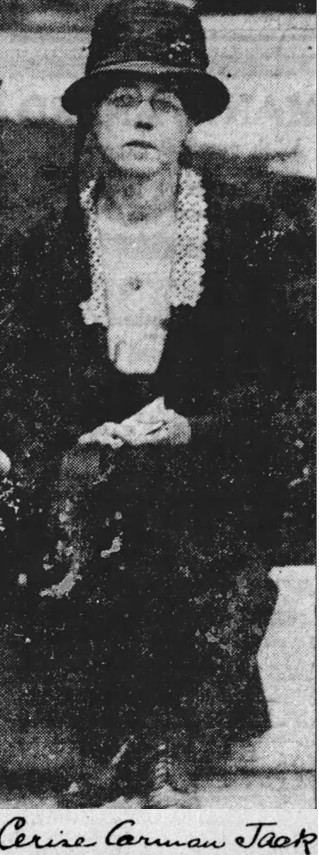
The forgotten story of Cerise Carman Jack, a radical suffragist and prison reform advocate who founded a prison debating society that would later help Malcolm X find his voice.
At 12:11 a.m. on August 23, 1927, Italian immigrant Nicola Sacco, 36, was strapped to Charlestown State Prison’s electric chair, at the end of the Cherry Hill cell block. Before being convulsed by nearly 2,000 volts of electrical current, Sacco lifted his eyes and shouted “Viva l’Anarchia!” Then, after a moment to gather his thoughts, he spoke in a hushed tone. “Farewell, my wife and child and all my friends.” After six agonizing minutes of voltage strikes, Sacco was, according to the Boston Globe, pronounced dead at 12:19:02 a.m. Sacco, along with Bartolomeo Vanzetti, had made national headlines after being sentenced to death for robbing and killing two men outside a shoe factory in April 1920. Over the next seven years, the two men proclaimed their innocence, and the lack of a fair trial, due in part to Judge Webster Thayer’s denial of appeal, stoked anger and protests around the world. Some believed the men were being used as props to punish anarchist movements, while others saw the case as the country’s response to growing fears of immigration.
Cerise Emily Agnes Carman Jack (1874 – 1935) was not afraid of Nicola Sacco; she was his friend. During that midnight hour of his execution, Cerise waited near the phone at her home in East Walpole. Upon hearing the news, Cerise was devastated. She had lost a dear friend, a man she had visited at Charlestown, teaching him English and gifting baskets of fresh peaches and apples from her farm. Her adopted daughter, Betty, had followed the case closely and with her mother had visited Sacco in prison. The state’s decision to execute Sacco caused Betty to have “very little faith in the legal system for a long time.” Cerise, meanwhile, remained determined to improve the lives of women and incarcerated men. Part of her forgotten legacy rests at Massachusetts’s Norfolk Prison Colony, now MCI-Norfolk, its architectural design still much the same now as it was 96 years ago.
Cerise at Norfolk
“Of those in prison, 95% are returned to society. This is a significant fact which wardens must always bear in mind. To send the[m] back worse when they entered, or better, is the test of any system of any penal program,” said Howard B. Gill, superintendent of Norfolk Prison Colony.
Most likely, Howard B. Gill and Cerise Carman Jack knew of each other before the January 1927 announcement of a new state prison in Norfolk. But it was not until September 1930, well after construction had started, that Cerise’s name began to appear in Norfolk prison literature. During this year, Gill’s vision for a more progressive prison had started to pepper the newspapers. At a student conference in East Northfield, Massachusetts, Gill spoke frankly: “The old prison formula, ‘Make the devils work,’ is slowly giving way to attempts to turn men out from our prisons better than when they entered.”
But fundamentally changing flawed individuals would take the efforts of many. As he told the audience before him, “A personnel of specialists in medicine, education, industry, recreation, society, investigation will be needed.”
By 1930, Cerise was 56, and still in touch with Nicola Sacco’s widow, Rose, who’d remarried. She had experience in education, and from Gill’s pronouncements could see potential to create positive change in the hearts of individuals living on the fringes of what she had deemed a hypocritical society. At Norfolk, she started slowly. In 1930, as incarcerated men built the wall around her, she came bearing gifts, bringing “beautiful bouquets of flowers” all throughout the summer months, reported one Colony newspaper writer. In September 1930, she made the 13-mile trip from East Walpole and brought an abundance of material. The Colony writers — all incarcerated at Norfolk — wrote a note of thanks to “the untiring friend Mrs. Jack, for the gift of magazines and records which she left with us this past week. She is one of the friends who make life worth living.”
Cerise’s life, one could say, was a constant debate between herself and American society. In April 1919, Cerise was labeled a “militant suffragist” by the Boston Globe for using the Boston Common’s Parkman Bandstand to speak out against President Woodrow Wilson. Debate then had become heated regarding a woman’s right to vote, and Wilson, in Cerise’s opinion, had “violated his promise to use every effort to promote Woman Suffrage.” and, due to the presence of police all around the park, that Wilson was more worried about his safety than actually participating in an honest conversation. Cerise was charged $1 for speaking on the Common without a permit, even though she had applied and been denied one. The District Attorney compared her to a Bolshevik, and her case, her refusal to plead guilty, made waves across the Boston area. She was eventually given a not guilty verdict by a Superior Court judge.
For a short time, Cerise had been in a holding cell, and the experience would have only helped her to relate to incarcerated individuals hoping to speak their mind in a more persuasive, argumentative way. Her empathy and academic background compelled her to launch the Norfolk Debating Society, the same society Malcolm X, then Malcolm Little, would use to find his voice while incarcerated at Norfolk in 1948.
It’s unclear how exactly Cerise decided on the initial rules for Norfolk’s first debate, but her fingerprints are all over the topic chosen for the first ever debate in Norfolk history. On Sunday evening, March 8, 1931, at 7:30, Norfolk Colony held what was billed as an “Extraordinary Debate,” centered on a question that would have been both provocative and deeply relevant to the lives of the colony’s residents: “That Married Women Should Be Allowed to Work Outside the Home if they so desire.”
The Colony reporter summed up the debate this way: “Each man was allowed three to three and a half minutes to present his arguments and each man had two minutes for rebuttal. Let no one say they didn’t give a heavy barrage of words pro and con, on the subject. It certainly was a surprise to many to witness the volume of sound, intelligent facts and plain every-day sense the boys crammed into those few minutes. [The] three judges…ably judged the debate. Two voted for the affirmative, awarding them the debate. But the negative won the honors for oratory and best presentation.”
Programs were paid for, printed, and distributed by judge Earle D. Sullivan, an advocate for the prison’s mission. “Nothing is too good for the gang,” he told the Colony writer. And of course, to the sponsor and later the “honorary president”, the men showed their gratitude: “To Mrs. Jack…we all extend heartiest congratulations and thanks.”
The success of the debate inspired many of the incarcerated men to further their education, and nudged them into the world of “non-fiction books, such as biographies, histories and essays,” wrote “Pesco,” a debater and Colony writer. “Statistics for practically every subject may be obtained. Make more use of your library,” he wrote to his fellow incarcerated men.
Gill Replaced and Cerise’s Legacy
Ten months after the first debate, the activity had become such a hit that an audience of nearly 150 sat and watched the first indoor debate within the now-walled prison. At least 20 of those who attended did so as civilians. Some were “lawyers, business men, and women interested in civic affairs,” reported the Boston Post. The topic was to resolve this opinion: That trials decided by the judge should replace the current trial by a jury. Cerise took on a coaching role this time, with the help of Warren J. Lonergan, whose wife directed the prison’s glee club. “A Sharon quartet sang and the prison orchestra played, during the intervals and after the match. The 20 guests from outside were served refreshments when it had ended, while the prisoners went to be without such additional excitement.”
By 1934, however, any and all excitement started to fade after a prisoner scaled the part of the wall where no prison guard could be found in the nearby tower. The staffing blunder — compounded by exaggerated charges made by an embittered ex-lawyer turned prisoner who’d been rejected for parole — caused local law enforcement and government officials to scrutinize even more all of Gill’s decisions. Soon, Gill was being investigated, and a stingingly critical report by auditor Francis X. Hurley was set to bring about his downfall. During this time, Cerise was confronted by a reporter and made the following statement: “The purpose of my visits will be explained when the Hurley report is filed. I am interested in the prison and have my finger on the pulse of conditions there, and out of fairness to Mr. Gill I shall make no statement now.”
It’s unknown if Cerise ever made that statement, because soon after, Gill was replaced by Maurice Winslow, but she continued to work with the debate team. In September, 1934, she is once again credited by the Colony for keeping the club afloat “for the past five years and [it] continues to grow,” as it held weekly meetings in the Kitchen Building. “Without question, the success of the organization is due mainly to the truly wonderful work of its leader, Mrs. Cerise Jack, who has given so much time and concern to it.”
Indeed, the debating club was growing, and other prisons heard about it and attempted to emulate its success. But unfortunately, in February 1935, it was reported that Cerise had become “ill.” Apparently, she never recovered enough to return to the prison, and in late August 1935, Cerise, according to her granddaughter, took her own life. She was 61.
Besides short, terse reports of her death in several newspapers, Cerise was only given one full and personalized obituary, a surprise given her life of service. That it came from the debating team at Norfolk seems only fitting.
The following is from the September 15, 1935 issue of the Colony. It is a published letter sent to Cerise’s husband John George Jack, a dendrologist and professor at Harvard:
“Upon learning of the death of your beloved wife, the Norfolk Debaters, her organization, met on Friday, August 30th and adopted the following resolutions:
• That the founder and leader of the Norfolk Debaters has passed away.
• That the life and success of the organization has been mainly due to her untiring efforts and inspiration.
•That her deep personal interest in each member of the organization which made her a true and admired friend will be sorely missed.
•That her good work in the interests of the Colony as a whole made her a leader that the organization was proud of.
•That her memory will be perpetuated within the organization and will continue to inspire it in its future activities.
•That a copy of these resolutions together with a sincere expression of deep sympathy be sent to you.”
About 13 years later, an incarcerated man named Malcolm Little joined the Norfolk Prison Colony debate team. By then the debate team’s success had grown to a national level, recognized by Time Magazine for defeating Ivy league-level debate teams such as Harvard, Princeton, and also MIT. None of it would have been possible without the foundational support of Cerise Carman Jack.