
Hit Enter to Search or X to close
.jpg)
EcoRove sits at the intersection of ecology, research, and storytelling. Founded in 2020 by architect and farmer Iyad Abou Gaida, architect and curator Jumanah Abbas, and filmmaker Em Joseph, The collective works across film, tapestry, publishing, and installation to tell stories of land, colonialism, and climate from the Eastern Mediterranean, in their own language and from their own perspective. We sat down with Iyad to talk about the origins of the project, the weaponization of the cedar tree, the environmental devastation in South Lebanon since October 7th, and why land justice is a climate issue for everyone.
EcoRove sits at the intersection of ecology, research, and storytelling. What first led you to start the project, and what gap were you trying to address?
We started talking about the project in 2019, and it was formalized in 2020. It began with Jumana Abbas, my co-founder. We were both at Columbia’s architecture school — she was in the CCCP program, I was in the architecture program — and at that time, it was a reaction to how climate change and colonialism were being discussed at these Ivy League schools. It was wishy-washy. Salon talk. Politics that doesn’t lead anywhere — academics feeling good about themselves without ever discussing the actual matter. We felt frustrated, and on our cigarette breaks, literally, we started talking about it.
That same year, a lot of Western media began covering the Lebanese cedar tree and how it’s facing climate change. But it was discussed in a very flat way — and a very sectarian way. Most of those articles framed the tree as important to Christian communities in Lebanon, casting them as its custodians. That’s not accurate. In Lebanon, whoever lives in proximity to a tree acts as its custodian — the natives of that land.
So EcoRove started as a refusal of that narrative. We wanted to talk about these topics in our own language, from our own perspective — not adopt conversations produced in the Global North and exported back to the Global South.
Then in 2020, three days before COVID, we met Em, who was also working on the cedar trees. Her sister introduced us. Me as an architect and farmer, Jumana as an architect and curator, Em as a filmmaker — we realized we could make multimodular work, experimenting with different forms to reach the widest audience possible. Not everyone is a museum-goer. Not everyone reads books, or watches films, or looks at paintings. So with every project, we try to work in multiple mediums, especially when we’re talking about colonialism, climate change, and capitalism.
Our current project, Land Keepers, is the first to truly embrace that. We have a tapestry, a large mural drawing on exhibition at Ohio State’s architecture school, a reader we published with GenderFail, and a 90-minute documentary in the works — one meant for theaters, alongside some experimental work as well. That’s where we see EcoRove moving, more and more.
Can you talk about your first project, The Cedar Exodus? How did it come about, and why that subject?
When Jumana and I were looking at how to challenge the narratives being enforced on us at Columbia, those cedar articles were popping up everywhere — The New York Times, BBC, CNN — full of distortions. And all three of us had different relationships to the tree.
For me, the cedar was always a symbol of Lebanon, but as a child, I also saw it as a symbol of abandonment. We were living under Israeli occupation in the South. The tree is everywhere — banknotes, the flag, the passport, every governmental document. But that same government never cared about what it considered the peripheries. The South was always bombed, infiltrated, occupied.
Then the 2006 war came. I was thirteen or fourteen. We lived in a bunker underground for 33 days. Around week two, the Lebanese army — soldiers with cedar patches on their shoulders — came and evacuated my American cousins, who were visiting for the summer. They didn’t even hold Lebanese citizenship. I asked my mother, why aren’t we being evacuated somewhere safer? She told me two things: we are rooted in this land, like the trees, so we are staying. And the government doesn’t care about us — they only care about people with foreign passports.
That cedar patch on the shoulder stuck in my head. As I grew up, I realized: it’s not the fault of the tree. The tree has been weaponized, and we should decolonize it. I started looking at how the French used the tree to separate Lebanon from its historical connections to the region and create a pseudo-identity. It’s funny, because the tree historically existed in northern Palestine, it still exists in Syria, and mainly in southern Turkey. The whole Eastern Mediterranean highlands had the tree.
For Jumana, who is Palestinian, the tree carries another weight — it was used as a fascist symbol by the far right during the civil war, who used it to kill leftists, Palestinians, Arabs. She knows Palestinians who are triggered by seeing that tree. And for Em, it was about reconnecting with her ancestral land — her mother’s family is Lebanese, and the connection had been whitewashed away. She looked at how the tree was extracted from Lebanon and planted in New York and Europe, and connected that to her own heritage.
We saw the tree as a being very similar to us — abstracted by political ideologies and colonial power. We wanted to give the tree agency, and by giving the tree agency, give agency to the natives who tend it, retelling our histories through our own tongue.
It’s striking that a tree can hold so much power. Why do you think oppressors use natural resources to divide and conquer?
This wasn’t only done in Lebanon — nature is weaponized all over the world to divide and control people. At the end of the day, we are products of the natural ecosystems we live in. Our personalities, even as we grow older, are shaped by our environment, and colonizers try to use that as another weapon, because they always like to isolate.
Look at the cedar forests: they are not actually separate from the forests in Palestine, or Syria, or the lowlands of Lebanon. It’s one large ecosystem — the mountain climate is shaped by the lower forests. But colonizers only understand divide and conquer. They say: this microclimate is unique, let’s isolate it from the larger climate it has symbiotic relationships with, tell the people they’re unique and should separate themselves from the rest — and then conquer them once they’re divided. This happens to landscapes and to humans alike. And it makes extraction easier. Once you start dividing, it’s easier to extract natural and human resources from these lands.
Your work centers plants, soil, and non-human life as active participants. Why is that important to environmental work — and is it connected to your upbringing?
Definitely. I see humans as one of the beings that live on this earth, deeply connected to nature. That’s part of my upbringing, but it’s not just me — it’s indigenous to that part of the world. The Eastern Mediterranean is where farming, as we think of it, historically began. Wheat farming started there.
I grew up on my family’s olive groves, tended for five generations — groves on the mountain, and a smaller farm by the river in the valley. My whole childhood was tending olives, apples, oranges, green plums, aubergines. I’d swim in the river and eat from it. So I understand we are not a being distinct from nature. We are not here to dominate it; we are here to live with it, with an obligation to be stewards. If our ecosystem thrives, we thrive. If it collapses, we collapse.
You find this in indigenous cultures across the world — and even in the West, on small farms in upstate New York, where people have a different relationship with the land that isn’t about extraction and profit. The mentality of dominating nature, of treating it as a backdrop where everything is there to be extracted and destroyed for profit — that mentality is attached to power and money.
Since October 7th, the region has experienced escalating instability. How has the environmental reality in South Lebanon changed?
It’s been very tough — we talk about this a lot in the Land Keepers reader. In South Lebanon, 95% of farmers couldn’t farm their lands for the past three years. Water resources have been heavily contaminated.
Israel understands the power of native people connected to their land, and its colonial project is about detaching natives from their land and severing that continuum. The tactics differ by region. In Palestine, the strategy has been to kill indigenous species and introduce invasive
European ones — changing the shape of the land so natives no longer know how to engage with it. Though I have to say, many Palestinians are adapting and finding ways to preserve the endemic landscape. In occupied Syria, it’s more about green colonization — wind turbine farms that seize what we call in Arabic communal land, used by beekeepers, herders, and foragers; land owned by no one and used ethically by everyone. I mention all of these regions because they’re connected to the larger ecosystem of South Lebanon, all around Mount Hermon. These ecologies blend into each other.
In South Lebanon, it’s been a burned-soil tactic — heavy use of white phosphorus, as in 2006, but this time over a much longer war, so the impact is far worse. Heavy pesticides banned in Lebanon, contaminating soil and groundwater. Heavy metals. A lot of land in the South can’t be farmed anymore, which threatens food sovereignty, since South Lebanon and the Beqaa Valley are the breadbaskets of the country.
The hope, on their side, is that farmers who can’t farm will leave for other parts of Lebanon, and the South becomes a vacant dead zone. But it’s a very colonial way of thinking. From the documentation I’ve been doing on the ground for the past year and a half, people are finding ways to create fertile topsoil, separate out the contaminated layers, and start farming again. It will take far longer — but these people are not giving away their ancestral lands. In no shape or form.
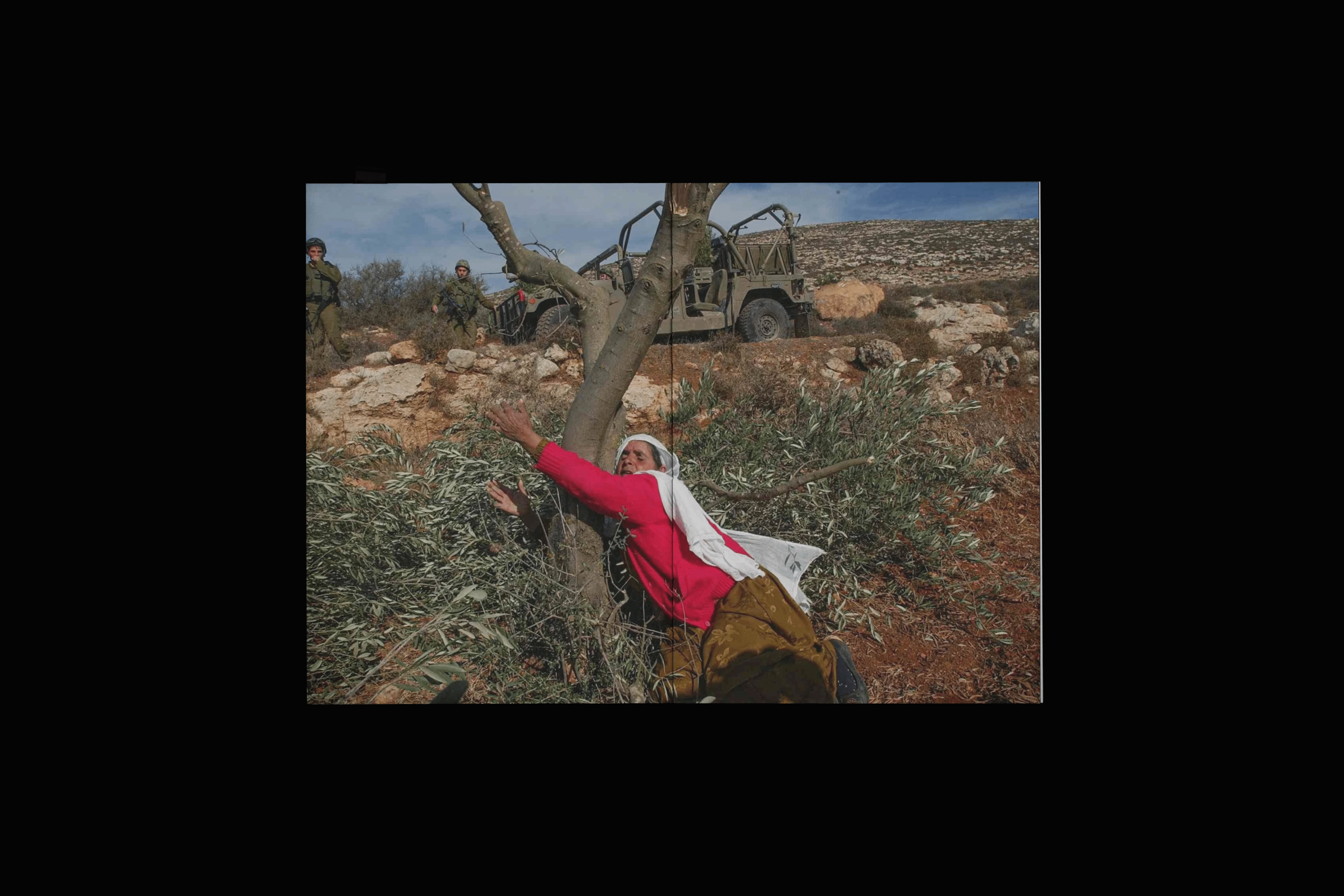
The other thing they’ve done — aside from contaminating soils — is steal olive trees that are one, two, even three thousand years old. That’s been the most heartbreaking. The Souri heirloom olive was first cultivated in South Lebanon before spreading to Palestine and Syria — it’s named after the city of Sur, the Phoenician port that still exists today. The theft of those thousand-year trees hit the hardest.
Beyond the ecosystem, how is the expansion of militarized zones affecting local communities?
It’s putting enormous pressure on people — economically, and on housing. My village, Hasbaya, has taken in a lot of displaced people; we’ve been spared bombing inside the village so far, though the periphery has been hit. Displaced families are deliberately scattered across different villages — a strategy we learned from the civil war and the Nakba: you never keep the whole family in one house or one town, to ensure the bloodline continues if the worst happens.
Many people are dependent on aid, living in tents or sleeping in open fields. Farmers, beekeepers, and herders have lost everything. People I spoke to after the first ceasefire in 2024 went back to find their bees dead from white phosphorus contamination, their cattle dead. What’s been beautiful, though, is that people from less-impacted villages have donated bees to restart hives, donated cattle to help herders rebuild their herds.
There’s also massive stress on food and water — a million people displaced in a tiny country with limited resources, displaced from one of the richest geographies in water and food into less abundant areas, which impacts those local ecologies too. And I have to be honest: it has created civil strife. There are sectarian, right-wing people who refused to take in the forcibly displaced — people allied with the West who saw this as “not their war” and shut their doors, parroting Western and Zionist narratives. Gratefully, they’ve been a minority. The majority of people are united and helping each other.
Are the people parroting those Western talking points not worried about sovereignty — about eventually being targeted themselves? Do they see the connection?
No, they don’t. Their idea of sovereignty is strange: to them it means having no relationship with any power that fights Western hegemony — they’ll even attack Spain. But if the U.S. or France imposes things on us, that’s fine, because they see themselves as part of Western civilization. They see themselves as white. Even when villages of their own sect in the South were attacked, they’d say: that’s just because those villages are in the South — they won’t come for us in Mount Lebanon.
They’ve been working on this political project for decades, and we’re stubborn people — acknowledging you’re wrong feels like delegitimizing yourself. And follow the money: these are usually liberal, bourgeois urbanites, or people who aspire to be. Their funding, their bank accounts, their children are in the West. Their whole livelihood is attached to it.
EcoRove functions as both documentation and preservation. How do you hope the work serves this current moment?
What we do feels very relevant right now, because we’re living in a moment where truth doesn’t matter — people say what they want and believe it, in politics, in economics, everywhere. As everyone speaks on our behalf, or on behalf of that part of the world, we want to tell our own stories and build community with people facing similar issues. What’s happening back home is not unique. The intensity might differ, but the underlying conditions — money, power, climate change — are impacting disenfranchised communities around the world.
I’ll say something here: I hate the term “Global South.” I prefer “Third World,” and let me explain. “Global South” frames us as the post-colonial victims — and there’s nothing wrong with that; it served a purpose for a time. But when I say Third World now, I mean reclaiming the term: we can literally be the third world order. The majority of the planet faces the same dangers — we’re impacted most by climate change, most by resource extraction. It’s time for us to unite and start reimagining. That’s what EcoRove is mainly about: retelling stories in order to reimagine new realities, and rethink our relationship with the planet, with capital, and with power.
How do you balance scientific research with storytelling and visual language?
It depends on the project. Scientific research is important, but it has limits — it often overlooks the relationship of people to the land and how they tend it. In The Cedar Exodus, we engaged with a lot of scientific research, sometimes critically, sometimes not. But whenever we talk about nature, we don’t want to talk only about the science. We want the day-to-day mundane practices and rituals. We take myth seriously — our part of the world is full of myth connected to the land and the way people engage with it, and these are as important as the research. Science is there to complement what people do on the ground, not the other way around.
So you rely a lot on memory. How do you capture that?
Memory and practice. Memory passes on through stories. Let me give an example — and an example of how science ruined something, and how people are going back.
There’s been a lot of talk about Baal recently, and Baal is another distortion. Baal is a Canaanite, Phoenician god — the god of fertility, thunder, and rain — and very much attached to us, the people of that land. Our whole indigenous farming system is called Baal farming: following seasonal cycles, entirely rain-fed, no irrigation, no pesticides, no chemicals, minimal human intervention. Working with nature.
Then in the 80s, the American University of Beirut started an agro-engineering department and unleashed engineers across the Lebanese landscape saying: no, you should irrigate, you should use pesticides, you should use GMO seeds. That put enormous pressure on groundwater and degraded the soil. And recently, people are going back to Baal farming — which I think of as the OG organic farming, beyond organic, because organic still allows GMO seeds, whereas Baal farming uses heirloom seeds adapted to the local climate.
Baal persisted in that part of the world not as a god, but as memory — a story passed from generation to generation through narratives and daily practices. That’s what we focus on: the hands, the mundane practices, the myths.
There have been reports of towns in South Lebanon being erased from Google Maps. As someone from the region, how does it feel to watch that happen in real time?
Honestly? My first reaction was anger. This is a long project of how colonization works — they erase you from records, the same way Palestinian maps were hidden from museums in London and across the world. A land with no people for a people with no land.
But then I remembered: it doesn’t matter. It really doesn’t matter. These are Western technologies that I don’t care about. What makes this land stay is not some tech bro deleting the name of my town on a map. It’s the people on the ground — whether they’re resisting through direct confrontation, or through green resistance, economic resistance, cultural resistance. They are rooted in this land.
We learned from the Nakba, when they told Palestinians “leave and you’ll come back” and never let them return. Now we know: we’re not going to leave. Yes, many in South Lebanon were displaced, but many remained — civilians and resistance fighters alike. Not one single village was emptied. So the colonizers can play their games. They can delete us from their digital platforms. I saw people posting in Arabic: “You deleted us, but we have feet on the ground — these are our pins.” You can rename the Gulf of Mexico the Gulf of America. It doesn’t make it the Gulf of America.
What does land justice look like in the region?
It varies, because the colonial approach to these different lands varies. But in all cases, it starts with natives and indigenous people going back to their land and being able to tend it. In the Palestinian case, it’s more intense — many ethnically cleansed villages have no Palestinian presence at all anymore, and people should be able to return. There should be reparations.
The invasive species planted in Palestine should be uprooted tomorrow, and natives species replanted. In Lebanon, there should be help rebuilding destroyed towns, cleaning the soils, and bringing back the stolen trees. We want them back. And they didn’t only steal trees — since the 90s they’ve infiltrated into Lebanon every few months to steal rich topsoil, because Lebanon has the most nutrient-dense topsoil in the region. We want those soils back. We want everything back. We want the names of our villages back — in the Upper Galilee, in Palestine, we want those names back.
Land justice starts by respecting and allowing the natives to return — and by respecting and allowing the native species, not just humans, to live on those soils.
For people who feel this isn’t connected to them — why is land justice important from a climate perspective, for anyone who wants to keep inhabiting the earth?
Because at the end of the day, natives and indigenous people know how to work these lands with nature rather than against it. The relationship of native people with the land is fundamentally different from that of colonizers or corporations. We can’t talk about climate change without talking about extraction — destroying whole ecologies for profit. The capitalist machine looks at land as something to extract and destroy for profit. Natives understand it as existential: the land is how they survive. They know you can’t take too much; you have to work with it, maintain it.
Look at the most biodiverse hotspots in the world — they’re tended by indigenous people. In the Amazon, native tribes promote and care for biodiversity, in contrast to the plantations on its periphery. Same in Africa, Southeast Asia, West Asia. Natives feel a historical obligation to the land: we only exist because our ancestors tended and nurtured this land, and we must continue. And one of the best ways to mitigate climate change is preserving local biodiversity. Promoting, preserving, and nurturing biodiversity — working with the land and its cycles — is crucial to the climate struggle everywhere in the world.
Finally — what is EcoRove working on now?
We’re continuing Land Keepers. The reader is now published — we’re very proud of it; it carries voices from across Mount Hermon’s ecological zone, spanning South Lebanon, occupied northern Palestine, and the occupied Jolan in Syria. The project culminates in 2027 with the 90-minute documentary, alongside continuing art installations.
Our next project expands beyond Palestine, Syria, and Lebanon to take in the Red Sea, the Mediterranean, and the countries around them. We’re looking at the migration of invasive marine species from the Red Sea into the Mediterranean through the Suez Canal — something that’s been happening for decades but has intensified with climate change. The Red Sea is overheating, and the Mediterranean’s temperatures are becoming optimal for these species, so they’re finding new fertile grounds.
It’s impacting local marine ecology, but also people’s relationship with the sea — we’re getting poisonous fish that were never there before — and the economic cycles that depend on it: what we fish, how we eat.
EcoRove’s Land Keepers reader, published with GenderFail, is available now. The Land Keepers documentary is expected in 2027.



.png)